<?xml version="1.0" encoding="utf-8"?>
<feed xmlns="http://www.w3.org/2005/Atom">
    <title>Great Stems</title>
    <link rel="alternate" type="text/html" href="http://www.greatstems.com/" />
    <link rel="self" type="application/atom+xml" href="http://www.greatstems.com/atom.xml" />
    <id>tag:,2009-05-23:/2</id>
    <updated>2012-05-12T03:32:54Z</updated>
    <subtitle>garden adventures. wildlife welcome.</subtitle>
    <generator uri="http://www.sixapart.com/movabletype/">Movable Type 4.21-en</generator>

<entry>
    <title>Chorus</title>
    <link rel="alternate" type="text/html" href="http://www.greatstems.com/2012/05/chorus.html" />
    <id>tag:www.greatstems.com,2012://2.495</id>

    <published>2012-05-12T03:05:00Z</published>
    <updated>2012-05-12T03:32:54Z</updated>

    <summary><![CDATA[ There are toads singing at all three ponds these days. Oh, how I love it! Their deep songs are my nighttime lullaby.&nbsp;I believe there's six males at the moment, and when they really go at it, each singing at...]]></summary>
    <author>
        <name>Meredith</name>
        
    </author>
    
        <category term="toads" scheme="http://www.sixapart.com/ns/types#category" />
    
    
    <content type="html" xml:lang="en-us" xml:base="http://www.greatstems.com/">
        <![CDATA[<p>
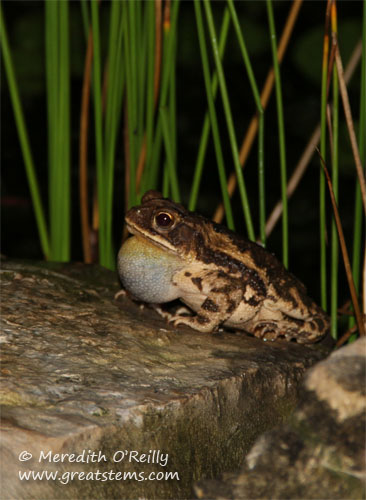
<p>There are toads singing at all three ponds these days. Oh, how I love it! Their deep songs are my nighttime lullaby.&nbsp;I believe there's six males at the moment, and when they really go at it, each singing at a different pitch, it's almost orchestral.
<span style="DISPLAY: inline" class="mt-enclosure mt-enclosure-image"></span></p>
<p>
<span style="DISPLAY: inline" class="mt-enclosure mt-enclosure-image"><img style="TEXT-ALIGN: center; MARGIN: 0px auto 20px; DISPLAY: block" class="mt-image-center" alt="toad05-11-12.jpg" src="http://www.greatstems.com/toad05-11-12.jpg" width="366" height="500" /></span>We also seem to&nbsp;have a sneaky frog that I saw hanging out in the waterfall this evening. But when I went to get the camera, he disappeared. But my return to the pond meant that at least I captured a picture of one of our singing sextet. </p>
<p>It's funny -- the toads were so competitive in their singing that they pretty much ignored the photographer and the flashlight-holder. We took a few pictures and then let them get back to their romantic calling.</p></p>
<p>
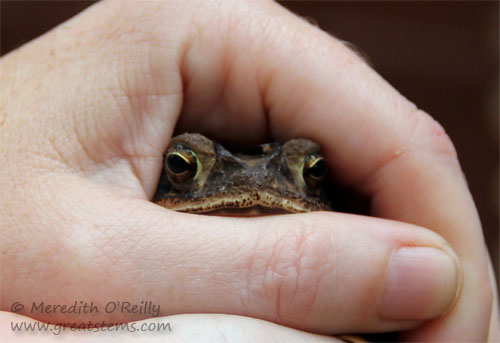
<span style="DISPLAY: inline" class="mt-enclosure mt-enclosure-image"><img style="TEXT-ALIGN: center; MARGIN: 0px auto 20px; DISPLAY: block" class="mt-image-center" alt="toad05-03-12.jpg" src="http://www.greatstems.com/toad05-03-12.jpg" width="500" height="343" /></span>Speaking of toads, look at this cute female we found while our tree guys were here last week. All snug as a bug in a rug! I put her near the front pond for safety, away from the commotion.</p>]]>
        
    </content>
</entry>

<entry>
    <title>Garden Firsts</title>
    <link rel="alternate" type="text/html" href="http://www.greatstems.com/2012/05/garden-firsts.html" />
    <id>tag:www.greatstems.com,2012://2.494</id>

    <published>2012-05-07T21:27:52Z</published>
    <updated>2012-05-07T21:44:35Z</updated>

    <summary>It&apos;s a funny thing how nature works. Last year we had one of the worst droughts in recorded Texas history, and this year we have some of the best wildlife viewing. In fact, 2011 was so empty of caterpillars, butterflies,...</summary>
    <author>
        <name>Meredith</name>
        
    </author>
    
        <category term="birds" scheme="http://www.sixapart.com/ns/types#category" />
    
        <category term="butterflies and caterpillars" scheme="http://www.sixapart.com/ns/types#category" />
    
        <category term="moths and caterpillars" scheme="http://www.sixapart.com/ns/types#category" />
    
        <category term="wildlife habitats" scheme="http://www.sixapart.com/ns/types#category" />
    
    
    <content type="html" xml:lang="en-us" xml:base="http://www.greatstems.com/">
        <![CDATA[<p style="MARGIN: 0in 0in 10pt" class="MsoNormal"><span style="LINE-HEIGHT: 115%; FONT-FAMILY: 'Arial','sans-serif'; FONT-SIZE: 10pt; mso-fareast-font-family: 'Times New Roman'"><font color="#000000">It's a funny thing how nature works. Last year we had one of the worst droughts in recorded Texas history, and this year we have some of the best wildlife viewing. In fact, 2011 was so empty of caterpillars, butterflies, and other insects that I had great concern for many of our birds, spiders, reptiles, and other wildlife that are dependent on such invertebrates. But this year, after having a reasonable amount of fall and winter rain, we've seen an amazing number of caterpillars of all species and with them a tremendous explosion of butterflies and moths. What that means is that we'll also have lots of baby birds this season, all things considered, and hopefully lots of other creatures. Needless to say, I'm having fun in the wildlife garden - so much to watch!<o:p></o:p></font></span></p>
<p style="MARGIN: 0in 0in 10pt" class="MsoNormal"><span style="LINE-HEIGHT: 115%; FONT-FAMILY: 'Arial','sans-serif'; FONT-SIZE: 10pt; mso-fareast-font-family: 'Times New Roman'"><font color="#000000">
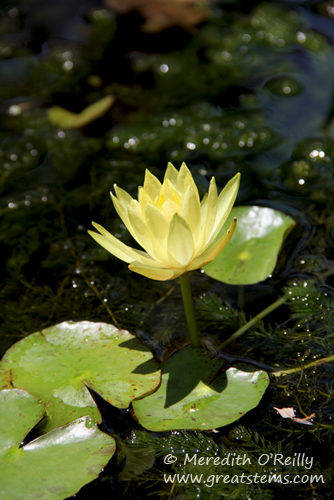
<span style="DISPLAY: inline" class="mt-enclosure mt-enclosure-image"><img style="TEXT-ALIGN: center; MARGIN: 0px auto 20px; DISPLAY: block" class="mt-image-center" alt="yellowwaterlilyb05-06-12.jpg" src="http://www.greatstems.com/yellowwaterlilyb05-06-12.jpg" width="334" height="500" /></span><em>Yellow Water Lily</em></font></span></p>
<p style="MARGIN: 0in 0in 10pt" class="MsoNormal"><span style="LINE-HEIGHT: 115%; FONT-FAMILY: 'Arial','sans-serif'; FONT-SIZE: 10pt; mso-fareast-font-family: 'Times New Roman'"><font color="#000000">This spring has marked a number of firsts for our relatively young garden (I'm going to call it young until it has reached its fifth birthday). Our native Yellow Water Lily is blooming at last. I have waited such a long time for it to do so, though to be fair, it's certainly possible that it has bloomed without me knowing it. My White Water Lily still hasn't bloomed yet, as far as I know, but I shall remain hopeful!<o:p></o:p></font></span></p>
<p style="MARGIN: 0in 0in 10pt" class="MsoNormal"><span style="LINE-HEIGHT: 115%; FONT-FAMILY: 'Arial','sans-serif'; FONT-SIZE: 10pt; mso-fareast-font-family: 'Times New Roman'"><font color="#000000">
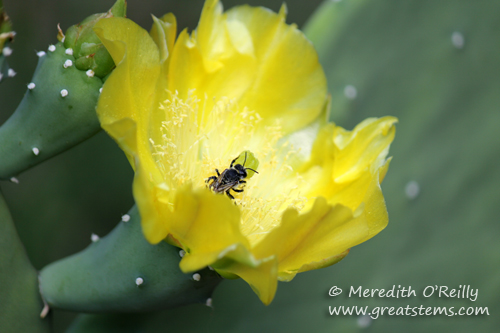
<span style="DISPLAY: inline" class="mt-enclosure mt-enclosure-image"><img style="TEXT-ALIGN: center; MARGIN: 0px auto 20px; DISPLAY: block" class="mt-image-center" alt="opuntiabloomb05-07-12.jpg" src="http://www.greatstems.com/opuntiabloomb05-07-12.jpg" width="500" height="333" /></span><em>Spineless Prickly Pear</em></font></span></p>
<p style="MARGIN: 0in 0in 10pt" class="MsoNormal"><span style="LINE-HEIGHT: 115%; FONT-FAMILY: 'Arial','sans-serif'; FONT-SIZE: 10pt; mso-fareast-font-family: 'Times New Roman'"><font color="#000000">We were getting worried that our Spineless Prickly Pear would never bloom, but lo and behold, it's in bloom right now. Sure enough, bees and flies and other insects are getting drunk on that delicious <i style="mso-bidi-font-style: normal">Opuntia</i> nectar!<o:p></o:p></font></span></p>
<p style="MARGIN: 0in 0in 10pt" class="MsoNormal"><span style="LINE-HEIGHT: 115%; FONT-FAMILY: 'Arial','sans-serif'; FONT-SIZE: 10pt; mso-fareast-font-family: 'Times New Roman'"><font color="#000000">
<span style="DISPLAY: inline" class="mt-enclosure mt-enclosure-image"><img style="TEXT-ALIGN: center; MARGIN: 0px auto 20px; DISPLAY: block" class="mt-image-center" alt="horsemintb05-07-12.jpg" src="http://www.greatstems.com/horsemintb05-07-12.jpg" width="340" height="500" /></span></font></span></p>
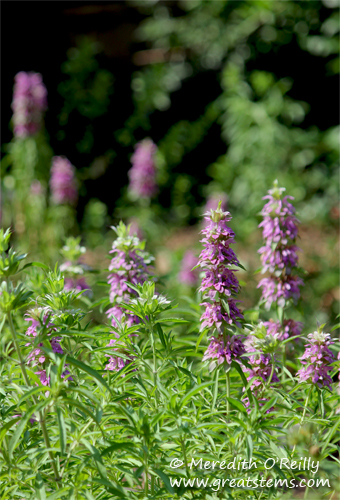
<p style="MARGIN: 0in 0in 10pt" class="MsoNormal" align="left"><span style="LINE-HEIGHT: 115%; FONT-FAMILY: 'Arial','sans-serif'; FONT-SIZE: 10pt; mso-fareast-font-family: 'Times New Roman'"><font color="#000000"><em>Horsemint</em></font></span></p>
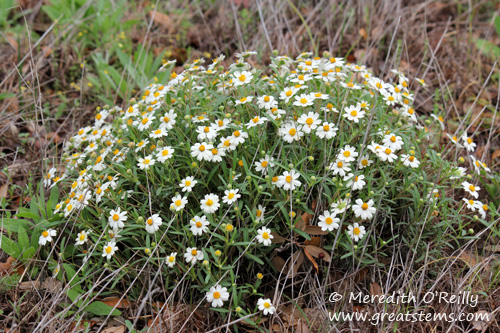
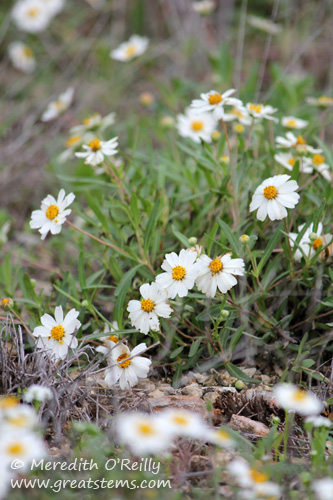
<p style="MARGIN: 0in 0in 10pt" class="MsoNormal"><span style="LINE-HEIGHT: 115%; FONT-FAMILY: 'Arial','sans-serif'; FONT-SIZE: 10pt; mso-fareast-font-family: 'Times New Roman'"><font color="#000000">Horsemint, Coreopsis, Black-eyed Susan, and Pincushion<span style="mso-spacerun: yes">&nbsp; </span>Daisy are all in bloom in the garden for the first time. Were those in seed mixes I'd spread around? Or did the birds deliver them? I'd think the first, except that Horsemint and Coreopsis also happen to be growing at the entrance to our subdivision. Hmmmm. The other two are probably just all me.<o:p></o:p></font></span></p>
<p style="MARGIN: 0in 0in 10pt" class="MsoNormal"><span style="LINE-HEIGHT: 115%; FONT-FAMILY: 'Arial','sans-serif'; FONT-SIZE: 10pt; mso-fareast-font-family: 'Times New Roman'"><font color="#000000">
<span style="DISPLAY: inline" class="mt-enclosure mt-enclosure-image"><img style="TEXT-ALIGN: center; MARGIN: 0px auto 20px; DISPLAY: block" class="mt-image-center" alt="slorangeb05-12.jpg" src="http://www.greatstems.com/slorangeb05-12.jpg" width="351" height="500" /></span></font></span></p>
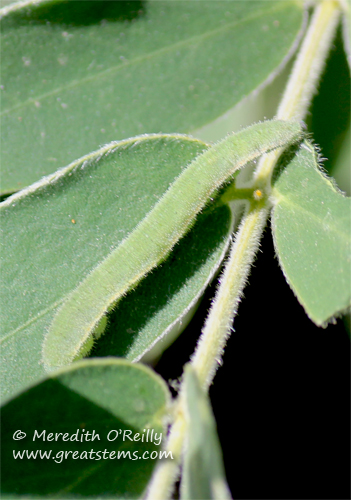
<p style="MARGIN: 0in 0in 10pt" class="MsoNormal" align="left"><span style="LINE-HEIGHT: 115%; FONT-FAMILY: 'Arial','sans-serif'; FONT-SIZE: 10pt; mso-fareast-font-family: 'Times New Roman'"><font color="#000000"><em>Sleepy Orange caterpillar -- I love how it blends with the fuzzy Lindheimer's Senna leaves</em></font></span></p>
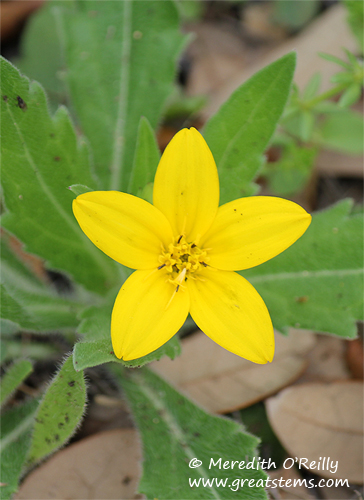
<p style="MARGIN: 0in 0in 10pt" class="MsoNormal"><span style="LINE-HEIGHT: 115%; FONT-FAMILY: 'Arial','sans-serif'; FONT-SIZE: 10pt; mso-fareast-font-family: 'Times New Roman'"><font color="#000000">Caterpillars I've longed for but hadn't yet seen munching on the plants we'd planted for them are at last here. With luck, they'll return as adults to lay more eggs. Pipevine caterpillars, previously present only from eggs brought home on nursery plants, have officially appeared as the result of a visiting female Pipevine Swallowtail. Sleepy Orange caterpillars have been munching on our Lindheimer's Senna, but with all the other Sulphur butterflies fluttering about, I expect there will be more. <o:p></o:p></font></span></p>
<p style="MARGIN: 0in 0in 10pt" class="MsoNormal"><span style="LINE-HEIGHT: 115%; FONT-FAMILY: 'Arial','sans-serif'; FONT-SIZE: 10pt; mso-fareast-font-family: 'Times New Roman'"><font color="#000000"><img style="TEXT-ALIGN: center; MARGIN: 0px auto 20px; DISPLAY: block" class="mt-image-center" alt="snowberrycatb05-12.jpg" src="http://www.greatstems.com/snowberrycatb05-12.jpg" width="500" height="355" /></font></span></p>
<p style="MARGIN: 0in 0in 10pt" class="MsoNormal"><span style="LINE-HEIGHT: 115%; FONT-FAMILY: 'Arial','sans-serif'; FONT-SIZE: 10pt; mso-fareast-font-family: 'Times New Roman'"><font color="#000000"><em>Snowberry Clearwing caterpillar on White Honeysuckle</em></font></span></p>
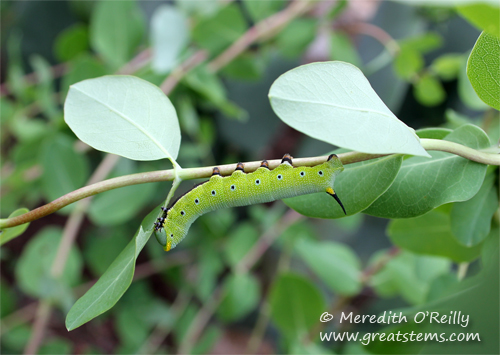
<p style="MARGIN: 0in 0in 10pt" class="MsoNormal"><span style="LINE-HEIGHT: 115%; FONT-FAMILY: 'Arial','sans-serif'; FONT-SIZE: 10pt; mso-fareast-font-family: 'Times New Roman'"><font color="#000000">Butterfly caterpillars aren't the only ones in great numbers. Snowberry Clearwing caterpillars, complete with the "horns" consistent with their family,&nbsp;have been happily grazing on the White Honeysuckle Shrub. Lots of unnamed but equally welcome moth caterpillars have been seen in trees, on shrubs, on grasses, on veggies, and perennials. That means it should be a good food year for bats and owls and swallows and the like!<o:p></o:p></font></span></p>
<p style="MARGIN: 0in 0in 10pt" class="MsoNormal"><span style="LINE-HEIGHT: 115%; FONT-FAMILY: 'Arial','sans-serif'; FONT-SIZE: 10pt; mso-fareast-font-family: 'Times New Roman'"><font color="#000000">The Monarchs and Queens have returned, as have the Black Swallowtails, I report with relief. I'll feel much better once I see Giant Swallowtails and Tigers again, along with other Swallowtail species of which I am quite fond. And I think we've all been impressed by the showing of Red Admirals this year! Painted Ladies, Buckeyes, Question Marks, Checkerspots, Gulf Fritillaries - oh the list goes on.<o:p></o:p></font></span></p>
<p style="MARGIN: 0in 0in 10pt" class="MsoNormal"><span style="LINE-HEIGHT: 115%; FONT-FAMILY: 'Arial','sans-serif'; FONT-SIZE: 10pt; mso-fareast-font-family: 'Times New Roman'"><font color="#000000">
<span style="DISPLAY: inline" class="mt-enclosure mt-enclosure-image"><img style="TEXT-ALIGN: center; MARGIN: 0px auto 20px; DISPLAY: block" class="mt-image-center" alt="dwoodpeckerb05-06-12.jpg" src="http://www.greatstems.com/dwoodpeckerb05-06-12.jpg" width="500" height="351" /></span></font></span></p>
<p style="MARGIN: 0in 0in 10pt" class="MsoNormal"><span style="LINE-HEIGHT: 115%; FONT-FAMILY: 'Arial','sans-serif'; FONT-SIZE: 10pt; mso-fareast-font-family: 'Times New Roman'"><font color="#000000"><em>Downy Woodpecker collecting insects</em></font></span></p>
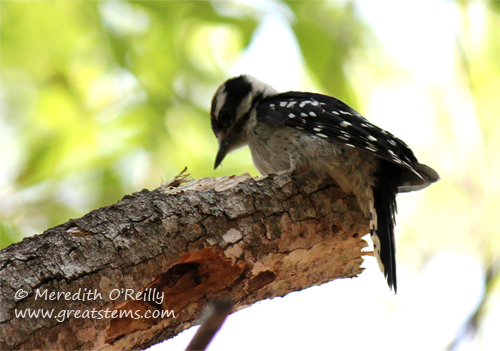
<p style="MARGIN: 0in 0in 10pt" class="MsoNormal"><span style="LINE-HEIGHT: 115%; FONT-FAMILY: 'Arial','sans-serif'; FONT-SIZE: 10pt; mso-fareast-font-family: 'Times New Roman'"><font color="#000000">Our Mama Eastern Screech Owl returned to our backyard, and last night I saw an owlet shyly peering down at me from its nesting box. Baby birds are starting to fledge right and left, and we're watching parent birds teaching<span style="mso-spacerun: yes">&nbsp; </span>their young how to find food. The toads are singing their nightly mating calls. And today for the first time, I watched a Downy Woodpecker feed insects from an old limb to another Downy Woodpecker on a nearby branch. Cute as can be! It's a good spring. Thank goodness!</font></span></p>]]>
        
    </content>
</entry>

<entry>
    <title>A Visit to the Home of Lindheimer, Father of Texas Botany</title>
    <link rel="alternate" type="text/html" href="http://www.greatstems.com/2012/05/a-visit-to-the-home-of-lindheimer-father-of-texas-botany.html" />
    <id>tag:www.greatstems.com,2012://2.493</id>

    <published>2012-05-04T02:34:23Z</published>
    <updated>2012-05-04T23:07:11Z</updated>

    <summary> In April I had the pleasure of speaking to the Comal Master Gardeners 2012 trainees about wildlife gardening, and it seemed like the perfect opportunity to include a visit to the Lindheimer Home and gardens in New Braunfels. Ferdinand...</summary>
    <author>
        <name>Meredith</name>
        
    </author>
    
        <category term="native TX plants" scheme="http://www.sixapart.com/ns/types#category" />
    
        <category term="tours" scheme="http://www.sixapart.com/ns/types#category" />
    
        <category term="travel" scheme="http://www.sixapart.com/ns/types#category" />
    
    
    <content type="html" xml:lang="en-us" xml:base="http://www.greatstems.com/">
        <![CDATA[<p style="MARGIN: 0in 0in 0pt" class="MsoNormal">
<p>
<p><span style="FONT-FAMILY: 'Arial','sans-serif'; FONT-SIZE: 10pt"><font color="#000000">
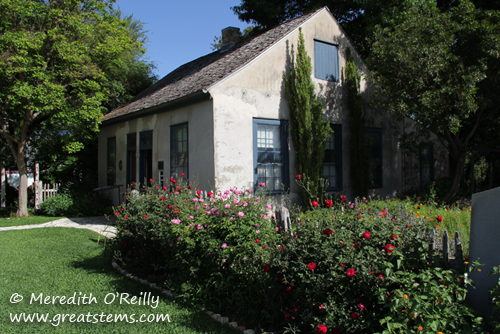
<span style="DISPLAY: inline" class="mt-enclosure mt-enclosure-image"><img style="TEXT-ALIGN: center; MARGIN: 0px auto 20px; DISPLAY: block" class="mt-image-center" alt="lindheimermm04-04-12.jpg" src="http://www.greatstems.com/lindheimermm04-04-12.jpg" width="500" height="334" /></span>
<span style="DISPLAY: inline" class="mt-enclosure mt-enclosure-image">In April I had the pleasure of speaking to the Comal Master Gardeners 2012 trainees about wildlife gardening, and it seemed like the perfect opportunity to include a visit to the <a href="http://www.nbconservation.org/lindheimer.htm">Lindheimer Home</a> and gardens in New Braunfels. </span></font></span><span style="FONT-FAMILY: 'Arial','sans-serif'; FONT-SIZE: 10pt"><font color="#000000">
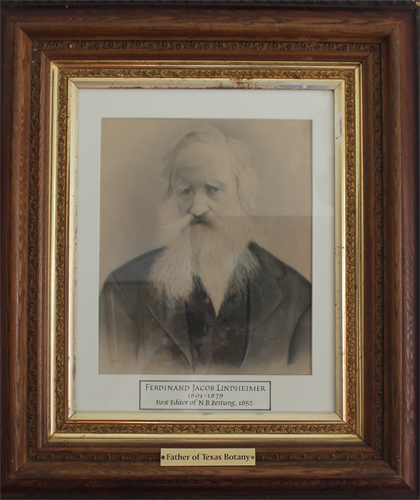
<span style="DISPLAY: inline" class="mt-enclosure mt-enclosure-image">Ferdinand Lindheimer, an extraordinary naturalist and the first permanent-resident botanist of Texas, is particularly notable in part for his vast contributions in the collecting and categorizing of thousands of Texas native plants but also for his unique role in other aspects of Texas history. In fact, his skilled passion for Texas flora earned Lindheimer an honorary title, the "Father of Texas Botany."<o:p></o:p></font></span></p>
<p></p>
<p></p>
<p style="MARGIN: 0in 0in 0pt" class="MsoNormal"><span style="FONT-FAMILY: 'Arial','sans-serif'; FONT-SIZE: 10pt"><o:p><font color="#000000"><img style="TEXT-ALIGN: center; MARGIN: 0px auto 20px; DISPLAY: block" class="mt-image-center" alt="lindheimergg04-04-12.jpg" src="http://www.greatstems.com/lindheimergg04-04-12.jpg" width="420" height="500" /></font></o:p></span><span style="FONT-FAMILY: 'Arial','sans-serif'; FONT-SIZE: 10pt"><font color="#000000"></form>
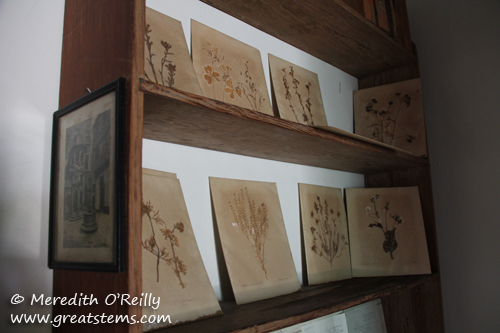
<span style="DISPLAY: inline" class="mt-enclosure mt-enclosure-image">In preparation for writing this article, I drove downtown to the Austin History Center, which includes in its collection of archived books and documents one copy of the translated letters of Lindheimer to renowned botanist George Engelmann, enclosed in the book <i style="mso-bidi-font-style: normal">A Life Among the Texas Flora, </i>by Minetta Altgelt Goyne (note: this is book is still in print and available for purchase). My goal was not to read the entire book that day but merely to get a feel for the passion behind Lindheimer's plant collecting, as well as to take a closer look at his personal and family history. <o:p></o:p></font></span></p>

<p style="MARGIN: 0in 0in 0pt" class="MsoNormal"><span style="FONT-FAMILY: 'Arial','sans-serif'; COLOR: red; FONT-SIZE: 10pt"><o:p>&nbsp;</o:p></span></p>
<p style="MARGIN: 0in 0in 0pt" class="MsoNormal"><span style="FONT-FAMILY: 'Arial','sans-serif'; FONT-SIZE: 10pt"><font color="#000000"><img style="TEXT-ALIGN: center; MARGIN: 0px auto 20px; DISPLAY: block" class="mt-image-center" alt="lindheimers04-04-12.jpg" src="http://www.greatstems.com/lindheimers04-04-12.jpg" width="500" height="333" />Ferdinand Jacob Lindheimer was born on May 21, 1802 (some sources say 1801), in Frankfurt, Germany. Immigrating to the United States in 1834 during a time of political unrest in Germany, Lindheimer traveled first to Illinois and then to Mexico by way of New Orleans. For a short while, he worked on a couple of plantations in Mexico, collecting plants and insects in his spare time. Upon hearing about the Texas Revolution, however, he returned north to enlist in the army, missing the Battle of San Jacinto by a day. After completing his time in the army, Lindheimer&nbsp;farmed for a short while&nbsp;in the Houston area, all the while studying Texas plants and insects. </font></span></p>
<p style="MARGIN: 0in 0in 0pt" class="MsoNormal"><span style="FONT-FAMILY: 'Arial','sans-serif'; FONT-SIZE: 10pt"><font color="#000000"></font></span>&nbsp;</p>
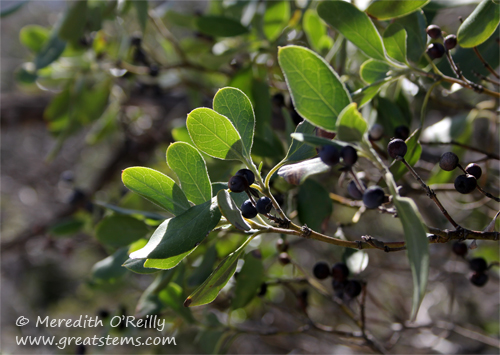
<p style="MARGIN: 0in 0in 0pt" class="MsoNormal"><span style="FONT-FAMILY: 'Arial','sans-serif'; FONT-SIZE: 10pt"><font color="#000000"><img style="TEXT-ALIGN: center; MARGIN: 0px auto 20px; DISPLAY: block" class="mt-image-center" alt="silktassel02-12.jpg" src="http://www.greatstems.com/silktassel02-12.jpg" width="500" height="355" /></font></span></p>
<p style="MARGIN: 0in 0in 0pt" class="MsoNormal"><span style="FONT-FAMILY: 'Arial','sans-serif'; FONT-SIZE: 10pt"><font color="#000000"><em>Silk Tassel, named after Lindheimer (</em>Garrya ovata ssp. Lindheimeri<em>), growing wild</em></font></span></p>
<p style="MARGIN: 0in 0in 0pt" class="MsoNormal"><span style="FONT-FAMILY: 'Arial','sans-serif'; FONT-SIZE: 10pt"><font color="#000000"></font></span>&nbsp;</p>
<p style="MARGIN: 0in 0in 0pt" class="MsoNormal"><span style="FONT-FAMILY: 'Arial','sans-serif'; FONT-SIZE: 10pt"><font color="#000000">Beginning in 1839, Lindheimer spent some time with George Engelmann, botanist at the Missouri Botanical Garden in St. Louis, and Harvard botanist Asa Gray, eventually working out an arrangement to collect and send thousands of Texas floral specimens for categorization. This arrangement would last about nine years. Along with the specimens, Lindheimer wrote long detailed letters to Englemann, and much can be learned about Lindheimer, life and culture in the early settlement of Texas, and Texas' valuable ecology and geography just by reading the translated letters. <span style="COLOR: red"><o:p></o:p></span></font></span></p>
<p style="MARGIN: 0in 0in 0pt" class="MsoNormal">
<p>
<p><span style="FONT-FAMILY: 'Arial','sans-serif'; FONT-SIZE: 10pt"><font color="#000000"></form>
<span style="DISPLAY: inline" class="mt-enclosure mt-enclosure-image"><img style="TEXT-ALIGN: center; MARGIN: 0px auto 20px; DISPLAY: block" class="mt-image-center" alt="lindheimeraa04-04-12.jpg" src="http://www.greatstems.com/lindheimeraa04-04-12.jpg" width="500" height="333" />Through Lindheimer's letters, we learn of his fondness for sweet native grapes and how pecans and persimmons were regular food sources. We learn of different wildlife he encountered, his attention to physical fitness and health, his understanding of local Native American tribes, and just how many species of cacti and yucca there really are in Texas. </span></font></span><span style="FONT-FAMILY: 'Arial','sans-serif'; FONT-SIZE: 10pt"><font color="#000000">
<span style="DISPLAY: inline" class="mt-enclosure mt-enclosure-image">Often Lindheimer gave detailed accounts of the trials of travel or difficult bouts with illness, and finances were always a necessary topic to discuss with Engelmann, who paid Lindheimer for his plant collections. But sometimes, Lindheimer would add in the most interesting of comments, such as, "<i style="mso-bidi-font-style: normal">Dr. Koester's medical treatments here are mostly unfortunate, often ghastly. Do let me know [through your contacts in] Frankfurt whether he is competent at all to practice even as a last resort.</i>" [p. 117]<i style="mso-bidi-font-style: normal"><span style="COLOR: red"><o:p></o:p></span></i></font></span></p>
<p></p>
<p></p>
<p style="MARGIN: 0in 0in 0pt" class="MsoNormal"><span style="FONT-FAMILY: 'Arial','sans-serif'; COLOR: red; FONT-SIZE: 10pt"><o:p></o:p></span></p>
<p style="MARGIN: 0in 0in 0pt" class="MsoNormal"><span style="FONT-FAMILY: 'Arial','sans-serif'; FONT-SIZE: 10pt"><font color="#000000"><img style="TEXT-ALIGN: center; MARGIN: 0px auto 20px; DISPLAY: block" class="mt-image-center" alt="texasstaraa04-12.jpg" src="http://www.greatstems.com/texasstaraa04-12.jpg" width="364" height="500" /></font></span></p>
<p style="MARGIN: 0in 0in 0pt" class="MsoNormal"><span style="FONT-FAMILY: 'Arial','sans-serif'; FONT-SIZE: 10pt"><font color="#000000"><em>Texas Star (</em>Lindheimera texana<em>), growing wild</em></font></span></p>
<p style="MARGIN: 0in 0in 0pt" class="MsoNormal"><span style="FONT-FAMILY: 'Arial','sans-serif'; FONT-SIZE: 10pt"><font color="#000000"></font></span>&nbsp;</p>
<p style="MARGIN: 0in 0in 0pt" class="MsoNormal"><span style="FONT-FAMILY: 'Arial','sans-serif'; FONT-SIZE: 10pt"><font color="#000000">Sometimes Lindheimer's descriptions of the Texas landscape were so poetic that I longed to have been a witness to the Texas that once was. In reference to the area that would become New Braunfels, Lindheimer wrote: <i style="mso-bidi-font-style: normal">"It is sufficient that we are at least here, where the streams flow crystal clear over the rocky beds. The fluid element gleams emerald green, and in its greater depths the fish rush back and forth visibly. Powerful springs cascade down from the rocky hills. They are probably subterranean brooks that have gathered in the caves of the limestone boulders and suddenly come to the surface. Forest, grazing land, and land for cultivated fields of the best quality are available. But what does that matter to me? Palmate yuccas, cactus, and mimosas and the fragrance and blossoms of them all, that's for me. Here I have seen for the first time the total splendor of the prairies. Flower upon flower, richer than the richest Persian carpet....</i>[p.112] If you are interested in Texas' natural and cultural history, Goyne's <i style="mso-bidi-font-style: normal">A Life Among the Texas Flora: Ferdinand Lindheimer's Letters to George Engelmann</i> is an excellent source of enlightenment.<o:p></o:p></font></span></p>
<p style="MARGIN: 0in 0in 0pt" class="MsoNormal"><span style="FONT-FAMILY: 'Arial','sans-serif'; COLOR: red; FONT-SIZE: 10pt"><o:p>&nbsp;</o:p></span></p>
<p style="MARGIN: 0in 0in 0pt" class="MsoNormal"><span style="FONT-FAMILY: 'Arial','sans-serif'; FONT-SIZE: 10pt"><font color="#000000"><img style="TEXT-ALIGN: center; MARGIN: 0px auto 20px; DISPLAY: block" class="mt-image-center" alt="lindheimerj04-04-12.jpg" src="http://www.greatstems.com/lindheimerj04-04-12.jpg" width="500" height="355" /></font></span></p>
<p style="MARGIN: 0in 0in 0pt" class="MsoNormal"><span style="FONT-FAMILY: 'Arial','sans-serif'; FONT-SIZE: 10pt"><font color="#000000">When Prince Carl of Solms-Braunfels purchased Texas land for a German colony in 1844, Lindheimer served as a guide for the immigrants. He was deeded land in the new German settlement of New Braunfels and built his home on land overlooking the blue Comal River, and from there he continued his plant collecting, got married, and began his family. It is estimated that during his entire lifetime, Lindheimer collected between 80,000 and 100,000 specimens, many of which were discoveries of new species or sub-species.</font></span></p>
<p style="MARGIN: 0in 0in 0pt" class="MsoNormal"><span style="FONT-FAMILY: 'Arial','sans-serif'; COLOR: red; FONT-SIZE: 10pt"><o:p>&nbsp;</o:p></span></p>
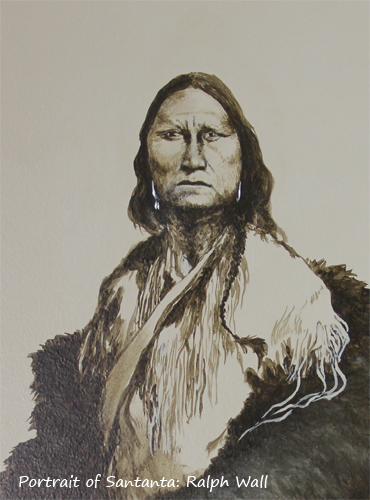
<p style="MARGIN: 0in 0in 0pt" class="MsoNormal"><span style="FONT-FAMILY: 'Arial','sans-serif'; FONT-SIZE: 10pt"><font color="#000000"><img style="TEXT-ALIGN: center; MARGIN: 0px auto 20px; DISPLAY: block" class="mt-image-center" alt="santantaRW04-04-12.jpg" src="http://www.greatstems.com/santantaRW04-04-12.jpg" width="370" height="500" />Lindheimer was known for his mild voice but strong opinions. He was an active supporter of freedom and justice. </font></span><span style="FONT-FAMILY: 'Arial','sans-serif'; FONT-SIZE: 10pt"><font color="#000000"></form>
<span style="DISPLAY: inline" class="mt-enclosure mt-enclosure-image">As a botanist, he was respected by many Native Americans, and in fact the fierce Kiowa chief Santanta was a regular visitor to Lindheimer's home. <em>(Note: On the wall in the front room&nbsp;of Lindheimer's home&nbsp;one can see the painting&nbsp;above of Chief Santana by Ralph Wall; it was added to the home in 1980.)</em></font></span></p>
<p style="MARGIN: 0in 0in 0pt" class="MsoNormal"><span style="FONT-FAMILY: 'Arial','sans-serif'; FONT-SIZE: 10pt"><font color="#000000"></font></span>&nbsp;</p>
<p style="MARGIN: 0in 0in 0pt" class="MsoNormal"><span style="FONT-FAMILY: 'Arial','sans-serif'; FONT-SIZE: 10pt"><font color="#000000"><img style="TEXT-ALIGN: center; MARGIN: 0px auto 20px; DISPLAY: block" class="mt-image-center" alt="lindheimeree04-04-12.jpg" src="http://www.greatstems.com/lindheimeree04-04-12.jpg" width="322" height="500" />For 20 years, Lindheimer served as the first editor of the <i style="mso-bidi-font-style: normal">Neu-Braunfelser Zeitung, </i>a bilingual German-English newspaper that lasted more than a century. He published the newspaper from his house and included his own sometimes controversial writings. He was involved in local education and served as the county's first Justice of the Peace. After his retirement, Lindheimer returned to his passion for Texas plants, until his death on December 2, 1879.<o:p></o:p></font></span></p>
<p style="MARGIN: 0in 0in 0pt" class="MsoNormal"><span style="FONT-FAMILY: 'Arial','sans-serif'; FONT-SIZE: 10pt"><o:p><font color="#000000">&nbsp;</font></o:p></span></p>
<p>
<p>
<p><span style="FONT-FAMILY: 'Arial','sans-serif'; FONT-SIZE: 10pt"><font color="#000000"></form>
<span style="DISPLAY: inline" class="mt-enclosure mt-enclosure-image"><img style="TEXT-ALIGN: center; MARGIN: 0px auto 20px; DISPLAY: block" class="mt-image-center" alt="lindheimerq04-04-12.jpg" src="http://www.greatstems.com/lindheimerq04-04-12.jpg" width="500" height="333" />Today the Lindheimer Home is under the care of the <a href="http://www.nbconservation.org/index.html">New Braunfels Conservation Society</a>. It has been restored to look much as it did during Lindheimer's lifetime. <span style="mso-spacerun: yes">&nbsp;</span>John Turner, who gave us a tour of the Lindheimer home, was greatly involved in the restoration, which was completed in 1995. </form></font></span></p>
<p><span style="FONT-FAMILY: 'Arial','sans-serif'; FONT-SIZE: 10pt"><font color="#000000">
<span style="DISPLAY: inline" class="mt-enclosure mt-enclosure-image"><img style="TEXT-ALIGN: center; MARGIN: 0px auto 20px; DISPLAY: block" class="mt-image-center" alt="lindheimerdd04-04-12.jpg" src="http://www.greatstems.com/lindheimerdd04-04-12.jpg" width="500" height="334" /></span></font></span></p>
<p></p>
<p></p>
<p>
<p><span style="FONT-FAMILY: 'Arial','sans-serif'; FONT-SIZE: 10pt"><font color="#000000">
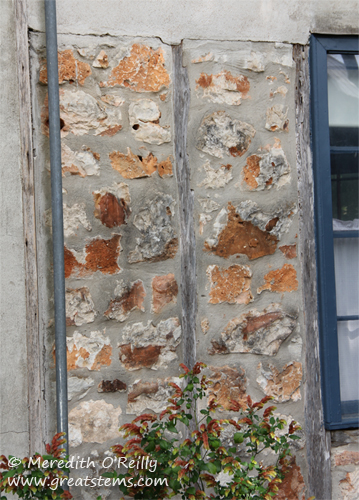
<span style="DISPLAY: inline" class="mt-enclosure mt-enclosure-image"><img style="TEXT-ALIGN: center; MARGIN: 0px auto 20px; DISPLAY: block" class="mt-image-center" alt="lindheimerkk04-04-12.jpg" src="http://www.greatstems.com/lindheimerkk04-04-12.jpg" width="359" height="500" />Stucco covers three sides of the main building, with the remaining surface exposing the <em>fachwerk</em>, or half-timbering, technique employed by German settlers, with rocks or brick filling space between the timbers. </span></font></span></p>

<p></p>
<p>
<p>
<p><span style="FONT-FAMILY: 'Arial','sans-serif'; FONT-SIZE: 10pt"><font color="#000000">
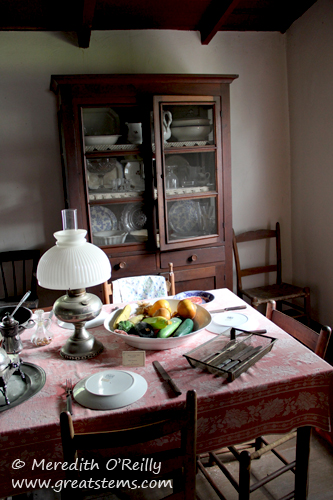
<span style="DISPLAY: inline" class="mt-enclosure mt-enclosure-image"><img style="TEXT-ALIGN: center; MARGIN: 0px auto 20px; DISPLAY: block" class="mt-image-center" alt="lindheimerl04-04-12.jpg" src="http://www.greatstems.com/lindheimerl04-04-12.jpg" width="500" height="357" />The house has a second-story loft, as well as a cellar, and a second building sits where the former outhouse had been. </span></font></span></p>
<p>
<p>
<p><span style="FONT-FAMILY: 'Arial','sans-serif'; FONT-SIZE: 10pt"><font color="#000000">
<span style="DISPLAY: inline" class="mt-enclosure mt-enclosure-image"><img style="TEXT-ALIGN: center; MARGIN: 0px auto 20px; DISPLAY: block" class="mt-image-center" alt="lindheimerc04-04-12.jpg" src="http://www.greatstems.com/lindheimerc04-04-12.jpg" width="333" height="500" />Inside, one sees much of the original furniture used by Lindheimer and his family. </span></font></span></p>
<p><span style="FONT-FAMILY: 'Arial','sans-serif'; FONT-SIZE: 10pt"><font color="#000000">
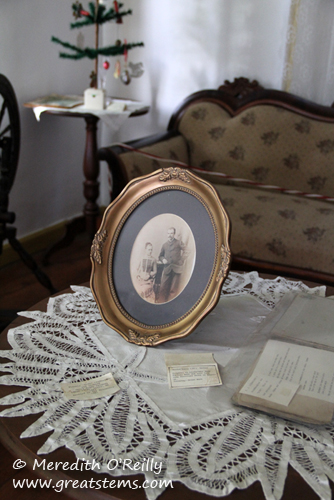
<span style="DISPLAY: inline" class="mt-enclosure mt-enclosure-image"><img style="TEXT-ALIGN: center; MARGIN: 0px auto 20px; DISPLAY: block" class="mt-image-center" alt="lindheimeref04-04-12.jpg" src="http://www.greatstems.com/lindheimeref04-04-12.jpg" width="334" height="500" />Original newspapers and plant specimens, as well as photographs and other items, are out on display. The image above is Lindheimer's granddaughter Sida and her husband.</font></span></p>
<p></p>
<p></p>
<p></p>
<p></p>
<p style="MARGIN: 0in 0in 0pt" class="MsoNormal"><span style="FONT-FAMILY: 'Arial','sans-serif'; FONT-SIZE: 10pt"><o:p><font color="#000000"></font></o:p></span></p>
<div>
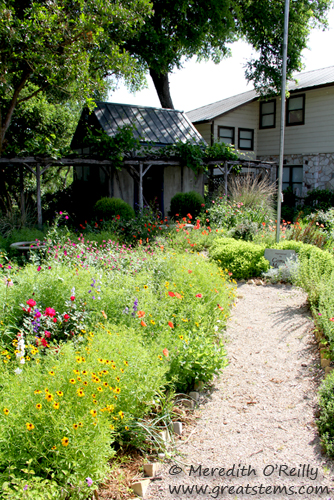
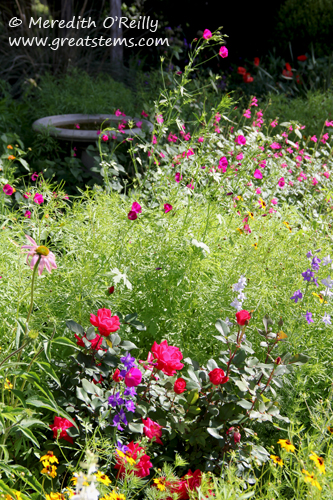
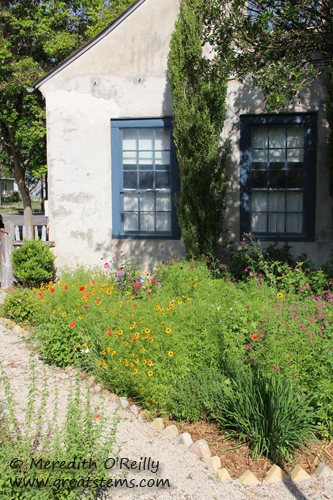
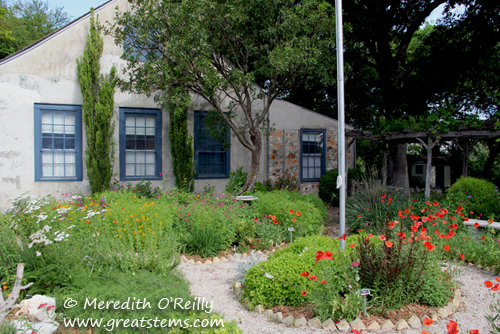
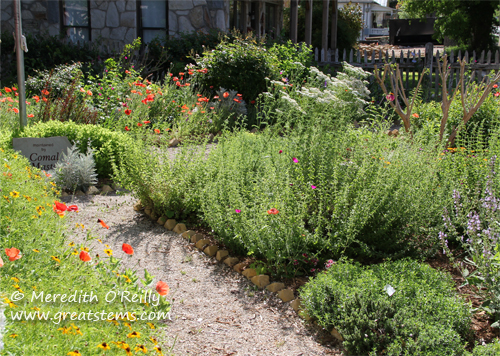
<p style="MARGIN-RIGHT: 0px" dir="ltr"><span style="FONT-FAMILY: 'Arial','sans-serif'; FONT-SIZE: 10pt"><font color="#000000"><img style="TEXT-ALIGN: center; MARGIN: 0px auto 20px; DISPLAY: block" class="mt-image-center" alt="lindheimeroo04-04-12.jpg" src="http://www.greatstems.com/lindheimeroo04-04-12.jpg" width="334" height="500" /><img style="TEXT-ALIGN: center; MARGIN: 0px auto 20px; DISPLAY: block" class="mt-image-center" alt="lindheimerh04-04-12.jpg" src="http://www.greatstems.com/lindheimerh04-04-12.jpg" width="333" height="500" />The <a href="http://txmg.org/comal/">Comal Master Gardeners</a> do an exquisite job of maintaining pristine colorful gardens around the quaint Lindheimer house. The gardens are a combination of assorted Texas natives, popular favorites, and a selection of plants specifically named after Lindheimer.</font></span></p>
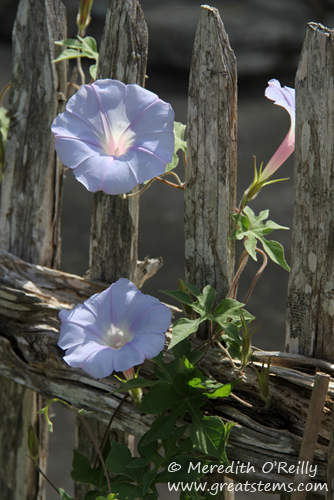
<p style="MARGIN-RIGHT: 0px" dir="ltr"><span style="FONT-FAMILY: 'Arial','sans-serif'; FONT-SIZE: 10pt"><font color="#000000"><img style="TEXT-ALIGN: center; MARGIN: 0px auto 20px; DISPLAY: block" class="mt-image-center" alt="lindheimervinea04-04-12.jpg" src="http://www.greatstems.com/lindheimervinea04-04-12.jpg" width="334" height="500" /><em>Lindheimer Morning Glory (</em>Ipomoea lindheimeri<em>)</em></font></span></p>
<p style="MARGIN-RIGHT: 0px" dir="ltr"><span style="FONT-FAMILY: 'Arial','sans-serif'; FONT-SIZE: 10pt"><font color="#000000">The most notable perhaps was the dainty but beautiful Lindheimer's Morning Glory, freshly blooming just in time for my visit. </form></font></span></p>
<p><span style="FONT-FAMILY: 'Arial','sans-serif'; FONT-SIZE: 10pt"><font color="#000000">
<span style="DISPLAY: inline" class="mt-enclosure mt-enclosure-image"><img style="TEXT-ALIGN: center; MARGIN: 0px auto 20px; DISPLAY: block" class="mt-image-center" alt="lindheimerp04-04-12.jpg" src="http://www.greatstems.com/lindheimerp04-04-12.jpg" width="500" height="356" />The Master Gardeners visiting with us said they hope to continue increasing the Lindheimer plants, especially those well suited for a garden (for not all of the Lindheimer plants would qualify as being ideal choices). After reading Lindheimer's letters that accompanied his plant specimen shipments to Engelmann, I'd like to also suggest continuing to add native plant species that Lindheimer particularly loved collecting from the Texas wild - what fun it would be to research those! For it cannot be questioned that Lindheimer's true passion was Texas flora, not just collecting it but experiencing adventure along the way. </span>
<span style="DISPLAY: inline" class="mt-enclosure mt-enclosure-image">But the Lindheimer garden is truly charming, and I commend the Master Gardeners for their dedication to creating such a lovely setting that is both an array of color and a tribute to Lindheimer. It is a garden that is a pleasure to stroll through. In fact, I was so delighted with the Lindheimer Morning Glory that I made sure to purchase one for my own garden at the <a href="http://www.wildflower.org/">Wildflower Center </a>plant sale soon thereafter. <o:p></o:p></font></span></p></div>
<p style="MARGIN: 0in 0in 0pt" class="MsoNormal"><span style="FONT-FAMILY: 'Arial','sans-serif'; FONT-SIZE: 10pt"><o:p><font color="#000000"></font></o:p></span></p>
<p style="MARGIN: 0in 0in 0pt" class="MsoNormal"><span style="FONT-FAMILY: 'Arial','sans-serif'; FONT-SIZE: 10pt"><font color="#000000"><img style="TEXT-ALIGN: center; MARGIN: 0px auto 20px; DISPLAY: block" class="mt-image-center" alt="lindheimeri04-04-12.jpg" src="http://www.greatstems.com/lindheimeri04-04-12.jpg" width="333" height="500" />Today, many plant species (and one snake) bear the name <i style="mso-bidi-font-style: normal">Lindheimer </i>in their scientific name. Depending on the source, there are at least 30 such species and possibly more than 40, but with taxonomic changes happening all the time, there is no way for me to confirm an accurate number. But after touring the Lindheimer Home and gardens and knowing that I intended to write this article, I decided to increase my personal collection of plants named for Lindheimer, and so far I am up to at least 7 (there might be others on the property): <o:p></o:p></font></span></p>
<p style="MARGIN: 0in 0in 0pt" class="MsoNormal"><span style="FONT-FAMILY: 'Arial','sans-serif'; FONT-SIZE: 10pt"><o:p><font color="#000000">&nbsp;</font></o:p></span></p>
<p style="TEXT-INDENT: -0.25in; MARGIN: 0in 0in 0pt 0.5in; mso-list: l0 level1 lfo1" class="MsoListParagraphCxSpFirst"><font color="#000000"><span style="FONT-FAMILY: Symbol; FONT-SIZE: 10pt; mso-fareast-font-family: Symbol; mso-bidi-font-family: Symbol"><span style="mso-list: Ignore">·<span style="FONT: 7pt 'Times New Roman'">&nbsp;&nbsp;&nbsp;&nbsp;&nbsp;&nbsp;&nbsp;&nbsp; </span></span></span><span style="FONT-FAMILY: 'Arial','sans-serif'; FONT-SIZE: 10pt">Silk Tassel (<i style="mso-bidi-font-style: normal">Garrya ovata ssp. lindheimeri</i>)<o:p></o:p></span></font></p>
<p style="TEXT-INDENT: -0.25in; MARGIN: 0in 0in 0pt 0.5in; mso-list: l0 level1 lfo1" class="MsoListParagraphCxSpMiddle"><font color="#000000"><span style="FONT-FAMILY: Symbol; FONT-SIZE: 10pt; mso-fareast-font-family: Symbol; mso-bidi-font-family: Symbol"><span style="mso-list: Ignore">·<span style="FONT: 7pt 'Times New Roman'">&nbsp;&nbsp;&nbsp;&nbsp;&nbsp;&nbsp;&nbsp;&nbsp; </span></span></span><span style="FONT-FAMILY: 'Arial','sans-serif'; FONT-SIZE: 10pt">Lindheimer's Senna (<i style="mso-bidi-font-style: normal">Senna lindheimeriana</i>)<o:p></o:p></span></font></p>
<p style="TEXT-INDENT: -0.25in; MARGIN: 0in 0in 0pt 0.5in; mso-list: l0 level1 lfo1" class="MsoListParagraphCxSpMiddle"><font color="#000000"><span style="FONT-FAMILY: Symbol; FONT-SIZE: 10pt; mso-fareast-font-family: Symbol; mso-bidi-font-family: Symbol"><span style="mso-list: Ignore">·<span style="FONT: 7pt 'Times New Roman'">&nbsp;&nbsp;&nbsp;&nbsp;&nbsp;&nbsp;&nbsp;&nbsp; </span></span></span><span style="FONT-FAMILY: 'Arial','sans-serif'; FONT-SIZE: 10pt">Big Muhly (<i style="mso-bidi-font-style: normal">Muhlenbergia lindheimeri</i>)<o:p></o:p></span></font></p>
<p style="TEXT-INDENT: -0.25in; MARGIN: 0in 0in 0pt 0.5in; mso-list: l0 level1 lfo1" class="MsoListParagraphCxSpMiddle"><font color="#000000"><span style="FONT-FAMILY: Symbol; FONT-SIZE: 10pt; mso-fareast-font-family: Symbol; mso-bidi-font-family: Symbol"><span style="mso-list: Ignore">·<span style="FONT: 7pt 'Times New Roman'">&nbsp;&nbsp;&nbsp;&nbsp;&nbsp;&nbsp;&nbsp;&nbsp; </span></span></span><span style="FONT-FAMILY: 'Arial','sans-serif'; FONT-SIZE: 10pt">Lindheimer's Morning Glory (<i style="mso-bidi-font-style: normal">Ipomoea lindheimeri</i>)<o:p></o:p></span></font></p>
<p style="TEXT-INDENT: -0.25in; MARGIN: 0in 0in 0pt 0.5in; mso-list: l0 level1 lfo1" class="MsoListParagraphCxSpMiddle"><font color="#000000"><span style="FONT-FAMILY: Symbol; FONT-SIZE: 10pt; mso-fareast-font-family: Symbol; mso-bidi-font-family: Symbol"><span style="mso-list: Ignore">·<span style="FONT: 7pt 'Times New Roman'">&nbsp;&nbsp;&nbsp;&nbsp;&nbsp;&nbsp;&nbsp;&nbsp; </span></span></span><span style="FONT-FAMILY: 'Arial','sans-serif'; FONT-SIZE: 10pt">Lindheimer's Beebalm (<i style="mso-bidi-font-style: normal">Monarda lindheimeri</i>)<o:p></o:p></span></font></p>
<p style="TEXT-INDENT: -0.25in; MARGIN: 0in 0in 0pt 0.5in; mso-list: l0 level1 lfo1" class="MsoListParagraphCxSpMiddle"><font color="#000000"><span style="FONT-FAMILY: Symbol; FONT-SIZE: 10pt; mso-fareast-font-family: Symbol; mso-bidi-font-family: Symbol"><span style="mso-list: Ignore">·<span style="FONT: 7pt 'Times New Roman'">&nbsp;&nbsp;&nbsp;&nbsp;&nbsp;&nbsp;&nbsp;&nbsp; </span></span></span><span style="FONT-FAMILY: 'Arial','sans-serif'; FONT-SIZE: 10pt">Texas Star (<i style="mso-bidi-font-style: normal">Lindheimera texana</i>)<o:p></o:p></span></font></p>
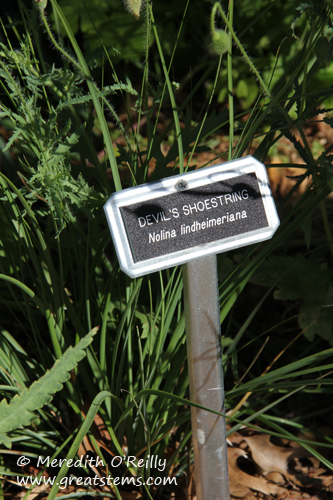
<p style="TEXT-INDENT: -0.25in; MARGIN: 0in 0in 0pt 0.5in; mso-list: l0 level1 lfo1" class="MsoListParagraphCxSpLast"><font color="#000000"><span style="FONT-FAMILY: Symbol; FONT-SIZE: 10pt; mso-fareast-font-family: Symbol; mso-bidi-font-family: Symbol"><span style="mso-list: Ignore">·<span style="FONT: 7pt 'Times New Roman'">&nbsp;&nbsp;&nbsp;&nbsp;&nbsp;&nbsp;&nbsp;&nbsp; </span></span></span><span style="FONT-FAMILY: 'Arial','sans-serif'; FONT-SIZE: 10pt">Devil's Shoestring (<i style="mso-bidi-font-style: normal">Nolina lindheimeriana</i>)<o:p></o:p></span></font></p>
<p style="MARGIN: 0in 0in 0pt" class="MsoNormal"><span style="FONT-FAMILY: 'Arial','sans-serif'; FONT-SIZE: 10pt"><o:p><font color="#000000">&nbsp;</font></o:p></span></p>
<p style="MARGIN: 0in 0in 0pt" class="MsoNormal"><span style="FONT-FAMILY: 'Arial','sans-serif'; FONT-SIZE: 10pt"><font color="#000000">I'm technically not counting Evergreen Sumac (<i style="mso-bidi-font-style: normal">Rhus virens </i>Lindheimer ex Gray<i style="mso-bidi-font-style: normal">)</i>, but some people do -- in any case, I have it. With luck, someday I'll be growing again White Gaura (<i style="mso-bidi-font-style: normal">Gaura lindheimeri</i>), which succumbed to drought, and perhaps I'll be able to add Balsam Gourd (<i style="mso-bidi-font-style: normal">Ibervillea lindheimeri</i>), Woolly Ironweed (<i style="mso-bidi-font-style: normal">Vernonia lindheimeri</i>), and others to the list. <o:p></o:p></font></span></p>
<p style="MARGIN: 0in 0in 0pt" class="MsoNormal"><span style="FONT-FAMILY: 'Arial','sans-serif'; FONT-SIZE: 10pt"><o:p><font color="#000000">&nbsp;</font></o:p></span></p>
<p style="MARGIN: 0in 0in 0pt" class="MsoNormal"><span style="FONT-FAMILY: 'Arial','sans-serif'; FONT-SIZE: 10pt"><font color="#000000"><img style="TEXT-ALIGN: center; MARGIN: 0px auto 20px; DISPLAY: block" class="mt-image-center" alt="lindheimerr04-04-12.jpg" src="http://www.greatstems.com/lindheimerr04-04-12.jpg" width="333" height="500" />Thank you to John Turner of the New Braunfels Conservation Society and to the Comal Master Gardeners for sharing a moment in time with Lindheimer with me. The friendliness of my tour guides, my love of Texas botany, and my being a former resident of New Braunfels made my visit just like coming home. Plus I had a great time speaking to the 2012 Master Gardener class. On the way home, I viewed wildflowers in the Texas Hill Country. What a great day!</font></span></p>
<p style="MARGIN: 0in 0in 0pt" class="MsoNormal"><span style="FONT-FAMILY: 'Arial','sans-serif'; FONT-SIZE: 10pt"><font color="#000000"></font></span>&nbsp;</p>
<p style="MARGIN: 0in 0in 0pt" class="MsoNormal"><span style="FONT-FAMILY: 'Arial','sans-serif'; FONT-SIZE: 10pt"><em><font color="#000000">Note: If you are wanting to visit the Lindheimer Home, you'll need to contact <a href="http://www.nbconservation.org/lindheimer.htm">New Braunfels Conservation Society</a> in advance to arrange a tour. In fact, I hear that the entire NBCS Conservation Plaza is a must-see, and it is a must-see I must see on my next visit!</font></em></span></form></p>]]>
        
    </content>
</entry>

<entry>
    <title>Mama Owl Is in Da House!</title>
    <link rel="alternate" type="text/html" href="http://www.greatstems.com/2012/04/mama-owl-is-in-da-house.html" />
    <id>tag:www.greatstems.com,2012://2.492</id>

    <published>2012-04-24T17:23:53Z</published>
    <updated>2012-04-24T17:49:52Z</updated>

    <summary><![CDATA[I'm just bouncing around in happiness since I discovered this morning&nbsp;that Mama Screech Owl is back, and it looks like she'll soon have babies fledging -- she can barely fit in her house! It seems Austin is having a great...]]></summary>
    <author>
        <name>Meredith</name>
        
    </author>
    
        <category term="owls" scheme="http://www.sixapart.com/ns/types#category" />
    
    
    <content type="html" xml:lang="en-us" xml:base="http://www.greatstems.com/">
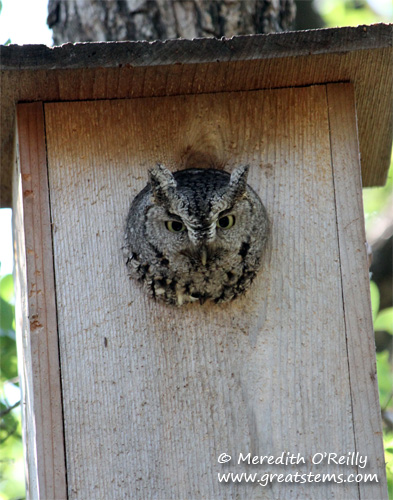
        <![CDATA[<p>I'm just bouncing around in happiness since I discovered this morning&nbsp;that Mama Screech Owl is back, and it looks like she'll soon have babies fledging -- she can barely fit in her house! It seems Austin is having a great Eastern Screech Owl year -- almost everyone I know has at least one occupied house! Which is why I was feeling so very jealous and also&nbsp;so very worried that something had happened to our mama lady. But there she be!</p>
<p>
<span style="DISPLAY: inline" class="mt-enclosure mt-enclosure-image"><img style="TEXT-ALIGN: center; MARGIN: 0px auto 20px; DISPLAY: block" class="mt-image-center" alt="esowl04-24-12.jpg" src="http://www.greatstems.com/esowl04-24-12.jpg" width="393" height="500" /></span>She switched houses, too -- opting for the house in the back of the yard instead of the side. I think it was a fine choice for her to select the other apartment -- a woman always has the right to change her mind and also to rearrange furniture! Or in this case, just plain move. Though she's on a tree that sways in the wind a lot more, she sure gets a good view of everything going on in the yard.</p>
<p>Once again, her appearance has mysteriously coincided with fewer toad calls at night. I get the feeling that she LOVES our wildlife garden for all the food it provides her and her babies. One of these days, maybe I'll get to see Papa Owl!</p>
<p>As if that weren't enough, I also found our first Pipevine Swallowtail caterpillars, hatched from eggs that a surprise female butterfly deposited a few weeks ago, and an Orange Sulphur caterpillar on our Lindheimer's Senna, too! Oh happy day!</p>
<p>&nbsp;</p>
<p>&nbsp;</p>]]>
        
    </content>
</entry>

<entry>
    <title>Giving a Turtle a Hand But Not Digits</title>
    <link rel="alternate" type="text/html" href="http://www.greatstems.com/2012/04/giving-a-turtle-a-hand-but-not-digits.html" />
    <id>tag:www.greatstems.com,2012://2.490</id>

    <published>2012-04-20T23:37:12Z</published>
    <updated>2012-04-20T22:37:41Z</updated>

    <summary>It&apos;s not every day that one has a chance to do a good deed and lose some fingers in the process. But recently my neighbor Jan gave us that opportunity when she reported that she had saved a snapping turtle...</summary>
    <author>
        <name>Meredith</name>
        
    </author>
    
        <category term="wildlife" scheme="http://www.sixapart.com/ns/types#category" />
    
    
    <content type="html" xml:lang="en-us" xml:base="http://www.greatstems.com/">
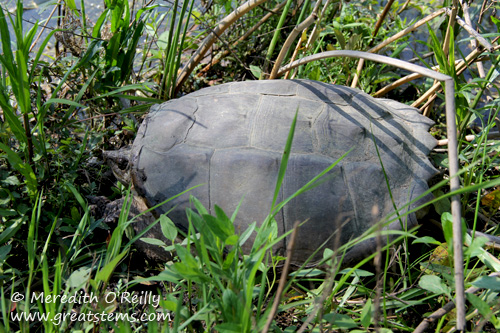
        <![CDATA[<p>It's not every day that one has a chance to do a good deed and lose some fingers in the process. But recently my neighbor Jan gave us that opportunity when she reported that she had saved a snapping turtle from a terrible fate that likely would have awaited it as it crossed the highway frontage road near our house. She named it Jaws, and appropriately so. Perhaps&nbsp;Jaws&nbsp;was a female who'd gotten lost after laying her eggs somewhere -- whatever the reason, the highway was no place for this turtle to be, and she was far, far from water.</p>
<p>
<span style="DISPLAY: inline" class="mt-enclosure mt-enclosure-image"><img style="TEXT-ALIGN: center; MARGIN: 0px auto 20px; DISPLAY: block" class="mt-image-center" alt="snappingturtlea04-01-12.jpg" src="http://www.greatstems.com/snappingturtlea04-01-12.jpg" width="500" height="354" /></span>Jan carefully put Jaws into the back of her pickup and asked for assistance in getting the turtle back to the nearby pond from which it likely came. She jokingly offered to let me put it&nbsp;in my backyard pond. As much as I love wildlife, my hot-tub pond does NOT need a giant snapping turtle. Besides, with the turtle's sheer size and weight, it&nbsp;might have displaced all the water! Actually, we estimated that&nbsp;Jaws weighed around 30 pounds, a pretty good size for a turtle.</p>
<p>
<p>
<p>
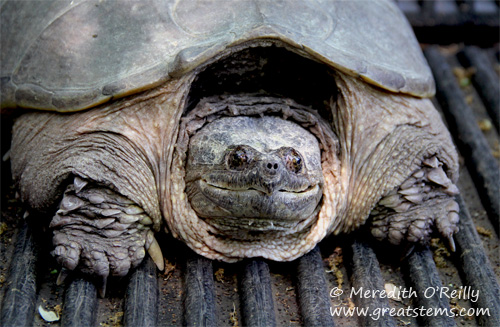
<span style="DISPLAY: inline" class="mt-enclosure mt-enclosure-image"><img style="TEXT-ALIGN: center; MARGIN: 0px auto 20px; DISPLAY: block" class="mt-image-center" alt="snappingturtleb04-01-12.jpg" src="http://www.greatstems.com/snappingturtleb04-01-12.jpg" width="500" height="327" /></span></p>
<p>
<p>
<p align="center">
<span style="DISPLAY: inline" class="mt-enclosure mt-enclosure-image"><em>What a smile! As if it is daring us to get in range...</em></span></p>
<p>
<span style="DISPLAY: inline" class="mt-enclosure mt-enclosure-image">Wanting my sons to have all sorts of memory-making experiences with nature, I first asked them to join me to go see the snapping turtle and then asked my oldest son if he'd like to help get the turtle to the pond -- carefully, mind you. He said yes, then proceeded to spend quiet moments reflecting on all the ways he values his fingers.</span></p>
<p></p>
<p></p>
<p></p>
<p></p>
<p>
<p>
<p>
<span style="DISPLAY: inline" class="mt-enclosure mt-enclosure-image"><img style="TEXT-ALIGN: center; MARGIN: 0px auto 20px; DISPLAY: block" class="mt-image-center" alt="snappingturtled04-01-12.jpg" src="http://www.greatstems.com/snappingturtled04-01-12.jpg" width="500" height="388" /></span></p>
<p>
<p>
<p align="center">
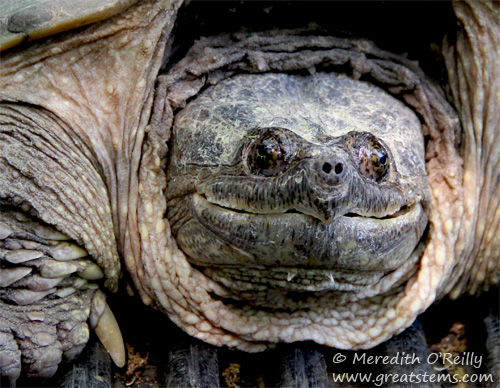
<span style="DISPLAY: inline" class="mt-enclosure mt-enclosure-image"><em>Closer, please.</em></span></p>
<p>
<p>
<p>
<p>
<p>
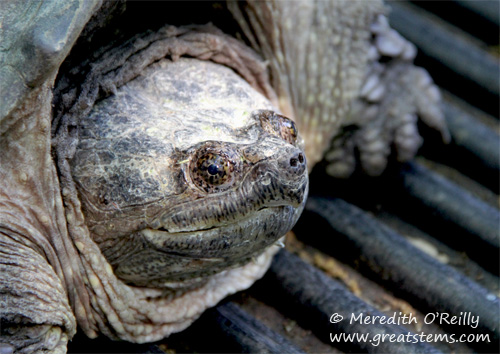
<span style="DISPLAY: inline" class="mt-enclosure mt-enclosure-image">Common Snapping Turtles are pure prehistoric awesomeness, as I like to say. They have so much body that they seem to ooze out of their shell, and that's one reason why they are so snappy -- they can't hide back in their shell in times of danger. But they actually are quite benign creatures overall -- the powerful jaws only come into play if they feel threatened (or hungry).&nbsp;</span></p>
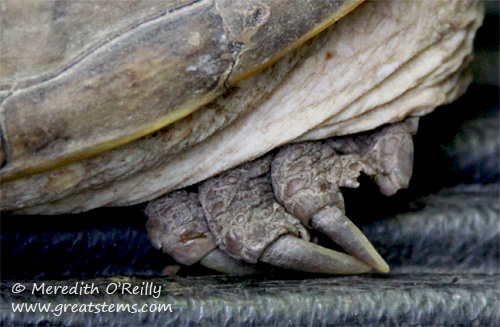
<p><img style="TEXT-ALIGN: center; MARGIN: 0px auto 20px; DISPLAY: block" class="mt-image-center" alt="snappingturtleh04-01-12.jpg" src="http://www.greatstems.com/snappingturtleh04-01-12.jpg" width="500" height="327" />Look at the gorgeous claws. </p>
<p></p>
<p></p>
<p></p>
<p></p>
<p></p>
<p></p>
<p></p>
<p></p>
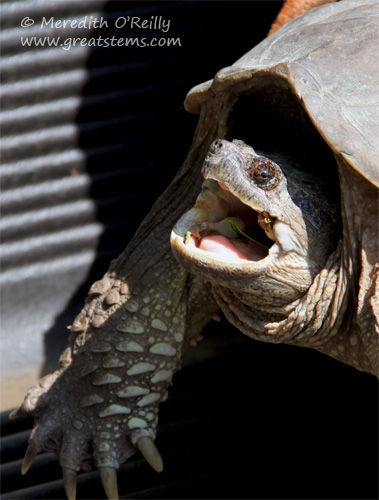
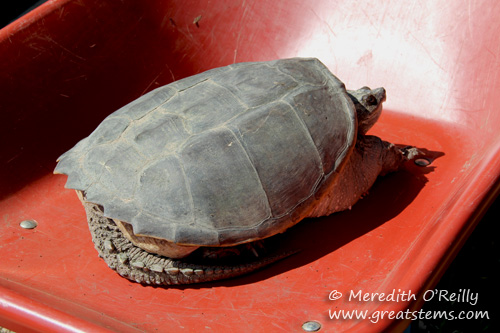
<p><img style="TEXT-ALIGN: center; MARGIN: 0px auto 20px; DISPLAY: block" class="mt-image-center" alt="snappingturtlec04-01-12.jpg" src="http://www.greatstems.com/snappingturtlec04-01-12.jpg" width="379" height="500" />And the nifty plates on the legs -- a&nbsp;vision in armor. Actually, take a look inside the mouth, too. For one thing, you can see whatever plant part it munched on. But you can also see its wide tongue, one of the ways you can distinguish a Common Snapping Turtle from an Alligator Snapping Turtle. Just don't look TOO closely, if you know what I mean.</p>
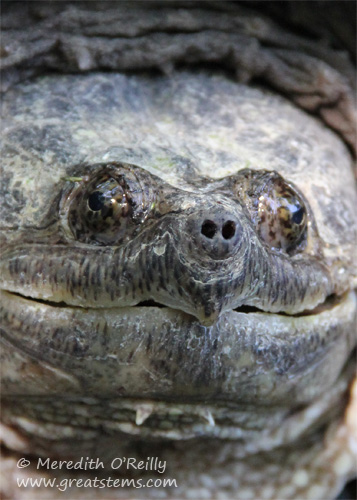
<p><img style="TEXT-ALIGN: center; MARGIN: 0px auto 20px; DISPLAY: block" class="mt-image-center" alt="snappingturtlee04-01-12.jpg" src="http://www.greatstems.com/snappingturtlee04-01-12.jpg" width="357" height="500" />Jaws also had perfect little nostrils on the tip of its nose. Can you just imagine the turtle laying low in the water and muck, reaching its head up to the surface every once in a while to take a breath of air? </p>
<p>
<p>
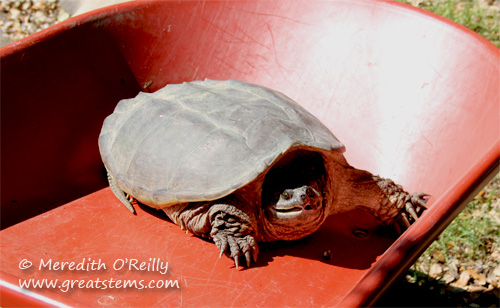
<span style="DISPLAY: inline" class="mt-enclosure mt-enclosure-image"><img style="TEXT-ALIGN: center; MARGIN: 0px auto 20px; DISPLAY: block" class="mt-image-center" alt="snappingturtlef04-01-12.jpg" src="http://www.greatstems.com/snappingturtlef04-01-12.jpg" width="500" height="333" />Another distinguishing characteristic of a Common Snapping Turtle is its long tail. </span></p>
<p></p>
<p>
<span style="DISPLAY: inline" class="mt-enclosure mt-enclosure-image"><img style="TEXT-ALIGN: center; MARGIN: 0px auto 20px; DISPLAY: block" class="mt-image-center" alt="snappingturtlei04-01-12.jpg" src="http://www.greatstems.com/snappingturtlei04-01-12.jpg" width="500" height="308" /></span>Look how it fills the wheelbarrow. Big girl. Or boy -- apparently you can tell by looking at the base of its tail, but sometimes such information isn't worth going after, haha.&nbsp;Keep in mind that a&nbsp;Common Snapping Turtle's neck is long and flexible, and this is what makes handling one such a risky venture. It can snap out forcefully and fast, sideways or vertically, in the blink of an eye.</p>
<p>As much as I tried, I couldn't get a picture of just how fast the snapping turtle snapped its jaws outward while my son moved the turtle from truck to wheelbarrow and wheelbarrow to pond. Perhaps a wise person would have switched to video mode, but I feel certain that in that case the turtle would have caught fingers for real and then I'd have a Youtube moment, as well as extreme mother guilt.</p>
<p>
<span style="DISPLAY: inline" class="mt-enclosure mt-enclosure-image"><img style="TEXT-ALIGN: center; MARGIN: 0px auto 20px; DISPLAY: block" class="mt-image-center" alt="snappingturtleg04-01-12.jpg" src="http://www.greatstems.com/snappingturtleg04-01-12.jpg" width="500" height="333" /></span>All things considered, I'm glad that Jaws has an aquatic home once again and that everyone still has their digits. Thanks, Jan, for watching out for our wildlife and to both Jan and Logan, you earn a Medal of Bravery. Me, I stayed behind the camera. For documentary purposes, of course.</p>]]>
        
    </content>
</entry>

<entry>
    <title>A Rainbow of Texas Wildflowers</title>
    <link rel="alternate" type="text/html" href="http://www.greatstems.com/2012/04/a-rainbow-of-texas-wildflowers.html" />
    <id>tag:www.greatstems.com,2012://2.489</id>

    <published>2012-04-18T15:23:42Z</published>
    <updated>2012-04-18T14:52:30Z</updated>

    <summary><![CDATA[ Over the past three weeks, I've been lucky enough to head out to the Hill Country a few times&nbsp;to see the beautiful Texas wildflowers blanketing fields and roadside edges in color this spring. They have been a most welcome...]]></summary>
    <author>
        <name>Meredith</name>
        
    </author>
    
        <category term="flowers" scheme="http://www.sixapart.com/ns/types#category" />
    
        <category term="native TX plants" scheme="http://www.sixapart.com/ns/types#category" />
    
    
    <content type="html" xml:lang="en-us" xml:base="http://www.greatstems.com/">
        <![CDATA[<p>
<span style="DISPLAY: inline" class="mt-enclosure mt-enclosure-image"><img style="TEXT-ALIGN: center; MARGIN: 0px auto 20px; DISPLAY: block" class="mt-image-center" alt="wildflowersd03-29-12.jpg" src="http://www.greatstems.com/wildflowersd03-29-12.jpg" width="500" height="333" /></span></p>
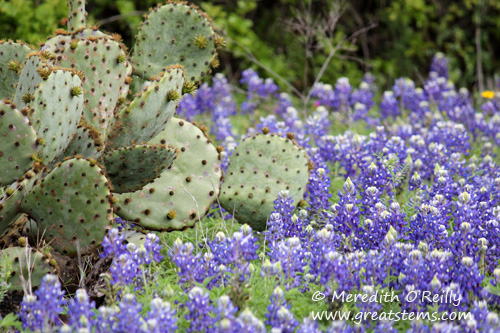
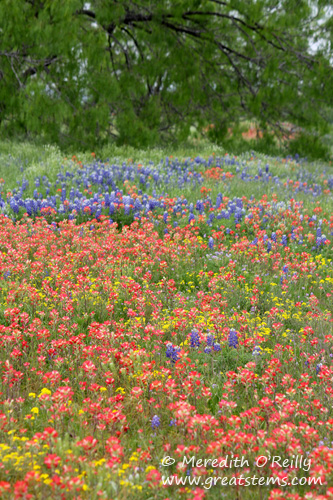
<p>Over the past three weeks, I've been lucky enough to head out to the Hill Country a few times&nbsp;to see the beautiful Texas wildflowers blanketing fields and roadside edges in color this spring. They have been a most welcome sight, as last year the drought meant there were almost no springtime wildflowers at all. Thank goodness for the little bit of rain we've had.</p>
<p>Take a walk on the wild(flower)&nbsp;side with me...</p>
<p>
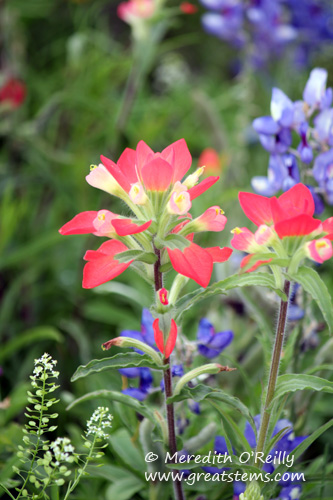
<span style="DISPLAY: inline" class="mt-enclosure mt-enclosure-image"><em></em><img style="TEXT-ALIGN: center; MARGIN: 0px auto 20px; DISPLAY: block" class="mt-image-center" alt="wildflowers03-29-12.jpg" src="http://www.greatstems.com/wildflowers03-29-12.jpg" width="333" height="500" /><img style="TEXT-ALIGN: center; MARGIN: 0px auto 20px; DISPLAY: block" class="mt-image-center" alt="wildflowersn03-29-12.jpg" src="http://www.greatstems.com/wildflowersn03-29-12.jpg" width="350" height="500" /></span>
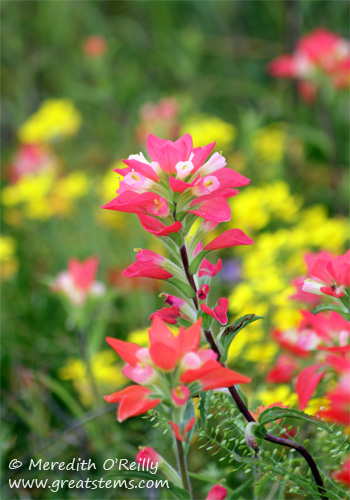
<span style="DISPLAY: inline" class="mt-enclosure mt-enclosure-image"><em>Indian Paintbrush</em></span></p>
<p></p>
<span style="DISPLAY: inline" class="mt-enclosure mt-enclosure-image"><em></em>
<p></span>
<span style="DISPLAY: inline" class="mt-enclosure mt-enclosure-image"><em></em><img style="TEXT-ALIGN: center; MARGIN: 0px auto 20px; DISPLAY: block" class="mt-image-center" alt="bfdaisya03-29-12.jpg" src="http://www.greatstems.com/bfdaisya03-29-12.jpg" width="333" height="500" /></span>
<span style="DISPLAY: inline" class="mt-enclosure mt-enclosure-image"><em>Blackfoot Daisy</em></span>
<span style="DISPLAY: inline" class="mt-enclosure mt-enclosure-image"></p>
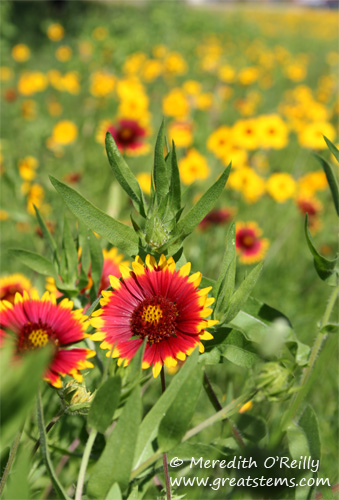
<p><img style="TEXT-ALIGN: center; MARGIN: 0px auto 20px; DISPLAY: block" class="mt-image-center" alt="wildflowersb03-29-12.jpg" src="http://www.greatstems.com/wildflowersb03-29-12.jpg" width="500" height="333" /></span>
<span style="DISPLAY: inline" class="mt-enclosure mt-enclosure-image"><em></em><img style="TEXT-ALIGN: center; MARGIN: 0px auto 20px; DISPLAY: block" class="mt-image-center" alt="wildflowersg03-29-12.jpg" src="http://www.greatstems.com/wildflowersg03-29-12.jpg" width="500" height="329" /></span>
<span style="DISPLAY: inline" class="mt-enclosure mt-enclosure-image"><em>Firewheel, or Indian Blanket</em></span></p>
<p>
<p>
<span style="DISPLAY: inline" class="mt-enclosure mt-enclosure-image"><em></em><img style="TEXT-ALIGN: center; MARGIN: 0px auto 20px; DISPLAY: block" class="mt-image-center" alt="wildflowersf03-29-12.jpg" src="http://www.greatstems.com/wildflowersf03-29-12.jpg" width="333" height="500" /></span>
<span style="DISPLAY: inline" class="mt-enclosure mt-enclosure-image"><img style="TEXT-ALIGN: center; MARGIN: 0px auto 20px; DISPLAY: block" class="mt-image-center" alt="wildflowersh03-29-12.jpg" src="http://www.greatstems.com/wildflowersh03-29-12.jpg" width="500" height="333" /><em>Prairie Fleabane</em></span></p>
<p></p>
<p>
<p>
<p>
<span style="DISPLAY: inline" class="mt-enclosure mt-enclosure-image"><img style="TEXT-ALIGN: center; MARGIN: 0px auto 20px; DISPLAY: block" class="mt-image-center" alt="wildflowerse03-29-12.jpg" src="http://www.greatstems.com/wildflowerse03-29-12.jpg" width="500" height="333" /></span>
<span style="DISPLAY: inline" class="mt-enclosure mt-enclosure-image"><em>Texas Bluebonnets, our official state flower,&nbsp;with Prickly Pear, our official state plant</em></span></p>
<p>
<span style="DISPLAY: inline" class="mt-enclosure mt-enclosure-image"><img style="TEXT-ALIGN: center; MARGIN: 0px auto 20px; DISPLAY: block" class="mt-image-center" alt="wildflowersi03-29-12.jpg" src="http://www.greatstems.com/wildflowersi03-29-12.jpg" width="500" height="323" /></span>
<span style="DISPLAY: inline" class="mt-enclosure mt-enclosure-image"><em>Mexican Hat</em></span></p>
<p></p>
<p></p>
<p>
<p>
<p>
<p>
<span style="DISPLAY: inline" class="mt-enclosure mt-enclosure-image"><em></em><img style="TEXT-ALIGN: center; MARGIN: 0px auto 20px; DISPLAY: block" class="mt-image-center" alt="wildflowersj03-29-12.jpg" src="http://www.greatstems.com/wildflowersj03-29-12.jpg" width="333" height="500" /></span>
<span style="DISPLAY: inline" class="mt-enclosure mt-enclosure-image"><img style="TEXT-ALIGN: center; MARGIN: 0px auto 20px; DISPLAY: block" class="mt-image-center" alt="bfdaisyb03-29-12.jpg" src="http://www.greatstems.com/bfdaisyb03-29-12.jpg" width="500" height="333" /></span>
<span style="DISPLAY: inline" class="mt-enclosure mt-enclosure-image"><img style="TEXT-ALIGN: center; MARGIN: 0px auto 20px; DISPLAY: block" class="mt-image-center" alt="bfdaisyc03-29-12.jpg" src="http://www.greatstems.com/bfdaisyc03-29-12.jpg" width="333" height="500" /></span>
<span style="DISPLAY: inline" class="mt-enclosure mt-enclosure-image"><img style="TEXT-ALIGN: center; MARGIN: 0px auto 20px; DISPLAY: block" class="mt-image-center" alt="wildflowersk03-29-12.jpg" src="http://www.greatstems.com/wildflowersk03-29-12.jpg" width="500" height="357" /></span>
<span style="DISPLAY: inline" class="mt-enclosure mt-enclosure-image"><em>Missouri Evening-Primrose</em></span></p>
<p>
<p>
<p>
<span style="DISPLAY: inline" class="mt-enclosure mt-enclosure-image"><em></em><img style="TEXT-ALIGN: center; MARGIN: 0px auto 20px; DISPLAY: block" class="mt-image-center" alt="wildflowersl03-29-12.jpg" src="http://www.greatstems.com/wildflowersl03-29-12.jpg" width="500" height="350" /></span>
<span style="DISPLAY: inline" class="mt-enclosure mt-enclosure-image"><em>Prairie Verbena and Coreopsis</em></span></p>
<p>
<p>
<p>
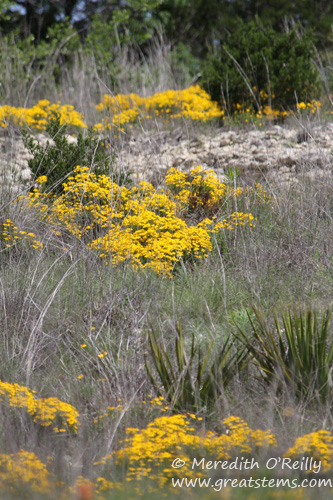
<span style="DISPLAY: inline" class="mt-enclosure mt-enclosure-image"><em></em><img style="TEXT-ALIGN: center; MARGIN: 0px auto 20px; DISPLAY: block" class="mt-image-center" alt="wildflowersc03-29-12.jpg" src="http://www.greatstems.com/wildflowersc03-29-12.jpg" width="333" height="500" /><img style="TEXT-ALIGN: center; MARGIN: 0px auto 20px; DISPLAY: block" class="mt-image-center" alt="wildflowersm03-29-12.jpg" src="http://www.greatstems.com/wildflowersm03-29-12.jpg" width="339" height="500" /></span>
<span style="DISPLAY: inline" class="mt-enclosure mt-enclosure-image"><img style="TEXT-ALIGN: center; MARGIN: 0px auto 20px; DISPLAY: block" class="mt-image-center" alt="damianitab04-06-12.jpg" src="http://www.greatstems.com/damianitab04-06-12.jpg" width="333" height="500" /></span>
<span style="DISPLAY: inline" class="mt-enclosure mt-enclosure-image"><img style="TEXT-ALIGN: center; MARGIN: 0px auto 20px; DISPLAY: block" class="mt-image-center" alt="damianita04-06-12.jpg" src="http://www.greatstems.com/damianita04-06-12.jpg" width="333" height="500" /></span>
<span style="DISPLAY: inline" class="mt-enclosure mt-enclosure-image"><em>Damianita</em></span></p>
<p>
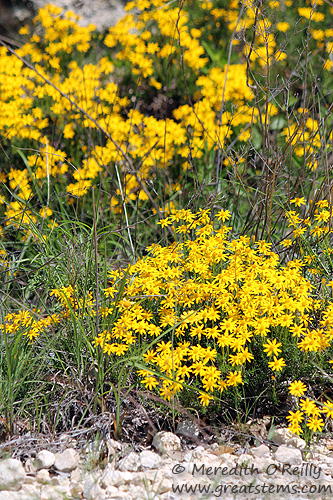
<span style="DISPLAY: inline" class="mt-enclosure mt-enclosure-image"><em></em><img style="TEXT-ALIGN: center; MARGIN: 0px auto 20px; DISPLAY: block" class="mt-image-center" alt="bfdaisyd03-29-12.jpg" src="http://www.greatstems.com/bfdaisyd03-29-12.jpg" width="333" height="500" /></span>
<span style="DISPLAY: inline" class="mt-enclosure mt-enclosure-image"><img style="TEXT-ALIGN: center; MARGIN: 0px auto 20px; DISPLAY: block" class="mt-image-center" alt="wildflowersq03-29-12.jpg" src="http://www.greatstems.com/wildflowersq03-29-12.jpg" width="333" height="500" /><img style="TEXT-ALIGN: center; MARGIN: 0px auto 20px; DISPLAY: block" class="mt-image-center" alt="wildflowerso03-29-12.jpg" src="http://www.greatstems.com/wildflowerso03-29-12.jpg" width="500" height="340" /></span></p>
<p></p>
<p></p>
<p></p>
<p></p>
<p></p>
<p></p>
<p></p>
<p><em>Coreopsis</em></p>
<p>
<span style="DISPLAY: inline" class="mt-enclosure mt-enclosure-image">&nbsp;</span>Texas is beautiful all around, but never more so than in the spring!</p>
<p><em>---------------</em></p>
<p><em>End note: Our state is having a terrible time with an invasive plant called Bastard Cabbage, or common giant mustard (</em>Rapistrum rugosum<em>). I had to drive quite a distance to find pristine pockets of wildflowers in the Hill Country,&nbsp;for vast areas have become&nbsp;covered with this awful plant, which originated in the Mediterranean and&nbsp;thrives in the same places and soil our wildflowers do. But then it takes over with its long tap roots, large size, and prolific seeds. I opted not to show a picture of the Bastard Cabbage (my son calls it "Bad Word" cabbage) so as not to taint my post with its presence. I'm mentioning it only because I worry about the trouble our wildflowers are having!</em></p>]]>
        
    </content>
</entry>

<entry>
    <title>Cheers for Floral Pom-poms</title>
    <link rel="alternate" type="text/html" href="http://www.greatstems.com/2012/04/cheers-for-floral-pom-poms.html" />
    <id>tag:www.greatstems.com,2012://2.488</id>

    <published>2012-04-16T23:47:11Z</published>
    <updated>2012-04-16T22:47:55Z</updated>

    <summary><![CDATA[ It's that time of year again when pom-pom blooms abound, and I can't help but want to do a cheer. Swaying gently in the breeze, the Goldenball Leadtree (Leucaena retusa)&nbsp;towers above my spineless Opuntia as a tall yet airy...]]></summary>
    <author>
        <name>Meredith</name>
        
    </author>
    
        <category term="native TX plants" scheme="http://www.sixapart.com/ns/types#category" />
    
    
    <content type="html" xml:lang="en-us" xml:base="http://www.greatstems.com/">
        <![CDATA[<p>
<span style="DISPLAY: inline" class="mt-enclosure mt-enclosure-image"><img style="TEXT-ALIGN: center; MARGIN: 0px auto 20px; DISPLAY: block" class="mt-image-center" alt="goldenball04-16-12.jpg" src="http://www.greatstems.com/goldenball04-16-12.jpg" width="500" height="365" /></span>It's that time of year again when pom-pom blooms abound, and I can't help but want to do a cheer.</p>
<p>
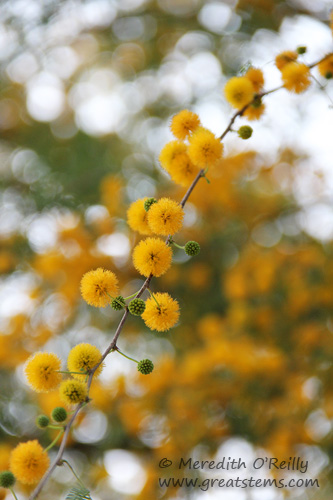
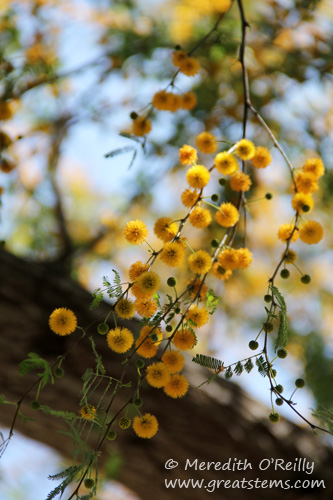
<span style="DISPLAY: inline" class="mt-enclosure mt-enclosure-image"><img style="TEXT-ALIGN: center; MARGIN: 0px auto 20px; DISPLAY: block" class="mt-image-center" alt="goldenballb04-16-12.jpg" src="http://www.greatstems.com/goldenballb04-16-12.jpg" width="340" height="500" /></span>Swaying gently in the breeze, the Goldenball Leadtree (<em>Leucaena retusa</em>)&nbsp;towers above my spineless <em>Opuntia </em>as a tall yet airy backdrop. Bright yellow pom-poms stand out against the evergreen foliage, an eye-catching combination.&nbsp;But perhaps most enticing of all, the Goldenball Leadtree's fragrant nectar beckons bumblebees and butterflies to partake in its sweetness, and I can't help but take a long whiff of the delightful aroma myself.</p>
<p>
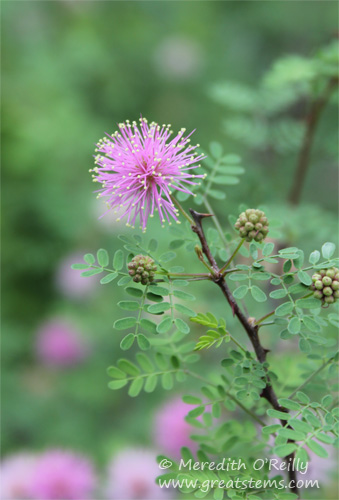
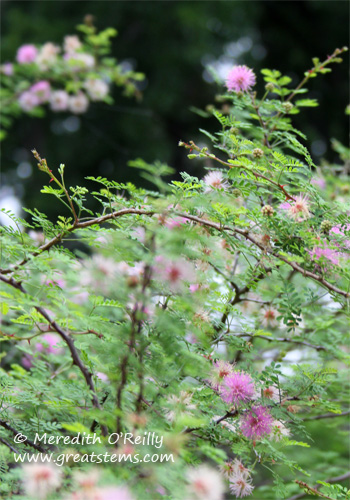
<span style="DISPLAY: inline" class="mt-enclosure mt-enclosure-image"><img style="TEXT-ALIGN: center; MARGIN: 0px auto 20px; DISPLAY: block" class="mt-image-center" alt="fragrantmimosa04-02-12.jpg" src="http://www.greatstems.com/fragrantmimosa04-02-12.jpg" width="339" height="500" /></span>Fragrant Mimosa <em>(Mimosa borealis)</em>&nbsp;is a vision of delicate pink fluff.</p>
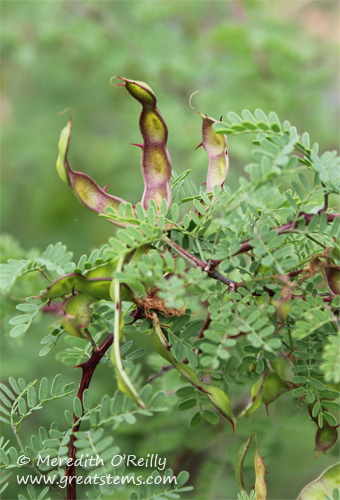
<p><img style="TEXT-ALIGN: center; MARGIN: 0px auto 20px; DISPLAY: block" class="mt-image-center" alt="fragrantmimosab04-02-12.jpg" src="http://www.greatstems.com/fragrantmimosab04-02-12.jpg" width="350" height="500" />The soft pink puffballs are a contrast to the sneaky thorns up and down the branches.</p>
<p>
<span style="DISPLAY: inline" class="mt-enclosure mt-enclosure-image"><img style="TEXT-ALIGN: center; MARGIN: 0px auto 20px; DISPLAY: block" class="mt-image-center" alt="fragrantmimosac04-16-12.jpg" src="http://www.greatstems.com/fragrantmimosac04-16-12.jpg" width="340" height="500" /></span>I'm slightly behind in showing the photos of the Fragrant Mimosa in bloom -- this week, it has already erupted in seedpods. Take a closer look above&nbsp;-- even the seedpods have prickles. This makes both seed collecting and seed cleaning an adventure everytime.</p>
<p>
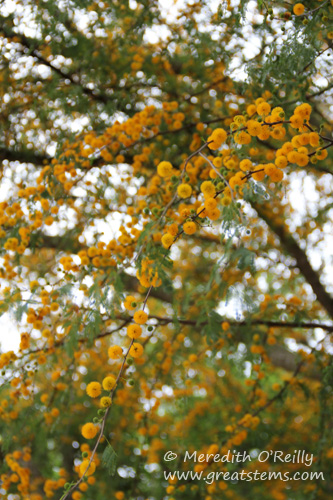
<span style="DISPLAY: inline" class="mt-enclosure mt-enclosure-image"><img style="TEXT-ALIGN: center; MARGIN: 0px auto 20px; DISPLAY: block" class="mt-image-center" alt="huisacheb04-14-12.jpg" src="http://www.greatstems.com/huisacheb04-14-12.jpg" width="333" height="500" /></span>Likewise, Huisache (<em>Acacia farnesiana</em>) beckons one over with its fragrant orange-gold blossoms, but watch out for its wicked thorns. </p>
<p>
<span style="DISPLAY: inline" class="mt-enclosure mt-enclosure-image"><img style="TEXT-ALIGN: center; MARGIN: 0px auto 20px; DISPLAY: block" class="mt-image-center" alt="huisachec04-14-12.jpg" src="http://www.greatstems.com/huisachec04-14-12.jpg" width="333" height="500" /></span>All over town, Huisache trees have been sharing their golden colors and intoxicating scent. It was tempting to bring one of these home from the Wildflower Center's plant sale this past weekend, but I resisted, as I suspect my backyard is not an appropriate setting.</p>
<p>All are native Texas plants. The first two are in my garden, and the Huisache I admired at the Wildflower Center.</p>
<p><img style="TEXT-ALIGN: center; MARGIN: 0px auto 20px; DISPLAY: block" class="mt-image-center" alt="huisache04-14-12.jpg" src="http://www.greatstems.com/huisache04-14-12.jpg" width="333" height="500" />2-4-6-8, Pom-Poms I appreciate!</p>]]>
        
    </content>
</entry>

<entry>
    <title>Meeting Wonderland&apos;s Caterpillar</title>
    <link rel="alternate" type="text/html" href="http://www.greatstems.com/2012/04/meeting-wonderlands-caterpillar.html" />
    <id>tag:www.greatstems.com,2012://2.487</id>

    <published>2012-04-15T04:51:12Z</published>
    <updated>2012-04-15T03:54:25Z</updated>

    <summary><![CDATA[As anyone who has read Alice in Wonderland knows, a caterpillar on a mushroom is an odd-enough sighting. For me, it&nbsp;is no less odd to find a caterpillar on a mushroom in real life. I have seen exactly one. This...]]></summary>
    <author>
        <name>Meredith</name>
        
    </author>
    
    
    <content type="html" xml:lang="en-us" xml:base="http://www.greatstems.com/">
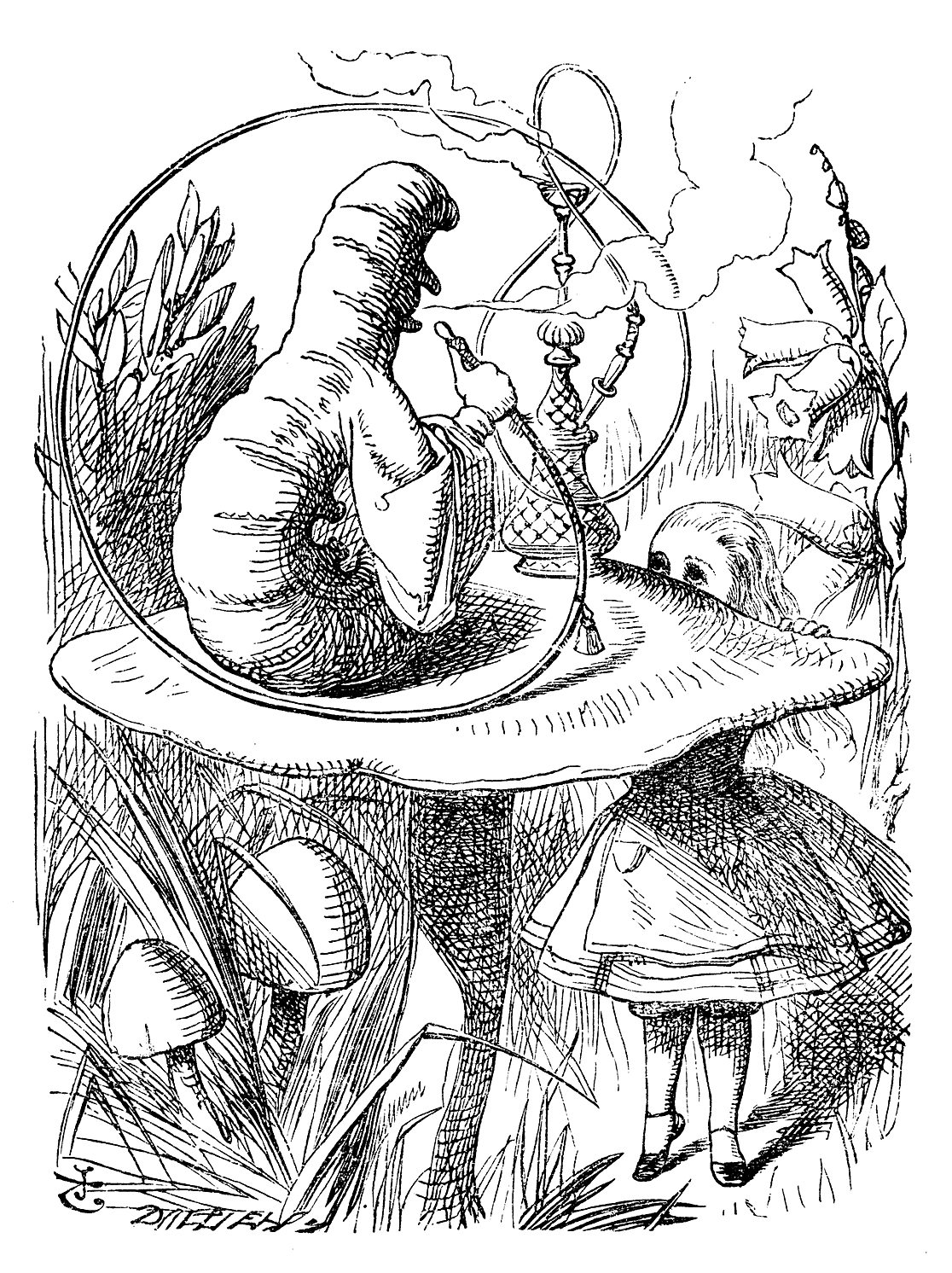
        <![CDATA[<p>As anyone who has read <em>Alice in Wonderland</em> knows, a caterpillar on a mushroom is an odd-enough sighting. <a href="http://upload.wikimedia.org/wikipedia/commons/5/53/Alice_05a-1116x1492.jpg"><img alt="File:Alice 05a-1116x1492.jpg" src="http://upload.wikimedia.org/wikipedia/commons/thumb/5/53/Alice_05a-1116x1492.jpg/448px-Alice_05a-1116x1492.jpg" width="448" height="599" /></a></p>
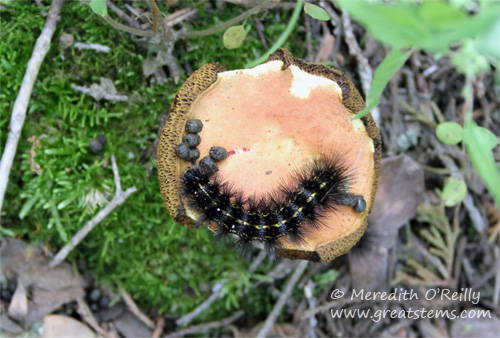
<p>For me, it&nbsp;is no less odd to find a caterpillar on a mushroom in real life. I have seen exactly one. <em>This means nothing about how common or uncommon it really is, mind you. It just means that I've only seen one. Ever.</em></p>
<p><img style="TEXT-ALIGN: center; MARGIN: 0px auto 20px; DISPLAY: block" class="mt-image-center" alt="blpmushroome04-07-12.jpg" src="http://www.greatstems.com/blpmushroome04-07-12.jpg" width="500" height="338" />The caterpillar-on-mushroom above was found at <a href="http://www.brightleaf.org/">Bright Leaf Preserve</a>, a guided-hike-only preserve here in Austin that is truly a Wonderland itself. The caterpillar, without much investigation on my part&nbsp;into its actual ID but could be a <em>Haploa </em>moth species, looked to be consuming the mushroom, evidence being the amount of frass sitting right there on the cap.&nbsp;The caterpillar didn't seem to have to move much, that's for sure -- certainly not to poop.</p>
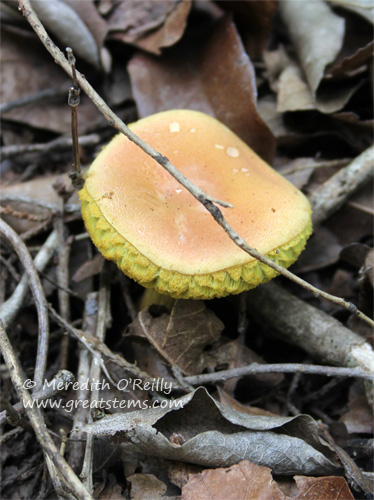
<p>As for&nbsp;the mushroom, it seemed to be some type of <em>Boletus</em>.&nbsp;On the same hike, we found another mushroom of similar type:</p>
<p><img style="TEXT-ALIGN: center; MARGIN: 0px auto 20px; DISPLAY: block" class="mt-image-center" alt="blpmushroom3b04-07-12.jpg" src="http://www.greatstems.com/blpmushroom3b04-07-12.jpg" width="374" height="500" /></p>
<p>I am really struggling to ID <em>Boletus </em>mushrooms, so I asked for help. Sue Meltzer, author of <a href="http://books.google.com/books/about/Texas_Mushrooms.html?id=HRtfvVigMmsC">Texas Mushrooms</a>, told me it might be <span style="FONT-FAMILY: 'Arial','sans-serif'; COLOR: black; FONT-SIZE: 10pt; mso-fareast-font-family: Calibri; mso-fareast-theme-font: minor-latin; mso-ansi-language: EN-US; mso-fareast-language: EN-US; mso-bidi-language: AR-SA"><em>Boletus rubricitrinus</em>, based on its reddish cap and yellow flesh. I asked about why the mushroom looked so flat, and Sue told me:</span> "<span style="FONT-FAMILY: 'Arial','sans-serif'; COLOR: black; FONT-SIZE: 10pt; mso-fareast-font-family: Calibri; mso-fareast-theme-font: minor-latin; mso-ansi-language: EN-US; mso-fareast-language: EN-US; mso-bidi-language: AR-SA">Mushrooms change during their life cycle. When fresh, they are very round, and the caps open and flatten as they mature to allow them to more efficiently disperse their spores.&nbsp;Picture a pretty girl lifting her skirt as she sits down until it is spread all around her.&nbsp;The color of the cap also fades as 1) the diameter increases, and 2) it becomes sunstruck.&nbsp;For a field guide, we always shoot photos of young, fresh mushrooms. That is because if you want to eat them, you should only choose them in that condition.&nbsp;Older mushrooms become bitter (this is also true of Portobello -- I won't buy them unless I can see that the gills are pink to pale brown. Once they are dark, they are very bitter). Also, mushrooms get attacked by insects and your caterpillar. Flies lay eggs on them which hatch into maggots.&nbsp;But the basic characteristics (in this case) yellow flesh and red cap; bruising to blue very quickly, are stable." Sue, thank you! For those interested in mushrooms commonly found in Texas, Sue's book is a wonderful and useful resource -- I very much recommend it. But oh, I have so much to learn -- mushrooms are not&nbsp;easy!&nbsp;</span></p>
<p><span style="FONT-FAMILY: 'Arial','sans-serif'; COLOR: black; FONT-SIZE: 10pt; mso-fareast-font-family: Calibri; mso-fareast-theme-font: minor-latin; mso-ansi-language: EN-US; mso-fareast-language: EN-US; mso-bidi-language: AR-SA">Also, a note of thanks to <a href="http://wiseacre-gardens.com/wordpress/">WiseAcre</a>, who offered words of condolence at having mushroom ID troubles. He compared it to a "frustrating, head-banging exercise in futility." I get that.</span></p>
<p>
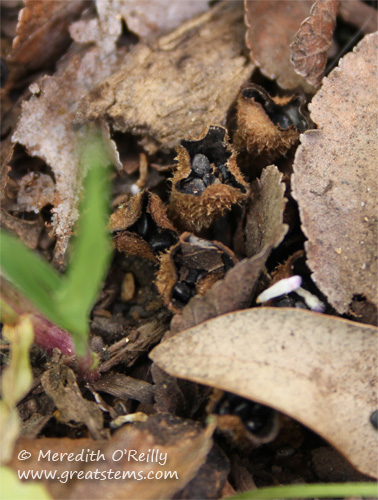
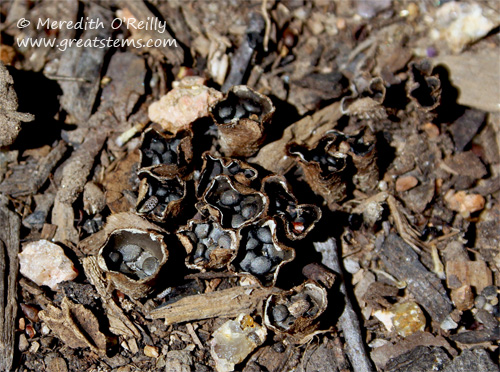
<span style="DISPLAY: inline" class="mt-enclosure mt-enclosure-image"><font color="#000000" size="2"></font><img style="TEXT-ALIGN: center; MARGIN: 0px auto 20px; DISPLAY: block" class="mt-image-center" alt="birdsnestc03-09-12.jpg" src="http://www.greatstems.com/birdsnestc03-09-12.jpg" width="378" height="500" /></span>All sorts of fungi sightings have peaked my interest lately. My favorite is perhaps the Bird's Nest Fungi growing right&nbsp;here&nbsp;in my backyard, under some poppies and other plants. These little mushrooms are so named for how they look like miniature egg-filled nests. The "eggs" are actually called <em>peridioles</em>, inside of which are spores. I'm amazed I noticed the tiny cups at all, and I owe it to the weeds in my garden bed that I found them, as the removal of said weeds prompted the discovery of&nbsp;what lay&nbsp;underneath.</p>
<p>
<span style="DISPLAY: inline" class="mt-enclosure mt-enclosure-image"><img style="TEXT-ALIGN: center; MARGIN: 0px auto 20px; DISPLAY: block" class="mt-image-center" alt="birdsnestd03-09-12.jpg" src="http://www.greatstems.com/birdsnestd03-09-12.jpg" width="500" height="372" /></span></p>
<p>Bird's Nest Fungi often appear in colonies, and mine were no exception. The "nests" serve as splash cups, and raindrops can easily disperse the peridioles. I ran across a <a href="http://www.youtube.com/watch?v=EGlaQhDi5ts">video of such spore dispersal </a>-- it's pretty nifty.</p>
<p>
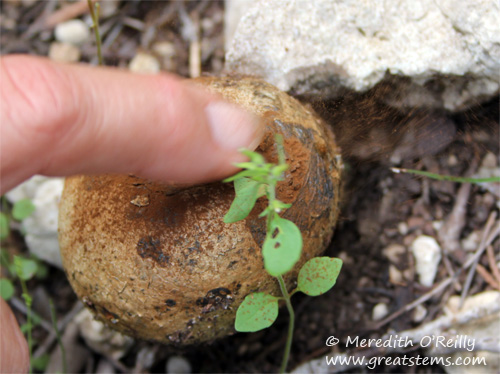
<span style="DISPLAY: inline" class="mt-enclosure mt-enclosure-image"><img style="TEXT-ALIGN: center; MARGIN: 0px auto 20px; DISPLAY: block" class="mt-image-center" alt="puffballb04-07-12.jpg" src="http://www.greatstems.com/puffballb04-07-12.jpg" width="500" height="374" /></span>Speaking of nifty, have you seen a Puffball? If you tap on the top, a cloud of&nbsp;what looks like dust or smoke comes&nbsp;out.&nbsp;That so-called dust&nbsp;is actually the spores being dispersed. Look closely and you can see it in the picture. </p>
<p>
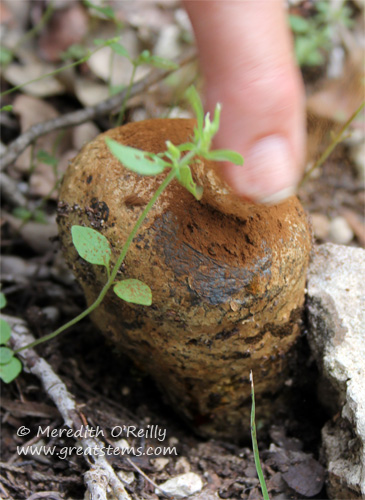
<span style="DISPLAY: inline" class="mt-enclosure mt-enclosure-image"><img style="TEXT-ALIGN: center; MARGIN: 0px auto 20px; DISPLAY: block" class="mt-image-center" alt="puffbald04-07-12.jpg" src="http://www.greatstems.com/puffbald04-07-12.jpg" width="365" height="500" /></span>Here's another view, again with visible spore dispersal. This Puffball was found in Bright Leaf Preserve on the same hike during which the Wonderland caterpillar was discovered.</p>
<p>
<span style="DISPLAY: inline" class="mt-enclosure mt-enclosure-image">&nbsp;</span>Fungi are fantastic, even if I do get a headache from all that banging my head in trying to ID them. Sometimes it's even hard to know you are looking at a fungus at all!</p>]]>
        
    </content>
</entry>

<entry>
    <title>Oh How My Garden Grows -- Befores and Afters</title>
    <link rel="alternate" type="text/html" href="http://www.greatstems.com/2012/04/oh-how-my-garden-grows----befores-and-afters.html" />
    <id>tag:www.greatstems.com,2012://2.486</id>

    <published>2012-04-10T02:28:23Z</published>
    <updated>2012-04-10T03:28:52Z</updated>

    <summary> Now that I&apos;ve finally finished my Florida wildlife posts, I get to have fun getting back to my roots, as it were -- my garden here in Austin! The rains over the winter helped revitalize my garden tremendously, and...</summary>
    <author>
        <name>Meredith</name>
        
    </author>
    
        <category term="wildlife habitats" scheme="http://www.sixapart.com/ns/types#category" />
    
    
    <content type="html" xml:lang="en-us" xml:base="http://www.greatstems.com/">
        <![CDATA[<p>
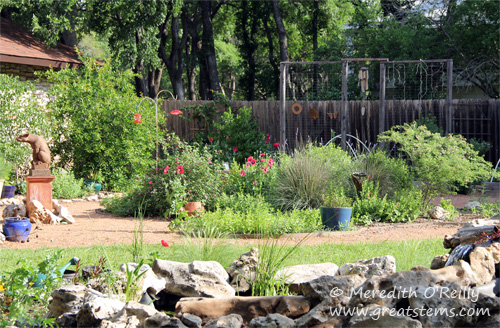
<span style="DISPLAY: inline" class="mt-enclosure mt-enclosure-image"><img style="TEXT-ALIGN: center; MARGIN: 0px auto 20px; DISPLAY: block" class="mt-image-center" alt="garden04-04-12.jpg" src="http://www.greatstems.com/garden04-04-12.jpg" width="500" height="328" /></span>Now that I've finally finished my <a href="http://www.greatstems.com/2012/04/florida-bound-a-cattle-stampede-means-its-time-to-go-home.html">Florida wildlife posts</a>, I get to have fun getting back to my roots, as it were -- my garden here in Austin! The rains over the winter helped revitalize my garden tremendously, and while we are nowhere near out of the drought yet, I'm just happy as can be that I have what feels like a garden again. My garden did NOT look like this last year, as I am what is best described as a minimal waterer. I teach my plants to be survivors.</p>
<p>Normally I'd do a before/after later in the year as an anniversary post, but every time I walk outside I am just amazed&nbsp;at the transformation of my yard in a mere 3.5 years. So I'm going to show it off!</p>
<p>BEFORE:</p>
<p>
<span style="DISPLAY: inline" class="mt-enclosure mt-enclosure-image"><img style="TEXT-ALIGN: center; MARGIN: 0px auto 20px; DISPLAY: block" class="mt-image-center" alt="10-2008garden.JPG" src="http://www.greatstems.com/10-2008garden.JPG" width="500" height="375" /></span></p>
<p>AFTER:</p>
<p>
<span style="DISPLAY: inline" class="mt-enclosure mt-enclosure-image"><img style="TEXT-ALIGN: center; MARGIN: 0px auto 20px; DISPLAY: block" class="mt-image-center" alt="garden04-04-12.jpg" src="http://www.greatstems.com/garden04-04-12.jpg" width="500" height="328" /></span></p>
<p>What a difference!&nbsp;That's a garden given only compost and occasionally liquid seaweed upon planting. It's more than 90 percent native Texas plants, and even though the poppies blooming aren't native, they give the garden such a nice touch of color.</p>
<p>Here's the hot-tub&nbsp;pond, BEFORE:</p>
<p>
<span style="DISPLAY: inline" class="mt-enclosure mt-enclosure-image"><img style="TEXT-ALIGN: center; MARGIN: 0px auto 20px; DISPLAY: block" class="mt-image-center" alt="04-2009pondbefore.JPG" src="http://www.greatstems.com/04-2009pondbefore.JPG" width="500" height="375" /></span></p>
<p>And AFTER:</p>
<p>
<span style="DISPLAY: inline" class="mt-enclosure mt-enclosure-image"><img style="TEXT-ALIGN: center; MARGIN: 0px auto 20px; DISPLAY: block" class="mt-image-center" alt="gardenb04-04-12.jpg" src="http://www.greatstems.com/gardenb04-04-12.jpg" width="333" height="500" />Last year we built the soil up around the pond to make a berm, and this year we've been creating a border around it and&nbsp;filling it in with plants.&nbsp;At some point I'll show you a different view of the pond area, as it's looking really nice (I just forgot to take the picture, and I'm impatient to show the changes).</span></p>
<p>
<span style="DISPLAY: inline" class="mt-enclosure mt-enclosure-image"><img style="TEXT-ALIGN: center; MARGIN: 0px auto 20px; DISPLAY: block" class="mt-image-center" alt="stonecrop04-08-12.jpg" src="http://www.greatstems.com/stonecrop04-08-12.jpg" width="333" height="500" /></span></p>
<p><em>Stonecrop</em></p>
<p>Speaking of the pond, the bullfrog is back. Or maybe it's a new bullfrog. I heard it for the first time ever just tonight -- the sound so confused me that I thought my pond pump was broken, until I realized that it was a frog's call. I think we've decided to name the bullfrog Jeremiah. Maybe the name is not so original, but it's a fun song to sing to the bullfrog while we are out there! I'm sad to say that Jeremiah hates me ever since I cleaned out the pond a couple of weeks ago. I think he thinks he's Alpha frog and I messed with his territory and his ego, or at least his sense of safety. I'd show you a picture of him&nbsp;except that now Jeremiah darts underwater anytime I'm within even 10 feet of the pond. Doesn't he realize that I cleaned the pond just for him? We seem to have plenty of fish, by the way. I blame <a href="http://dracogardens.blogspot.com/">Bob Pool (Draco Gardens)</a> and his darn procreating goldfish.</p>
<p><img style="TEXT-ALIGN: center; MARGIN: 0px auto 20px; DISPLAY: block" class="mt-image-center" alt="fragrantmimosa04-02-12.jpg" src="http://www.greatstems.com/fragrantmimosa04-02-12.jpg" width="339" height="500" /><em>Fragrant Mimosa in bloom</em></p>
<p>The Wonderful Pomegranate is blooming at last, not that I remembered to take a picture. It's blooming one whopping&nbsp;bloom at a time, leaving the rest as buds that just tease me until it's the next one's turn to open. Now how is&nbsp;pollination going to happen like that? I want Pomegranates!</p>
<p><em>
<span style="DISPLAY: inline" class="mt-enclosure mt-enclosure-image"><img style="TEXT-ALIGN: center; MARGIN: 0px auto 20px; DISPLAY: block" class="mt-image-center" alt="monarchcats04-08-12.jpg" src="http://www.greatstems.com/monarchcats04-08-12.jpg" width="328" height="500" /></span></em></p>
<p>This year I have 37 milkweed plants (Tropical, as I still can't get Antelope Horns to establish). They have been eaten down to sticks by all the giant Monarch caterpillars. Now what? I don't want to have to buy even more milkweed! I guess it's a decent problem to have -- I'm ecstatic to be supporting so many Monarchs.</p>
<p>It's getting hot, and I'm wishing it would rain again, but I'm just grateful as can be for what I've got. The butterflies are returning en masse, as are the caterpillars, and birds are singing glorious songs of happy, happy. My gardening goal for the year is simply to fill in the empty spaces in the beds we have and maintain only -- other than that, we've got to focus on building a new shed. Forward progress!</p>]]>
        
    </content>
</entry>

<entry>
    <title>Cracking Up in a Most Eggscellent Way</title>
    <link rel="alternate" type="text/html" href="http://www.greatstems.com/2012/04/cracking-up-in-a-most-eggscellent-way.html" />
    <id>tag:www.greatstems.com,2012://2.485</id>

    <published>2012-04-09T16:20:00Z</published>
    <updated>2012-04-09T15:21:36Z</updated>

    <summary><![CDATA[ Oh no! A casualty! We've had great fun yesterday hunting Easter eggs in the wildlife garden with friends, and we made good use of our colorful painted Easter rocks&nbsp;once again. Add to that cascarones, lots and lots of butterflies...]]></summary>
    <author>
        <name>Meredith</name>
        
    </author>
    
        <category term="fun stuff" scheme="http://www.sixapart.com/ns/types#category" />
    
    
    <content type="html" xml:lang="en-us" xml:base="http://www.greatstems.com/">
        <![CDATA[<p>
<span style="DISPLAY: inline" class="mt-enclosure mt-enclosure-image"><img style="TEXT-ALIGN: center; MARGIN: 0px auto 20px; DISPLAY: block" class="mt-image-center" alt="crackedup04-08-12.jpg" src="http://www.greatstems.com/crackedup04-08-12.jpg" width="500" height="347" /></span></p>
<p>Oh no! A casualty! </p>
<p>We've had great fun yesterday hunting Easter eggs in the wildlife garden with friends, and we made good use of our <a href="http://www.greatstems.com/2011/04/easter-rocks-and-i-mean-that-literally.html">colorful painted Easter rocks</a>&nbsp;once again. Add to that cascarones, lots and lots of butterflies and blooming flowers, delicious food, and yummy Key Lime Pie cupcakes -- what a great day! Thank you, Easter Bunny, and all our friends! Happy Easter, everyone!</p>
<p><em>Note to self: Did my husband remember to get those eggs back off the ground? Real raw eggs and Texas heat do not a good combination make....</em></p>]]>
        
    </content>
</entry>

<entry>
    <title>Florida Bound: A Cattle Stampede Means It&apos;s Time to Go Home</title>
    <link rel="alternate" type="text/html" href="http://www.greatstems.com/2012/04/florida-bound-a-cattle-stampede-means-its-time-to-go-home.html" />
    <id>tag:www.greatstems.com,2012://2.484</id>

    <published>2012-04-09T04:15:10Z</published>
    <updated>2012-04-09T03:15:31Z</updated>

    <summary><![CDATA[ Even though we were well on our way back home from Florida, we couldn't resist making an additional stop or two in Louisiana before the final home stretch to Texas. Beignets, check. Gumbo, check. Wildlife refuge, check. &nbsp;We wanted...]]></summary>
    <author>
        <name>Meredith</name>
        
    </author>
    
        <category term="birds" scheme="http://www.sixapart.com/ns/types#category" />
    
        <category term="travel" scheme="http://www.sixapart.com/ns/types#category" />
    
    
    <content type="html" xml:lang="en-us" xml:base="http://www.greatstems.com/">
        <![CDATA[<p>
<p>
<span style="DISPLAY: inline" class="mt-enclosure mt-enclosure-image">Even though we were well on our <a href="http://www.greatstems.com/2012/04/florida-bound-homosassa-wildlife-state-park.html">way back home from Florida</a>, we couldn't resist making an additional stop or two in Louisiana before the final home stretch to Texas. Beignets, check. Gumbo, check. Wildlife refuge, check.</span></p></p>
<p>
<span style="DISPLAY: inline" class="mt-enclosure mt-enclosure-image">&nbsp;</span><img style="TEXT-ALIGN: center; MARGIN: 0px auto 20px; DISPLAY: block" class="mt-image-center" alt="binocularsa03-16-12.jpg" src="http://www.greatstems.com/binocularsa03-16-12.jpg" width="500" height="333" />We wanted to visit a wildife refuge in Louisiana to get an idea of environmental differences between it and Florida -- and if we had an opportunity, to sneak in a glimpse of the coast. The answer -- the <a href="http://creolenaturetrail.org/">Creole Nature Trail</a>, a long wildlife-scenic highway route&nbsp;south of Lake Charles.&nbsp;The trail&nbsp;took us to the <a href="http://www.fws.gov/refuges/profiles/index.cfm?id=43612">Cameron Prairie Wildlife Refuge</a>, as well as several other viewing spots.</p>
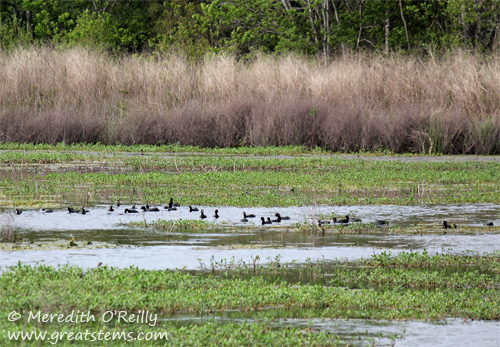
<p><img style="TEXT-ALIGN: center; MARGIN: 0px auto 20px; DISPLAY: block" class="mt-image-center" alt="coots03-16-12.jpg" src="http://www.greatstems.com/coots03-16-12.jpg" width="500" height="347" /></p>
<p>
<p>
<p>
<p>
<span style="DISPLAY: inline" class="mt-enclosure mt-enclosure-image">Cameron Prairie Wildlife Refuge's primary purpose is to support migratory&nbsp;birds,&nbsp;such as wintering&nbsp;waterfowl,&nbsp;as well as many&nbsp;other animal species with its 9,621 acres of <font size="2">marsh, coastal prairie, and old rice fields.</font></span></p></p>
<p><em>
<span style="DISPLAY: inline" class="mt-enclosure mt-enclosure-image"><img style="TEXT-ALIGN: center; MARGIN: 0px auto 20px; DISPLAY: block" class="mt-image-center" alt="grebeandcoots03-16-12.jpg" src="http://www.greatstems.com/grebeandcoots03-16-12.jpg" width="392" height="500" /></span>
<span style="DISPLAY: inline" class="mt-enclosure mt-enclosure-image">A Pied-Billed Grebe swims among American Coots</em></span></p>
<p>
<span style="DISPLAY: inline" class="mt-enclosure mt-enclosure-image"><em></em><img style="TEXT-ALIGN: center; MARGIN: 0px auto 20px; DISPLAY: block" class="mt-image-center" alt="binoculars03-16-12.jpg" src="http://www.greatstems.com/binoculars03-16-12.jpg" width="500" height="333" />A boardwalk and observation deck make it easy to look search for water-loving birds, and we observed White Ibises, different species of ducks, Great Egrets, Coots, Grebes, Great Blue Herons, and others.</span></p>
<p>
<p>
<span style="DISPLAY: inline" class="mt-enclosure mt-enclosure-image"><img style="TEXT-ALIGN: center; MARGIN: 0px auto 20px; DISPLAY: block" class="mt-image-center" alt="bee03-17-12.jpg" src="http://www.greatstems.com/bee03-17-12.jpg" width="500" height="359" /><em>Carpenter Bee -- it's very difficult to capture an image of this fast-flying insect!</em></span></p></p>
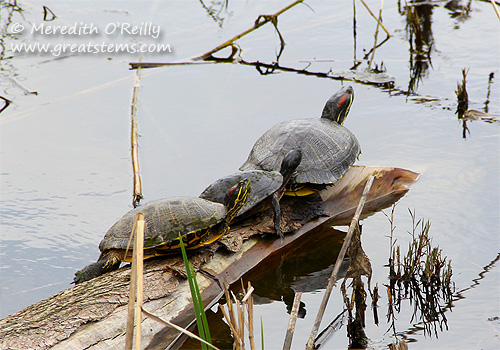
<p>
<span style="DISPLAY: inline" class="mt-enclosure mt-enclosure-image"><img style="TEXT-ALIGN: center; MARGIN: 0px auto 20px; DISPLAY: block" class="mt-image-center" alt="turtles03-17-12.jpg" src="http://www.greatstems.com/turtles03-17-12.jpg" width="500" height="350" /></span>
<span style="DISPLAY: inline" class="mt-enclosure mt-enclosure-image">Of course, many other wildlife species live at or visit the refuge -- turtles, lizards, butterflies, insects, and, of course, alligators. </span></p>
<p></p>
<p></p>
<p>
<span style="DISPLAY: inline" class="mt-enclosure mt-enclosure-image"><img style="TEXT-ALIGN: center; MARGIN: 0px auto 20px; DISPLAY: block" class="mt-image-center" alt="easternpondhawk03-17-12.jpg" src="http://www.greatstems.com/easternpondhawk03-17-12.jpg" width="359" height="500" /></span><em>Eastern Pondhawk</em></p>
<p><em>
<span style="DISPLAY: inline" class="mt-enclosure mt-enclosure-image"><img style="TEXT-ALIGN: center; MARGIN: 0px auto 20px; DISPLAY: block" class="mt-image-center" alt="granole03-17-12.jpg" src="http://www.greatstems.com/granole03-17-12.jpg" width="500" height="333" /></span>Green Anole, Shedding</em></p>
<p><em></em><img style="TEXT-ALIGN: center; MARGIN: 0px auto 20px; DISPLAY: block" class="mt-image-center" alt="scope03-16-12.jpg" src="http://www.greatstems.com/scope03-16-12.jpg" width="500" height="333" />The boys, throughout our entire trip, were quite the naturalists, and they were excellent at both finding and IDing wildlife&nbsp;species -- Louisiana was no exception.</p>
<p><img style="TEXT-ALIGN: center; MARGIN: 0px auto 20px; DISPLAY: block" class="mt-image-center" alt="" src="http://www.greatstems.com/rwblackbird03-17-12.jpg" width="366" height="500" />The Red-Winged Blackbirds were the most plentiful birds we saw in southwestern Louisiana. Great numbers of large flocks were spotted time and again throughout the marshland and agricultural areas we visited.</p>
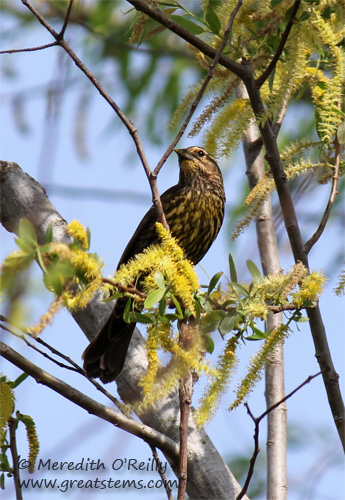
<p><img style="TEXT-ALIGN: center; MARGIN: 0px auto 20px; DISPLAY: block" class="mt-image-center" alt="rwblackbirdfemale03-17-12.jpg" src="http://www.greatstems.com/rwblackbirdfemale03-17-12.jpg" width="345" height="500" /><em>Female Red-Winged Blackbird</em></p>
<p><em>
<span style="DISPLAY: inline" class="mt-enclosure mt-enclosure-image"><img style="TEXT-ALIGN: center; MARGIN: 0px auto 20px; DISPLAY: block" class="mt-image-center" alt="rwblackbirdfemaleb03-17-12.jpg" src="http://www.greatstems.com/rwblackbirdfemaleb03-17-12.jpg" width="380" height="500" /></span></em></p>
<p><em></em><img style="TEXT-ALIGN: center; MARGIN: 0px auto 20px; DISPLAY: block" class="mt-image-center" alt="bnstilt03-17-12.jpg" src="http://www.greatstems.com/bnstilt03-17-12.jpg" width="500" height="337" /> 
<span style="DISPLAY: inline" class="mt-enclosure mt-enclosure-image"></span><em>Black-Necked Stilt</em></p>
<p>Leaving the refuge, we continued toward the coast, the roads taking us past miles and miles of marshland.Often we could see alligators along the road's edge, where marsh waters attracted a smorgasbord of animals on which an alligator might feast. Unfortunately, this&nbsp;also meant that we occasionally saw dead alligators along the&nbsp;road, a car or truck likely their source of doom. One deceased alligator looked to be at least ten feet long, and it was a very sad sight.</p>
<p><img style="TEXT-ALIGN: center; MARGIN: 0px auto 20px; DISPLAY: block" class="mt-image-center" alt="cows03-16-12.jpg" src="http://www.greatstems.com/cows03-16-12.jpg" width="500" height="353" />Ah, but we had adventures yet to come. We found that the maps we had and the roadway signs left something to be desired as we traveled that day in Louisiana.&nbsp;Trying to visit a particularly spot&nbsp;along the trail, we&nbsp;made a&nbsp;wrong turn, through no fault of our own (seriously), and after driving a bit we found ourselves on a road lined with curious cattle who splashed through the marshland&nbsp;to come over to&nbsp;see us. In moments lots of cows surrounded our Civic Hybrid, and those big cows made our little car seem smaller than ever.</p>
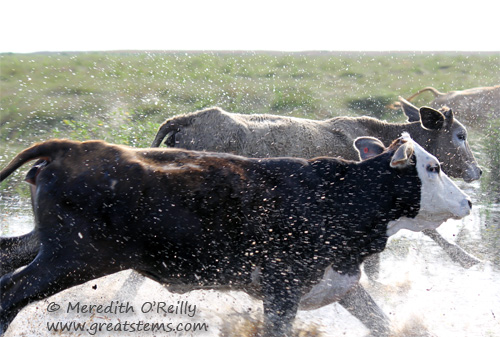
<p>I snapped a picture of a cow just outside my window but it apparently decided that it wanted nothing to do with us or my camera, and it ran, which startled another cow running, and another, and before we knew it, we were in the middle of a stampede of some&nbsp;25 startled cows rushing toward, around, and past us and our little vehicle. 
<span style="DISPLAY: inline" class="mt-enclosure mt-enclosure-image"><img style="TEXT-ALIGN: center; MARGIN: 0px auto 20px; DISPLAY: block" class="mt-image-center" alt="cowsb03-16-12.jpg" src="http://www.greatstems.com/cowsb03-16-12.jpg" width="500" height="337" /></span>I had no choice but to keep moving my car in the same direction, very slowly, but it wasn't until we began to pass a few of them that one mooed a "Hey, it's okay" moo and the cows started to slow and calm down. The experience was a first for us, indeed, and in moments the cows just stared at us calmly again&nbsp;as if nothing had happened.</p>
<p><img style="TEXT-ALIGN: center; MARGIN: 0px auto 20px; DISPLAY: block" class="mt-image-center" alt="LAgullsb03-17-12.jpg" src="http://www.greatstems.com/LAgullsb03-17-12.jpg" width="500" height="352" />Back on the proper road, we continued to discover more reasons to gripe about the maps and lack of decent road signs, but eventually we found ourselves at a ferry, which&nbsp;takes cars&nbsp;across a ship&nbsp;channel to another portion of the highway. Even there at the ferry, we had sign issues. There was a sign and painted road marks showing where to stop to await the ferry, but there was no sign telling us that after 5pm you needed to drive over to another place in order to get on the ferry. So the driver of the car in front of us waited at the posted place, and we waited behind him, and time tick-tocked and tick-tocked, until a local resident drove up and said, "Hey, after 5pm you have to go over THERE to get on the ferry," pointing to some place not visible from where we sat. Thank goodness he said something or we might still be at that stop sign waiting for the ferry.</p>
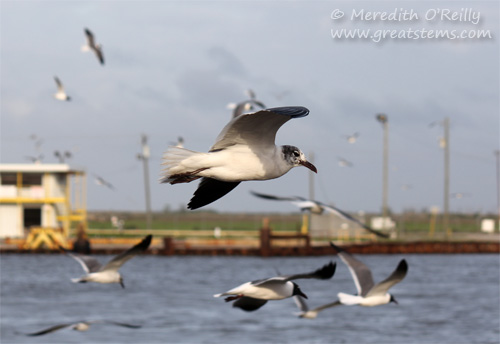
<p>
<span style="DISPLAY: inline" class="mt-enclosure mt-enclosure-image"><img style="TEXT-ALIGN: center; MARGIN: 0px auto 20px; DISPLAY: block" class="mt-image-center" alt="LAgullsc03-17-12.jpg" src="http://www.greatstems.com/LAgullsc03-17-12.jpg" width="500" height="344" /></span>On the plus side, the boys hadn't been on a ferry in a very&nbsp;long time, so far back they couldn't remember the experience, so it was nice to be able to drive our car onto a boat, then get out and walk around for a few minutes as we crossed the channel. The gulls and pelicans flying all around us made it even more exciting.</p>
<p><img style="TEXT-ALIGN: center; MARGIN: 0px auto 20px; DISPLAY: block" class="mt-image-center" alt="LAgulld03-17-12.jpg" src="http://www.greatstems.com/LAgulld03-17-12.jpg" width="384" height="500" />The gulls in particular followed the ferry en masse, hovering just off the back as the waters churned around us. Perhaps they hoped some&nbsp;people would toss them food,&nbsp;but they honestly didn't seem interested in&nbsp;the humans&nbsp;on the&nbsp;ferry&nbsp;-- maybe instead&nbsp;they were hoping to spot some fish in the waters behind the boat.</p>
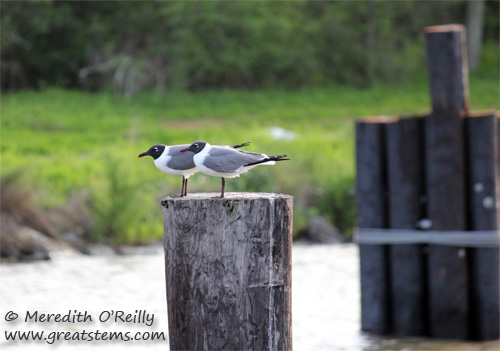
<p><img style="TEXT-ALIGN: center; MARGIN: 0px auto 20px; DISPLAY: block" class="mt-image-center" alt="LAgulls03-17-12.jpg" src="http://www.greatstems.com/LAgulls03-17-12.jpg" width="500" height="351" /><img style="TEXT-ALIGN: center; MARGIN: 0px auto 20px; DISPLAY: block" class="mt-image-center" alt="LAbeach03-17-12.jpg" src="http://www.greatstems.com/LAbeach03-17-12.jpg" width="333" height="500" />Soon after the ferry ride, we found ourselves driving along the beach. We&nbsp;pulled over to look for shells and found them we did -- many were huge! </p>
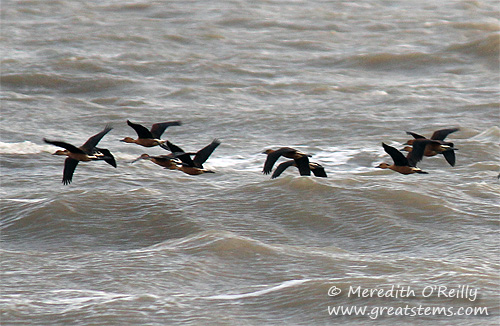
<p>
<span style="DISPLAY: inline" class="mt-enclosure mt-enclosure-image"><img style="TEXT-ALIGN: center; MARGIN: 0px auto 20px; DISPLAY: block" class="mt-image-center" alt="fulvouswhistlingducks03-17-12.jpg" src="http://www.greatstems.com/fulvouswhistlingducks03-17-12.jpg" width="500" height="326" /></span><em>Fulvous Whistling-Ducks</em></p>
<p>The Louisiana coast&nbsp;was so different from the coasts of Florida's peninsula, but it reminded me much of the familiar coasts of Texas. Clearly we were close to home!&nbsp;</p>
<p>
<span style="DISPLAY: inline" class="mt-enclosure mt-enclosure-image"><img style="TEXT-ALIGN: center; MARGIN: 0px auto 20px; DISPLAY: block" class="mt-image-center" alt="sunset03-16-12.jpg" src="http://www.greatstems.com/sunset03-16-12.jpg" width="500" height="355" /></span></p>
<p>The sun went down as we finished our drive along the Creole Trail, and thousands of Red-Winged Blackbirds silhouetted against the sun's vibrant setting colors marked the final wildlife viewing of our vacation. It was time to get home to see Texas once again.</p>
<p>Thanks for joining&nbsp;us on our journey across the southern states to Florida and back. It created many memories of a lifetime for me and my boys, and we can't wait to go back!</p>]]>
        
    </content>
</entry>

<entry>
    <title>Florida Bound: Homosassa Springs Wildlife State Park</title>
    <link rel="alternate" type="text/html" href="http://www.greatstems.com/2012/04/florida-bound-homosassa-wildlife-state-park.html" />
    <id>tag:www.greatstems.com,2012://2.483</id>

    <published>2012-04-06T14:55:26Z</published>
    <updated>2012-04-06T13:55:44Z</updated>

    <summary>On our way home to Austin from the Everglades, we decided to visit one more state park along Florida&apos;s western coast, the Homosassa Wildlife State Park. This 210-acre park is a rescue facility for many bird and animal species native...</summary>
    <author>
        <name>Meredith</name>
        
    </author>
    
        <category term="birds" scheme="http://www.sixapart.com/ns/types#category" />
    
        <category term="travel" scheme="http://www.sixapart.com/ns/types#category" />
    
    
    <content type="html" xml:lang="en-us" xml:base="http://www.greatstems.com/">
        <![CDATA[<p>On our way home to Austin from the <a href="http://www.greatstems.com/2012/04/florida-bound-visiting-the-southern-everglades.html">Everglades</a>, we decided to visit one more state park along Florida's western coast, the <a href="http://www.floridastateparks.org/homosassasprings/default.cfm">Homosassa Wildlife State Park</a>. This 210-acre park is a rescue facility for many bird and animal species native to Florida. Most of these animals cannot&nbsp;survive in the wild, but&nbsp;their home at the park is as&nbsp;close to their natural habitat as possible.&nbsp;That draws in many other animal species to take up residence, as well. The state park, with is spring-fed waters,&nbsp;is also a rehabilitation center for injured and orphaned West Indian manatees, who eventually are released back to the wild. </p>
<p>
<span style="DISPLAY: inline" class="mt-enclosure mt-enclosure-image"><img style="TEXT-ALIGN: center; MARGIN: 0px auto 20px; DISPLAY: block" class="mt-image-center" alt="grhorned03-16-12.jpg" src="http://www.greatstems.com/grhorned03-16-12.jpg" width="345" height="500" /></span></p>
<p><em>Great Horned Owl</em></p>
<p>
<p>
<p>
<p>
<span style="DISPLAY: inline" class="mt-enclosure mt-enclosure-image">Because I have a lot of photos to show, I'm going to keep text to a minimum and only show my favorite images or ones that tell a good story. You'll see mostly birds and reptiles here, mainly because the mammals, including the endangered Florida Panthers and Red Wolves,&nbsp; were too far away to allow for a good picture.</span></p>
<p></p>
<p></p>
<span style="DISPLAY: inline" class="mt-enclosure mt-enclosure-image"><em>
<p><em></span>
<span style="DISPLAY: inline" class="mt-enclosure mt-enclosure-image"><img style="TEXT-ALIGN: center; MARGIN: 0px auto 20px; DISPLAY: block" class="mt-image-center" alt="woodducks03-16-12.jpg" src="http://www.greatstems.com/woodducks03-16-12.jpg" width="500" height="344" /></span>
<span style="DISPLAY: inline" class="mt-enclosure mt-enclosure-image"></em></p>
<p><em>Wood Ducks</em><img style="TEXT-ALIGN: center; MARGIN: 0px auto 20px; DISPLAY: block" class="mt-image-center" alt="barredowl03-16-12.jpg" src="http://www.greatstems.com/barredowl03-16-12.jpg" width="370" height="500" />Barred Owl</em></span></p>
<p></p>
<p>
<p><em></em></p><em>
<span style="DISPLAY: inline" class="mt-enclosure mt-enclosure-image"><img style="TEXT-ALIGN: center; MARGIN: 0px auto 20px; DISPLAY: block" class="mt-image-center" alt="alligatorb03-16-12.jpg" src="http://www.greatstems.com/alligatorb03-16-12.jpg" width="326" height="500" /></span></em>
<p></p>
<p><em>American Alligator</em></p>
<p>
<span style="DISPLAY: inline" class="mt-enclosure mt-enclosure-image"><img style="TEXT-ALIGN: center; MARGIN: 0px auto 20px; DISPLAY: block" class="mt-image-center" alt="alligators03-16-12.jpg" src="http://www.greatstems.com/alligators03-16-12.jpg" width="333" height="500" /></span></p>
<p>
<p>
<p>
<p>
<p>
<span style="DISPLAY: inline" class="mt-enclosure mt-enclosure-image"><em>Likewise</em></span></p>
<p>
<span style="DISPLAY: inline" class="mt-enclosure mt-enclosure-image"><img style="TEXT-ALIGN: center; MARGIN: 0px auto 20px; DISPLAY: block" class="mt-image-center" alt="alligator03-16-12.jpg" src="http://www.greatstems.com/alligator03-16-12.jpg" width="500" height="333" /></span>
<span style="DISPLAY: inline" class="mt-enclosure mt-enclosure-image"><img style="TEXT-ALIGN: center; MARGIN: 0px auto 20px; DISPLAY: block" class="mt-image-center" alt="flamingod03-16-12.jpg" src="http://www.greatstems.com/flamingod03-16-12.jpg" width="346" height="500" /></span>
<span style="DISPLAY: inline" class="mt-enclosure mt-enclosure-image"><em>Flamingos</em></span></p>
<p></p>
<p></p>
<p>
<span style="DISPLAY: inline" class="mt-enclosure mt-enclosure-image"><em></em><img style="TEXT-ALIGN: center; MARGIN: 0px auto 20px; DISPLAY: block" class="mt-image-center" alt="grheron03-16-12.jpg" src="http://www.greatstems.com/grheron03-16-12.jpg" width="500" height="333" /><em>This Green Heron has a severe wing injury, and lucky for it, it has a home at the state park.</em></span></p>
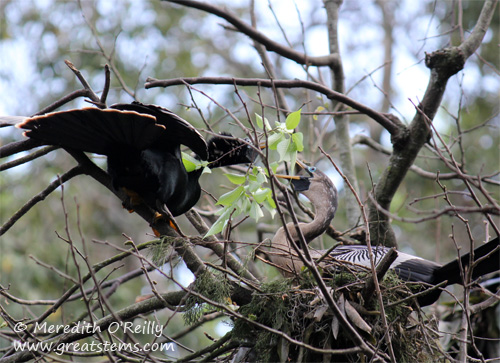
<p></p>
<p></p>
<p>
<p>
<span style="DISPLAY: inline" class="mt-enclosure mt-enclosure-image"><img style="TEXT-ALIGN: center; MARGIN: 0px auto 20px; DISPLAY: block" class="mt-image-center" alt="anhingasa03-16-12.jpg" src="http://www.greatstems.com/anhingasa03-16-12.jpg" width="500" height="363" /></span>I watched a male Anhinga work several minutes to pull a section of leaves from a tree I was standing under. Once he pulled the short branch away, he flew over to the nest where his mate rested. She dictated where she wanted him to put it, and it was clear that she wanted it "just so." My husband might recognize this scenario.</p>
<p></p>
<p>
<p>
<p>
<span style="DISPLAY: inline" class="mt-enclosure mt-enclosure-image"><img style="TEXT-ALIGN: center; MARGIN: 0px auto 20px; DISPLAY: block" class="mt-image-center" alt="anhingasb03-16-12.jpg" src="http://www.greatstems.com/anhingasb03-16-12.jpg" width="500" height="333" />Eventually he got the branch in an acceptable spot.</span></p>
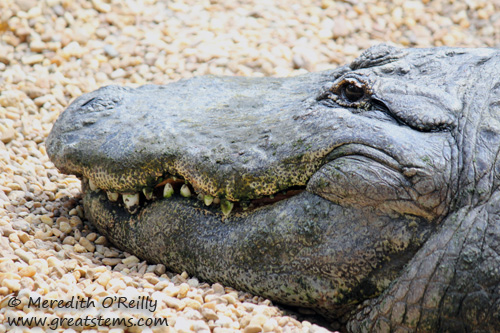
<p>
<span style="DISPLAY: inline" class="mt-enclosure mt-enclosure-image"><img style="TEXT-ALIGN: center; MARGIN: 0px auto 20px; DISPLAY: block" class="mt-image-center" alt="alligatorc03-16-12.jpg" src="http://www.greatstems.com/alligatorc03-16-12.jpg" width="500" height="333" /></span></p>
<p></p>
<p></p>
<p>
<p>
<p>
<span style="DISPLAY: inline" class="mt-enclosure mt-enclosure-image">Nolan and I sat down to sketch this beautiful alligator, sparking the interest of others who came over to watch us. The alligator seemed to appreciate our attention, and it kept moving ever closer to us. I'm sure that's the reason, right?</span></p>
<p>
<span style="DISPLAY: inline" class="mt-enclosure mt-enclosure-image"><em><img style="TEXT-ALIGN: center; MARGIN: 0px auto 20px; DISPLAY: block" class="mt-image-center" alt="alligatorfeet03-16-12.jpg" src="http://www.greatstems.com/alligatorfeet03-16-12.jpg" width="500" height="333" /></em></span><em>
<span style="DISPLAY: inline" class="mt-enclosure mt-enclosure-image"><img style="TEXT-ALIGN: center; MARGIN: 0px auto 20px; DISPLAY: block" class="mt-image-center" alt="alligatortail03-16-12.jpg" src="http://www.greatstems.com/alligatortail03-16-12.jpg" width="333" height="500" /></span>
<span style="DISPLAY: inline" class="mt-enclosure mt-enclosure-image"><img style="TEXT-ALIGN: center; MARGIN: 0px auto 20px; DISPLAY: block" class="mt-image-center" alt="amercroc03-16-12.jpg" src="http://www.greatstems.com/amercroc03-16-12.jpg" width="500" height="333" /></span>Baby American Crocodile -- note the distinguishing "zipper" teeth characteristic. American Crocodiles are endangered.</em></p>
<p></p>
<p></p>
<p>
<span style="DISPLAY: inline" class="mt-enclosure mt-enclosure-image"><img style="TEXT-ALIGN: center; MARGIN: 0px auto 20px; DISPLAY: block" class="mt-image-center" alt="babyalligator03-16-12.jpg" src="http://www.greatstems.com/babyalligator03-16-12.jpg" width="500" height="333" /></span></p>
<p><em>For juvenile comparison, a baby American Alligator (to better see the jaw difference, look to the big guys above)</em></p>
<p>
<span style="DISPLAY: inline" class="mt-enclosure mt-enclosure-image"><img style="TEXT-ALIGN: center; MARGIN: 0px auto 20px; DISPLAY: block" class="mt-image-center" alt="branole03-16-12.jpg" src="http://www.greatstems.com/branole03-16-12.jpg" width="500" height="358" /></span></p>
<p><em>Brown Anole, showing his dewlap. This is an invasive species.</em></p>
<p>
<span style="DISPLAY: inline" class="mt-enclosure mt-enclosure-image"><img style="TEXT-ALIGN: center; MARGIN: 0px auto 20px; DISPLAY: block" class="mt-image-center" alt="whiteibisb03-16-12.jpg" src="http://www.greatstems.com/whiteibisb03-16-12.jpg" width="500" height="341" /></span></p>
<p><em>White Ibises, Juvenile and Adult</em></p>
<p>
<span style="DISPLAY: inline" class="mt-enclosure mt-enclosure-image"><img style="TEXT-ALIGN: center; MARGIN: 0px auto 20px; DISPLAY: block" class="mt-image-center" alt="greategret03-16-12.jpg" src="http://www.greatstems.com/greategret03-16-12.jpg" width="333" height="500" /></span></p>
<p>
<p>
<p>
<span style="DISPLAY: inline" class="mt-enclosure mt-enclosure-image"><em>Great Egret</em></span></p>
<p></p>
<p>
<p>
<p>
<span style="DISPLAY: inline" class="mt-enclosure mt-enclosure-image"><img style="TEXT-ALIGN: center; MARGIN: 0px auto 20px; DISPLAY: block" class="mt-image-center" alt="whiteibis03-16-12.jpg" src="http://www.greatstems.com/whiteibis03-16-12.jpg" width="500" height="337" /></span>
<span style="DISPLAY: inline" class="mt-enclosure mt-enclosure-image"><em>White Ibis</em><img style="TEXT-ALIGN: center; MARGIN: 0px auto 20px; DISPLAY: block" class="mt-image-center" alt="redshhawk03-16-12.jpg" src="http://www.greatstems.com/redshhawk03-16-12.jpg" width="361" height="500" /></span>
<span style="DISPLAY: inline" class="mt-enclosure mt-enclosure-image">&nbsp;</span>
<span style="DISPLAY: inline" class="mt-enclosure mt-enclosure-image"><span style="LINE-HEIGHT: 115%; FONT-FAMILY: 'Calibri','sans-serif'; FONT-SIZE: 11pt; mso-ascii-theme-font: minor-latin; mso-fareast-font-family: Calibri; mso-fareast-theme-font: minor-latin; mso-hansi-theme-font: minor-latin; mso-bidi-font-family: 'Times New Roman'; mso-bidi-theme-font: minor-bidi; mso-ansi-language: EN-US; mso-fareast-language: EN-US; mso-bidi-language: AR-SA"><font color="#000000"><em>Red-Shouldered Hawk</em></font></span></form></p>
<p>
<p>
<p>
<span style="DISPLAY: inline" class="mt-enclosure mt-enclosure-image"><span style="LINE-HEIGHT: 115%; FONT-FAMILY: 'Calibri','sans-serif'; FONT-SIZE: 11pt; mso-ascii-theme-font: minor-latin; mso-fareast-font-family: Calibri; mso-fareast-theme-font: minor-latin; mso-hansi-theme-font: minor-latin; mso-bidi-font-family: 'Times New Roman'; mso-bidi-theme-font: minor-bidi; mso-ansi-language: EN-US; mso-fareast-language: EN-US; mso-bidi-language: AR-SA"><em><font color="#000000"></font></em></span><img style="TEXT-ALIGN: center; MARGIN: 0px auto 20px; DISPLAY: block" class="mt-image-center" alt="flamingoc03-16-12.jpg" src="http://www.greatstems.com/flamingoc03-16-12.jpg" width="343" height="500" /><em>Flamingo</em></form></p>
<p>
<span style="DISPLAY: inline" class="mt-enclosure mt-enclosure-image"><img style="TEXT-ALIGN: center; MARGIN: 0px auto 20px; DISPLAY: block" class="mt-image-center" alt="flamingob03-16-12.jpg" src="http://www.greatstems.com/flamingob03-16-12.jpg" width="500" height="333" /></span><em>Flamingos, mildly bickering</em>
<p><em><img style="TEXT-ALIGN: center; MARGIN: 0px auto 20px; DISPLAY: block" class="mt-image-center" alt="brpelicansb03-16-12.jpg" src="http://www.greatstems.com/brpelicansb03-16-12.jpg" width="335" height="500" /></em></p>
<span style="DISPLAY: inline" class="mt-enclosure mt-enclosure-image"><em>Brown Pelicans, wonderful parents to their little baby. I watched the father add sticks to the nest, and both parents shared the responsibility of feeding their baby. </em></span>
<p></p>
<p></p>
<p></p>
<p></p>
<p></p>
<p><em>
<span style="DISPLAY: inline" class="mt-enclosure mt-enclosure-image"><img style="TEXT-ALIGN: center; MARGIN: 0px auto 20px; DISPLAY: block" class="mt-image-center" alt="brpelicansc03-16-12.jpg" src="http://www.greatstems.com/brpelicansc03-16-12.jpg" width="347" height="500" /></span>
<span style="DISPLAY: inline" class="mt-enclosure mt-enclosure-image">Here is an image of the feeding process, made interesting by the very large bills of the parents.</em></span></p>
<p></p>
<p>
<p><em>
<span style="DISPLAY: inline" class="mt-enclosure mt-enclosure-image"><img style="TEXT-ALIGN: center; MARGIN: 0px auto 20px; DISPLAY: block" class="mt-image-center" alt="whoopingcrane03-16-12.jpg" src="http://www.greatstems.com/whoopingcrane03-16-12.jpg" width="351" height="500" /></span>
<span style="DISPLAY: inline" class="mt-enclosure mt-enclosure-image">Whooping Crane, Endangered</span></em></p>
<p></p>
<p>
<p>
<p><em>
<span style="DISPLAY: inline" class="mt-enclosure mt-enclosure-image"><img style="TEXT-ALIGN: center; MARGIN: 0px auto 20px; DISPLAY: block" class="mt-image-center" alt="amerpelicans03-16-12.jpg" src="http://www.greatstems.com/amerpelicans03-16-12.jpg" width="500" height="326" /></span>
<span style="DISPLAY: inline" class="mt-enclosure mt-enclosure-image">American White Pelicans, with their visible "horns." These horns will be shed after breeding season.</span></em></p>
<p>
<p>
<p><em>
<span style="DISPLAY: inline" class="mt-enclosure mt-enclosure-image"></em><img style="TEXT-ALIGN: center; MARGIN: 0px auto 20px; DISPLAY: block" class="mt-image-center" alt="rspoonbill03-16-12.jpg" src="http://www.greatstems.com/rspoonbill03-16-12.jpg" width="333" height="500" /></span>
<span style="DISPLAY: inline" class="mt-enclosure mt-enclosure-image"><em>Roseate Spoonbill</em></span></p>
<p>
<span style="DISPLAY: inline" class="mt-enclosure mt-enclosure-image"><em></em><img style="TEXT-ALIGN: center; MARGIN: 0px auto 20px; DISPLAY: block" class="mt-image-center" alt="sandhillcranes03-16-12.jpg" src="http://www.greatstems.com/sandhillcranes03-16-12.jpg" width="325" height="500" /></span>
<span style="DISPLAY: inline" class="mt-enclosure mt-enclosure-image"><em>Sandhill Cranes</em></span></p>
<p></p>
<p></p>
<p></p>
<p></p>
<p>
<p>
<p>
<p><em>
<span style="DISPLAY: inline" class="mt-enclosure mt-enclosure-image"><img style="TEXT-ALIGN: center; MARGIN: 0px auto 20px; DISPLAY: block" class="mt-image-center" alt="skink03-16-12.jpg" src="http://www.greatstems.com/skink03-16-12.jpg" width="382" height="500" /></span>
<span style="DISPLAY: inline" class="mt-enclosure mt-enclosure-image">Broad-headed Skink, perhaps?</span></em></p>
<p>
<span style="DISPLAY: inline" class="mt-enclosure mt-enclosure-image"><em><img style="TEXT-ALIGN: center; MARGIN: 0px auto 20px; DISPLAY: block" class="mt-image-center" alt="burrowingowls03-16-12.jpg" src="http://www.greatstems.com/burrowingowls03-16-12.jpg" width="333" height="500" /></em></span>
<span style="DISPLAY: inline" class="mt-enclosure mt-enclosure-image"><em>Burrowing Owls</em></span></p>
<p></p>
<p></p>
<p>
<p>
<p>
<span style="DISPLAY: inline" class="mt-enclosure mt-enclosure-image"><em></em></span>
<span style="DISPLAY: inline" class="mt-enclosure mt-enclosure-image"><img style="TEXT-ALIGN: center; MARGIN: 0px auto 20px; DISPLAY: block" class="mt-image-center" alt="amereagle03-16-12.jpg" src="http://www.greatstems.com/amereagle03-16-12.jpg" width="333" height="500" /></span>
<span style="DISPLAY: inline" class="mt-enclosure mt-enclosure-image"><em>Bald Eagle</em></span></p>
<p>
<span style="DISPLAY: inline" class="mt-enclosure mt-enclosure-image"><em></em><img style="TEXT-ALIGN: center; MARGIN: 0px auto 20px; DISPLAY: block" class="mt-image-center" alt="louhippo03-16-12.jpg" src="http://www.greatstems.com/louhippo03-16-12.jpg" width="500" height="344" /></span><em>Lu the African Hippopotamus. </em><em>Part of the previous privately-owned attraction at Homosassa Springs since 1964, Lu the hippo was given&nbsp;special Florida citizenship in order to allow him to stay at the State Park's&nbsp;native wildlife refuge. </em></p>
<p></p>
<p></p>
<p>It was time at last to officially leave Florida and travel west toward Texas. Just to offer full disclosure about our Florida trip, we did sneak in two days at Orlando -- Epcot and Universal Studios. A detour, I admit, from the wildlife we focused on the rest of the time, but we wanted to have some butterbeer at the Wizarding World of Harry Potter. Without going into details here, I'll just say that we had a glorious time, and butterbeer is yummy.</p>]]>
        
    </content>
</entry>

<entry>
    <title>Florida Bound: Southern Everglades</title>
    <link rel="alternate" type="text/html" href="http://www.greatstems.com/2012/04/florida-bound-visiting-the-southern-everglades.html" />
    <id>tag:www.greatstems.com,2012://2.480</id>

    <published>2012-04-06T00:41:15Z</published>
    <updated>2012-04-05T23:54:02Z</updated>

    <summary> One of the highlights of our Florida trip was canoeing in the Everglades at 9-Mile Pond, just a few miles north of the Flamingo Center. Arriving in the early morning, we were welcomed by an alligator drifting lazily across...</summary>
    <author>
        <name>Meredith</name>
        
    </author>
    
        <category term="travel" scheme="http://www.sixapart.com/ns/types#category" />
    
    
    <content type="html" xml:lang="en-us" xml:base="http://www.greatstems.com/">
        <![CDATA[<p>
<p>
<span style="DISPLAY: inline" class="mt-enclosure mt-enclosure-image"><img style="TEXT-ALIGN: center; MARGIN: 0px auto 20px; DISPLAY: block" class="mt-image-center" alt="alligatora03-13-12.jpg" src="http://www.greatstems.com/alligatora03-13-12.jpg" width="500" height="339" />One of the highlights of our <a href="http://www.greatstems.com/2012/03/florida-bound-the-everglades-anhinga-trail.html">Florida trip</a> was canoeing in the Everglades at 9-Mile Pond, just a few miles north of the Flamingo Center. Arriving in the early morning, we were welcomed by an alligator drifting lazily across the pond.</span></p>
<p></p>
<p>
<p>
<span style="DISPLAY: inline" class="mt-enclosure mt-enclosure-image"><img style="TEXT-ALIGN: center; MARGIN: 0px auto 20px; DISPLAY: block" class="mt-image-center" alt="blvulturesa03-13-12.jpg" src="http://www.greatstems.com/blvulturesa03-13-12.jpg" width="500" height="340" /></span>
<span style="DISPLAY: inline" class="mt-enclosure mt-enclosure-image">The alligator wasn't the only one to greet us -- several vultures awaited our arrival and that of the other folks doing the canoe trip with us. It didn't take long before the vultures began to attack and consume the rubber parts of cars foolishly left in the parking lot. This is why the vultures we saw all around the Everglades seemed to stalk us whenever we drove into a visitors area.&nbsp;Fortunately for us, we had been warned not to park in the 9-mile lot and also to make sure to cover our windshield wipers and sideview mirrors with bags to help protect them. The woman who drove the car above </span>
<span style="DISPLAY: inline" class="mt-enclosure mt-enclosure-image">&nbsp;</span>
<span style="DISPLAY: inline" class="mt-enclosure mt-enclosure-image">didn't bother to move her car, saying, "Meh, it's a rental."</span></p>
<p></p>
<p>
<p>
<span style="DISPLAY: inline" class="mt-enclosure mt-enclosure-image"><img style="TEXT-ALIGN: center; MARGIN: 0px auto 20px; DISPLAY: block" class="mt-image-center" alt="canoeingb03-13-12.jpg" src="http://www.greatstems.com/canoeingb03-13-12.jpg" width="500" height="333" /></span>
<span style="DISPLAY: inline" class="mt-enclosure mt-enclosure-image">Our Park Ranger guide, Daniel,&nbsp;was excellent -- articulate, informative, and funny.</span></p>
<p></p>
<p>
<p>
<p>
<span style="DISPLAY: inline" class="mt-enclosure mt-enclosure-image"><img style="TEXT-ALIGN: center; MARGIN: 0px auto 20px; DISPLAY: block" class="mt-image-center" alt="alligatorc03-13-12.jpg" src="http://www.greatstems.com/alligatorc03-13-12.jpg" width="500" height="331" /></span>
<span style="DISPLAY: inline" class="mt-enclosure mt-enclosure-image">The canoe trip took us across 9-Mile Pond and then&nbsp;along a winding path through&nbsp;many Red Mangrove islands. </span></p>
<p>
<span style="DISPLAY: inline" class="mt-enclosure mt-enclosure-image"><img style="TEXT-ALIGN: center; MARGIN: 0px auto 20px; DISPLAY: block" class="mt-image-center" alt="canoeing03-13-12.jpg" src="http://www.greatstems.com/canoeing03-13-12.jpg" width="333" height="500" />Sometimes we maneuvered through tunnels made from overhead arching branches, while the mangrove roots arched downward into the water. <em>In case you are wondering why my son isn't wearing a life jacket in the image above, the Park Ranger let us take them off once we were in the shallow waters of the mangroves. I opted not to "rock the boat."</em></span></p>
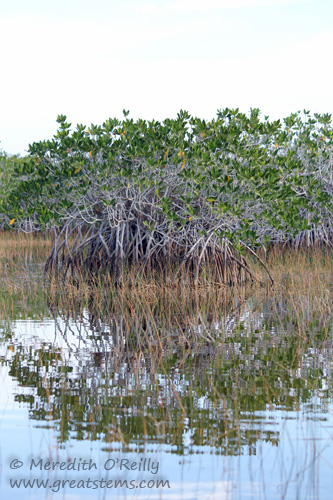
<p></p>
<p></p>
<p>
<p>
<span style="DISPLAY: inline" class="mt-enclosure mt-enclosure-image">&nbsp;</span>
<span style="DISPLAY: inline" class="mt-enclosure mt-enclosure-image"><img style="TEXT-ALIGN: center; MARGIN: 0px auto 20px; DISPLAY: block" class="mt-image-center" alt="mangroves03-13-12.jpg" src="http://www.greatstems.com/mangroves03-13-12.jpg" width="333" height="500" />Red Mangroves create a community utilized by many different plants and animal species. Additionally, they serve as protection for the delicate ecosystem, especially during hurricanes.</span></p>
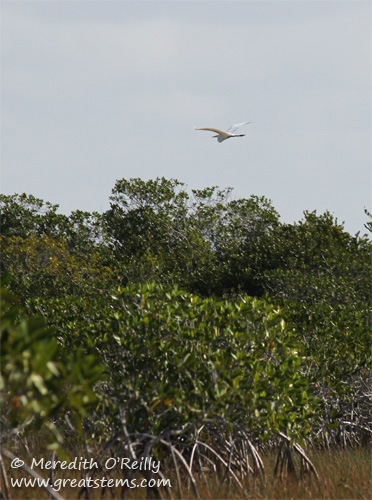
<p></p>
<p>
<span style="DISPLAY: inline" class="mt-enclosure mt-enclosure-image"><img style="TEXT-ALIGN: center; MARGIN: 0px auto 20px; DISPLAY: block" class="mt-image-center" alt="flyingegret03-13-12.jpg" src="http://www.greatstems.com/flyingegret03-13-12.jpg" width="372" height="500" />We saw the occasional alligator, and several birds took flight as we&nbsp;paddled our way around curves and corners.</span>
<span style="DISPLAY: inline" class="mt-enclosure mt-enclosure-image">&nbsp;</span>
<span style="DISPLAY: inline" class="mt-enclosure mt-enclosure-image">&nbsp;</span></p>
<p>
<p>
<span style="DISPLAY: inline" class="mt-enclosure mt-enclosure-image"><img style="TEXT-ALIGN: center; MARGIN: 0px auto 20px; DISPLAY: block" class="mt-image-center" alt="mangroveroots03-13-12.jpg" src="http://www.greatstems.com/mangroveroots03-13-12.jpg" width="333" height="500" />The upright Mangrove roots stood out of the water like stilts, supporting the tree above.</span></p>
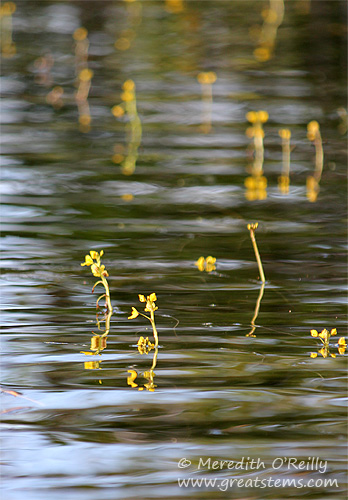
<p></p>
<p>
<p>
<span style="DISPLAY: inline" class="mt-enclosure mt-enclosure-image">&nbsp;</span>
<span style="DISPLAY: inline" class="mt-enclosure mt-enclosure-image"><img style="TEXT-ALIGN: center; MARGIN: 0px auto 20px; DISPLAY: block" class="mt-image-center" alt="ybladderwort03-13-12.jpg" src="http://www.greatstems.com/ybladderwort03-13-12.jpg" width="348" height="500" /></span>
<span style="DISPLAY: inline" class="mt-enclosure mt-enclosure-image">Bladderwort, a carnivorous plant, was plentiful in the waters below us. Bladderwort extends only its flower above water. Below the surface, bladders on the leaves trap and consume mosquito larvae and other tiny aquatic creatures.</span></p>
<p></p>
<p>
<p>
<p>
<span style="DISPLAY: inline" class="mt-enclosure mt-enclosure-image">&nbsp;</span>
<span style="DISPLAY: inline" class="mt-enclosure mt-enclosure-image"><img style="TEXT-ALIGN: center; MARGIN: 0px auto 20px; DISPLAY: block" class="mt-image-center" alt="alligatorb03-13-12.jpg" src="http://www.greatstems.com/alligatorb03-13-12.jpg" width="500" height="332" /><img style="TEXT-ALIGN: center; MARGIN: 0px auto 20px; DISPLAY: block" class="mt-image-center" alt="mangrovesb03-13-12.jpg" src="http://www.greatstems.com/mangrovesb03-13-12.jpg" width="333" height="500" />Out in an open area of Spike Rush and scattered Mangroves, our group paused to discuss the&nbsp;movement of water through the Everglades ecosystems&nbsp;and how wildlife adapts to the flow of water in wet and dry seasons. </span></p>
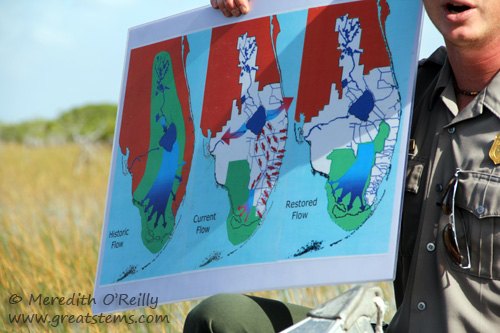
<p>
<span style="DISPLAY: inline" class="mt-enclosure mt-enclosure-image"><img style="TEXT-ALIGN: center; MARGIN: 0px auto 20px; DISPLAY: block" class="mt-image-center" alt="evergladesflow03-13-12.jpg" src="http://www.greatstems.com/evergladesflow03-13-12.jpg" width="500" height="333" /></span>Park Ranger Daniel&nbsp;also spoke to us about&nbsp;the historic flow of water that once supported the&nbsp;vast Everglades and how human development and drainage drastically altered the path of water on which the Everglades flora and fauna&nbsp;have long been dependent, leading to several species becoming endangered. Efforts are in the works to restore some of the water flow to the Everglades, but as you can imagine, it will take time.</p>
<p></p>
<p></p>
<p>
<span style="DISPLAY: inline" class="mt-enclosure mt-enclosure-image"><img style="TEXT-ALIGN: center; MARGIN: 0px auto 20px; DISPLAY: block" class="mt-image-center" alt="syrphidfly03-13-12.jpg" src="http://www.greatstems.com/syrphidfly03-13-12.jpg" width="500" height="359" /></span>While we were stopped, Syrphid flies, <em>Palpida albifrons,</em> sought resting spots on our canoes, much to the chagrin of those in our group who at first feared they were bees. Great mimics, aren't these flies? I'm astonished I managed to get a picture, given the movement of the canoe in the water and the wary reaction of the flies to my camera.</p>
<p><img style="TEXT-ALIGN: center; MARGIN: 0px auto 20px; DISPLAY: block" class="mt-image-center" alt="fish03-13-12.jpg" src="http://www.greatstems.com/fish03-13-12.jpg" width="500" height="340" />Below us, we only saw small fish, but much larger fish can be found throughout the fresh to brackish waters.</p>
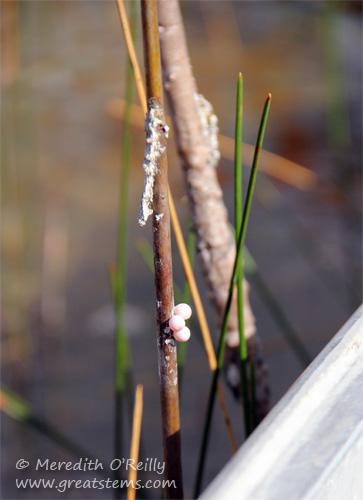
<p><img style="TEXT-ALIGN: center; MARGIN: 0px auto 20px; DISPLAY: block" class="mt-image-center" alt="applesnaileggs03-13-12.jpg" src="http://www.greatstems.com/applesnaileggs03-13-12.jpg" width="363" height="500" /></p>
<p>
<p>
<p>
<span style="DISPLAY: inline" class="mt-enclosure mt-enclosure-image"><em>Apple Snail eggs</em></span></p>
<p>
<span style="DISPLAY: inline" class="mt-enclosure mt-enclosure-image"><em></em><img style="TEXT-ALIGN: center; MARGIN: 0px auto 20px; DISPLAY: block" class="mt-image-center" alt="mangrovesc03-13-12.jpg" src="http://www.greatstems.com/mangrovesc03-13-12.jpg" width="333" height="500" /></span>One&nbsp;young Red Mangrove is all it takes to start an island, as materials collect under its roots and more Mangroves develop. Well, one young Mangrove and a lot of time!</p>
<p></p>
<p></p>
<p><img style="TEXT-ALIGN: center; MARGIN: 0px auto 20px; DISPLAY: block" class="mt-image-center" alt="thistle03-13-12.jpg" src="http://www.greatstems.com/thistle03-13-12.jpg" width="356" height="500" /><img style="TEXT-ALIGN: center; MARGIN: 0px auto 20px; DISPLAY: block" class="mt-image-center" alt="spoonbills03-13-12.jpg" src="http://www.greatstems.com/spoonbills03-13-12.jpg" width="500" height="380" />After leaving the 9-mile pond, we headed south toward Flamingo. Along the way we spotted Roseate Spoonbills and many other birds at Mrazek Pond, which as it turns out happens to be a prime birding location.</p>
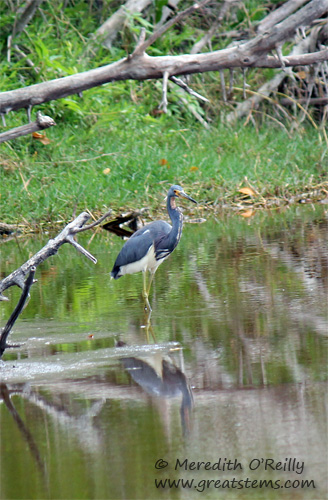
<p><img style="TEXT-ALIGN: center; MARGIN: 0px auto 20px; DISPLAY: block" class="mt-image-center" alt="triheronb03-13-12.jpg" src="http://www.greatstems.com/triheronb03-13-12.jpg" width="328" height="500" /></p>
<p><em>Tri-Colored Heron</em></p>
<p><em></em><img style="TEXT-ALIGN: center; MARGIN: 0px auto 20px; DISPLAY: block" class="mt-image-center" alt="triheron03-13-12.jpg" src="http://www.greatstems.com/triheron03-13-12.jpg" width="500" height="348" /></p>
<p>
<p>
<span style="DISPLAY: inline" class="mt-enclosure mt-enclosure-image">&nbsp;</span>
<span style="DISPLAY: inline" class="mt-enclosure mt-enclosure-image"><em>Tri-Colored Heron and, I believe, a Lesser Yellowlegs.</em></span></p>
<p></p>
<p>
<p>
<p>
<span style="DISPLAY: inline" class="mt-enclosure mt-enclosure-image"><em><img style="TEXT-ALIGN: center; MARGIN: 0px auto 20px; DISPLAY: block" class="mt-image-center" alt="bwteal03-13-12.jpg" src="http://www.greatstems.com/bwteal03-13-12.jpg" width="500" height="342" />Blue-Winged Teal, Female</em></span></p>
<p>
<p>
<p>
<span style="DISPLAY: inline" class="mt-enclosure mt-enclosure-image"><em></em><img style="TEXT-ALIGN: center; MARGIN: 0px auto 20px; DISPLAY: block" class="mt-image-center" alt="birdsatFlamingo03-13-12.jpg" src="http://www.greatstems.com/birdsatFlamingo03-13-12.jpg" width="500" height="364" /><em>View from Flamingo, Southern Everglades</em></span></p>
<p>
<span style="DISPLAY: inline" class="mt-enclosure mt-enclosure-image"><em></em><img style="TEXT-ALIGN: center; MARGIN: 0px auto 20px; DISPLAY: block" class="mt-image-center" alt="butterflies03-13-12.jpg" src="http://www.greatstems.com/butterflies03-13-12.jpg" width="500" height="352" />Down at Flamingo, we walked about the Visitor's Center, enjoying sights of birds and butterflies. Manatees were mating at the marina, as well.</span></p>
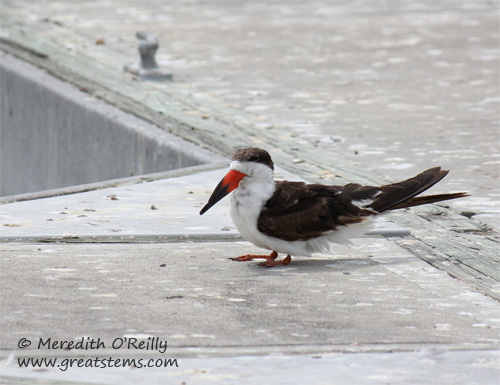
<p></p>
<p></p>
<p></p>
<p></p>
<p>
<span style="DISPLAY: inline" class="mt-enclosure mt-enclosure-image">&nbsp;</span>
<span style="DISPLAY: inline" class="mt-enclosure mt-enclosure-image"><img style="TEXT-ALIGN: center; MARGIN: 0px auto 20px; DISPLAY: block" class="mt-image-center" alt="skimmer03-13-12.jpg" src="http://www.greatstems.com/skimmer03-13-12.jpg" width="500" height="385" /></span><em>Black Skimmer</em></p>
<p><em></em>
<span style="DISPLAY: inline" class="mt-enclosure mt-enclosure-image"><img style="TEXT-ALIGN: center; MARGIN: 0px auto 20px; DISPLAY: block" class="mt-image-center" alt="blackskimmerd03-13-12.jpg" src="http://www.greatstems.com/blackskimmerd03-13-12.jpg" width="500" height="351" />I fell in love with the Black Skimmers, especially fascinated by the elongated lower mandible that allows a skimmer to, well, skim the water for its food.</span></p>
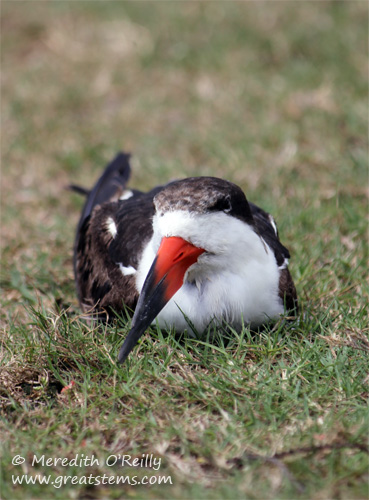
<p>
<p>
<span style="DISPLAY: inline" class="mt-enclosure mt-enclosure-image"><img style="TEXT-ALIGN: center; MARGIN: 0px auto 20px; DISPLAY: block" class="mt-image-center" alt="blackskimmerb03-13-12.jpg" src="http://www.greatstems.com/blackskimmerb03-13-12.jpg" width="369" height="500" /><img style="TEXT-ALIGN: center; MARGIN: 0px auto 20px; DISPLAY: block" class="mt-image-center" alt="gull03-13-12.jpg" src="http://www.greatstems.com/gull03-13-12.jpg" width="500" height="369" /></span>
<span style="DISPLAY: inline" class="mt-enclosure mt-enclosure-image">&nbsp;</span>
<span style="DISPLAY: inline" class="mt-enclosure mt-enclosure-image"><em>Laughing Gull, Juvenile</em></span></p>
<p></p>
<p>
<span style="DISPLAY: inline" class="mt-enclosure mt-enclosure-image">&nbsp;</span>
<span style="DISPLAY: inline" class="mt-enclosure mt-enclosure-image"><img style="TEXT-ALIGN: center; MARGIN: 0px auto 20px; DISPLAY: block" class="mt-image-center" alt="gullb03-13-12.jpg" src="http://www.greatstems.com/gullb03-13-12.jpg" width="500" height="380" /></span>Our visit to the Everglades was ever too brief. We have grand plans to go camping there for a full week sometime soon!</p>
<p><img style="TEXT-ALIGN: center; MARGIN: 0px auto 20px; DISPLAY: block" class="mt-image-center" alt="keywestpelicans03-13-12.jpg" src="http://www.greatstems.com/keywestpelicans03-13-12.jpg" width="369" height="500" /></p>
<p>
<p>
<span style="DISPLAY: inline" class="mt-enclosure mt-enclosure-image"><em>Pelicans, Key West</em></span></p>
<p>
<span style="DISPLAY: inline" class="mt-enclosure mt-enclosure-image"><em></em>&nbsp;</span>We ended the day with a drive out to Key West, which is considered the southernmost point of the contiguous United States. We had some key lime pie, as one should do while in Key West. I'm happy to report that while the pie was delicious, my boys like mine better! Just writing this, I'm craving lime -- I think I best do something about that!</p>
<p></p>
<p><img style="TEXT-ALIGN: center; MARGIN: 0px auto 20px; DISPLAY: block" class="mt-image-center" alt="keywest03-13-12.jpg" src="http://www.greatstems.com/keywest03-13-12.jpg" width="500" height="333" />From this southernmost point, we pointed our car north again. It was time to head back toward Austin, but we still had a few stops to make during our journey home....</p>]]>
        
    </content>
</entry>

<entry>
    <title>Florida Bound: The Everglades, Anhinga Trail</title>
    <link rel="alternate" type="text/html" href="http://www.greatstems.com/2012/03/florida-bound-the-everglades-anhinga-trail.html" />
    <id>tag:www.greatstems.com,2012://2.482</id>

    <published>2012-04-01T01:20:03Z</published>
    <updated>2012-04-05T23:53:03Z</updated>

    <summary> Continuing with the story about our Florida trip, Destination Everglades, we couldn&apos;t help but fall in love with the Anhinga Trail, located near the Royal Palm Visitor Center, which is a few miles from the Ernest Coe entrance to...</summary>
    <author>
        <name>Meredith</name>
        
    </author>
    
        <category term="travel" scheme="http://www.sixapart.com/ns/types#category" />
    
    
    <content type="html" xml:lang="en-us" xml:base="http://www.greatstems.com/">
        <![CDATA[<p>
<span style="DISPLAY: inline" class="mt-enclosure mt-enclosure-image"><img style="TEXT-ALIGN: center; MARGIN: 0px auto 20px; DISPLAY: block" class="mt-image-center" alt="gbheron03-12-12.jpg" src="http://www.greatstems.com/gbheron03-12-12.jpg" width="500" height="333" />Continuing with the story about our <a href="http://www.greatstems.com/2012/03/florida-bound-big-cypress-bend-boardwalk.html">Florida trip, Destination Everglades</a>, we couldn't help but fall in love with the Anhinga Trail, located near the Royal Palm Visitor Center, which is a few miles from the Ernest Coe entrance to the national park. The trail consists of a short boardwalk over a sawgrass marsh, where an abundance of alligators, turtles, snakes, and&nbsp;countless species&nbsp;of birds feed and nest.This trail is the must-see spot if you only have time for a short visit to the Everglades. I also recommend that if you can, stay until dusk. </p>
<p>
<p></span>
<span style="DISPLAY: inline" class="mt-enclosure mt-enclosure-image">Although we visited the Anhinga Trail on two different days, I'm going to combine images here.</span></p>
<p></p>
<p>
<p>
<p>
<span style="DISPLAY: inline" class="mt-enclosure mt-enclosure-image"><img style="TEXT-ALIGN: center; MARGIN: 0px auto 20px; DISPLAY: block" class="mt-image-center" alt="vultures03-12-12.jpg" src="http://www.greatstems.com/vultures03-12-12.jpg" width="362" height="500" />If the vultures that greet you as you arrive seem ominous, there's a reason for it, but it's not what you might think. I'll explain in my next post -- yes, more suspense!</span></p>
<p>
<span style="DISPLAY: inline" class="mt-enclosure mt-enclosure-image">I wasn't so clever as to get an overall shot of the boardwalk itself, as I couldn't draw my eyes away from the plentiful fauna.</span>
<span style="DISPLAY: inline" class="mt-enclosure mt-enclosure-image"></p>
<p></p>
<p></p>&nbsp;</span>
<p><em><img style="TEXT-ALIGN: center; MARGIN: 0px auto 20px; DISPLAY: block" class="mt-image-center" alt="anhingab03-13-12.jpg" src="http://www.greatstems.com/anhingab03-13-12.jpg" width="383" height="500" />Anhinga</em></p>
<p>The popular trail is named after this bird, a diving and swimming bird called the Anhinga.</p>
<p><img style="TEXT-ALIGN: center; MARGIN: 0px auto 20px; DISPLAY: block" class="mt-image-center" alt="anhingafeathers03-13-12.jpg" src="http://www.greatstems.com/anhingafeathers03-13-12.jpg" width="500" height="348" />The Anhinga typically swims with most of its body submerged and only its neck and head above water, but it can also dive under the surface to search for fish. It is unable to use oil to waterproof its feathers the way ducks do, and as a result the feathers become waterlogged when it swims. </p>
<p><img style="TEXT-ALIGN: center; MARGIN: 0px auto 20px; DISPLAY: block" class="mt-image-center" alt="anhinga03-13-12.jpg" src="http://www.greatstems.com/anhinga03-13-12.jpg" width="500" height="321" />This is why Anhingas are often seen with outstretched wings drying in the sun.</p>
<span style="DISPLAY: inline" class="mt-enclosure mt-enclosure-image">&nbsp;</span>
<p>
<span style="DISPLAY: inline" class="mt-enclosure mt-enclosure-image"><img style="TEXT-ALIGN: center; MARGIN: 0px auto 20px; DISPLAY: block" class="mt-image-center" alt="cormorant03-13-12.jpg" src="http://www.greatstems.com/cormorant03-13-12.jpg" width="500" height="333" /><em>Double-crested cormorant, above and below</em></span></p>
<p></p>
<p><img style="TEXT-ALIGN: center; MARGIN: 0px auto 20px; DISPLAY: block" class="mt-image-center" alt="cormorantb03-13-12.jpg" src="http://www.greatstems.com/cormorantb03-13-12.jpg" width="337" height="500" />Another great underwater swimmer is the Double-Crested Cormorant, shown above. I got a glimpse of one swimming below the surface, but alas, I was too mesmerized to take a picture. Like the Anhinga, the cormorant often stretches out its non-waterproof wings in order to dry them.</p>
<p>
<p>
<p>
<p>
<span style="DISPLAY: inline" class="mt-enclosure mt-enclosure-image"><img style="TEXT-ALIGN: center; MARGIN: 0px auto 20px; DISPLAY: block" class="mt-image-center" alt="greenheron03-12-12.jpg" src="http://www.greatstems.com/greenheron03-12-12.jpg" width="500" height="333" /></span>
<span style="DISPLAY: inline" class="mt-enclosure mt-enclosure-image"><em>Green Heron</em></span></p>
<p>
<span style="DISPLAY: inline" class="mt-enclosure mt-enclosure-image">I think my favorite Everglades bird, if I were forced to pick one, was the Green Heron. The muted earthy colors of this gorgeous bird really aren't well represented by the words "Green Heron." The feathers were so uniquely stunning, I didn't even realize how brightly orange the heron's legs were until I got home to the computer. But I was just as fascinated by the way it stalked its food, crouching down low to study the water for any slight movement and being ready to quickly nab its prey. </span></p>
<p></p>
<p></p>
<p></p>
<p>
<p>
<p>
<span style="DISPLAY: inline" class="mt-enclosure mt-enclosure-image"><img style="TEXT-ALIGN: center; MARGIN: 0px auto 20px; DISPLAY: block" class="mt-image-center" alt="greenheronb03-12-12.jpg" src="http://www.greatstems.com/greenheronb03-12-12.jpg" width="500" height="334" /></span>
<span style="DISPLAY: inline" class="mt-enclosure mt-enclosure-image"><img style="TEXT-ALIGN: center; MARGIN: 0px auto 20px; DISPLAY: block" class="mt-image-center" alt="gbherond03-12-12.jpg" src="http://www.greatstems.com/gbherond03-12-12.jpg" width="500" height="333" /></span>
<span style="DISPLAY: inline" class="mt-enclosure mt-enclosure-image"><em>Great Blue Heron (also seen at top of post)</em></span></p>
<p>
<span style="DISPLAY: inline" class="mt-enclosure mt-enclosure-image"><em></em><img style="TEXT-ALIGN: center; MARGIN: 0px auto 20px; DISPLAY: block" class="mt-image-center" alt="woodstork03-12-12.jpg" src="http://www.greatstems.com/woodstork03-12-12.jpg" width="500" height="343" /></span></p>
<p></p>
<p></p>
<p><em>Wood Stork (Endangered)</em></p>
<p>During our first visit to the Anhinga Trail, an endangered Wood Stork graced us with its presence. The animals along the trail are remarkably&nbsp;complacent, and the&nbsp;Wood Stork was no exception.&nbsp;Off in the distance, we could see three more in a tree.</p>
<p>
<span style="DISPLAY: inline" class="mt-enclosure mt-enclosure-image"><img style="TEXT-ALIGN: center; MARGIN: 0px auto 20px; DISPLAY: block" class="mt-image-center" alt="woodstorkb03-12-12.jpg" src="http://www.greatstems.com/woodstorkb03-12-12.jpg" width="500" height="355" /></span>I was surprised at how many people considered this bird unattractive. I found the lack of head feathers simply that which makes it unique. Baldness can be quite a sexy feature, you know. <em>(Side note: For the record, I was totally Team Picard, not Team Ryker.)</em></p>
<p>
<p>
<p>
<span style="DISPLAY: inline" class="mt-enclosure mt-enclosure-image"><img style="TEXT-ALIGN: center; MARGIN: 0px auto 20px; DISPLAY: block" class="mt-image-center" alt="alligatoraa03-12-12.jpg" src="http://www.greatstems.com/alligatoraa03-12-12.jpg" width="333" height="500" /></span>
<span style="DISPLAY: inline" class="mt-enclosure mt-enclosure-image">Of course there were plenty of American Alligators, big and small. </span></p>
<p>
<span style="DISPLAY: inline" class="mt-enclosure mt-enclosure-image"><img style="TEXT-ALIGN: center; MARGIN: 0px auto 20px; DISPLAY: block" class="mt-image-center" alt="alligatorad03-12-12.jpg" src="http://www.greatstems.com/alligatorad03-12-12.jpg" width="500" height="333" /></span>We were even witness to the stealthy attack one made on a bird that was preening in the water. Poor bird. Happy alligator.</p>
<p></p>
<p></p>
<p>
<span style="DISPLAY: inline" class="mt-enclosure mt-enclosure-image"><img style="TEXT-ALIGN: center; MARGIN: 0px auto 20px; DISPLAY: block" class="mt-image-center" alt="alligatorab03-12-12.jpg" src="http://www.greatstems.com/alligatorab03-12-12.jpg" width="500" height="332" /></span>It wasn't this large alligator, which didn't move... at... all. I suspect, given its size, that at other times it moves quite fast.</p>
<p><img style="TEXT-ALIGN: center; MARGIN: 0px auto 20px; DISPLAY: block" class="mt-image-center" alt="blvulture03-13-12.jpg" src="http://www.greatstems.com/blvulture03-13-12.jpg" width="440" height="500" /></p>
<p>
<p>
<p>
<span style="DISPLAY: inline" class="mt-enclosure mt-enclosure-image"><em>Black Vulture</em></span></p>
<p>
<span style="DISPLAY: inline" class="mt-enclosure mt-enclosure-image"><em></em><img style="TEXT-ALIGN: center; MARGIN: 0px auto 20px; DISPLAY: block" class="mt-image-center" alt="rwblackbird03-12-12.jpg" src="http://www.greatstems.com/rwblackbird03-12-12.jpg" width="500" height="359" /></span></p>
<p></p>
<p></p>
<p>
<p>
<p>
<span style="DISPLAY: inline" class="mt-enclosure mt-enclosure-image"><em>Red-Winged Blackbird</em></span></p>
<p>
<span style="DISPLAY: inline" class="mt-enclosure mt-enclosure-image"><img style="TEXT-ALIGN: center; MARGIN: 0px auto 20px; DISPLAY: block" class="mt-image-center" alt="cmoorhen03-13-12.jpg" src="http://www.greatstems.com/cmoorhen03-13-12.jpg" width="500" height="345" /></span><em>Common Moorhen</em></p>
<p></p>
<p></p>
<p>
<p>
<p>
<p>
<p>
<span style="DISPLAY: inline" class="mt-enclosure mt-enclosure-image"><img style="TEXT-ALIGN: center; MARGIN: 0px auto 20px; DISPLAY: block" class="mt-image-center" alt="palmwarbler03-13-12.jpg" src="http://www.greatstems.com/palmwarbler03-13-12.jpg" width="500" height="385" /></span>
<span style="DISPLAY: inline" class="mt-enclosure mt-enclosure-image"><em>Palm Warbler</em></span></p>
<p>
<span style="DISPLAY: inline" class="mt-enclosure mt-enclosure-image"><img style="TEXT-ALIGN: center; MARGIN: 0px auto 20px; DISPLAY: block" class="mt-image-center" alt="egret03-13-12.jpg" src="http://www.greatstems.com/egret03-13-12.jpg" width="500" height="361" /></span>
<span style="DISPLAY: inline" class="mt-enclosure mt-enclosure-image"><em>Great Egret, above and below</em></span></p>
<p></p>
<p></p>
<p>
<span style="DISPLAY: inline" class="mt-enclosure mt-enclosure-image"><em><img style="TEXT-ALIGN: center; MARGIN: 0px auto 20px; DISPLAY: block" class="mt-image-center" alt="gregret03-13-12.jpg" src="http://www.greatstems.com/gregret03-13-12.jpg" width="326" height="500" /></em></span></p>
<p></p>
<p></p>
<p>
<p>
<p>
<span style="DISPLAY: inline" class="mt-enclosure mt-enclosure-image"><img style="TEXT-ALIGN: center; MARGIN: 0px auto 20px; DISPLAY: block" class="mt-image-center" alt="littleblue03-12-12.jpg" src="http://www.greatstems.com/littleblue03-12-12.jpg" width="500" height="342" /><em>Little Blue Heron</em></span></p>
<p>
<p>
<p>
<span style="DISPLAY: inline" class="mt-enclosure mt-enclosure-image">We saw lots of other birds, including Tricolored Herons, ibises, sparrows, and several that I'm still trying to accurately identify. </span></p>
<p>
<span style="DISPLAY: inline" class="mt-enclosure mt-enclosure-image">&nbsp;</span>
<span style="DISPLAY: inline" class="mt-enclosure mt-enclosure-image"><img style="TEXT-ALIGN: center; MARGIN: 0px auto 20px; DISPLAY: block" class="mt-image-center" alt="egretibis03-12-12.jpg" src="http://www.greatstems.com/egretibis03-12-12.jpg" width="377" height="500" /></span></p>
<p></p>
<p></p>
<p></p>
<p></p>
<p>
<p>
<p>
<span style="DISPLAY: inline" class="mt-enclosure mt-enclosure-image">As the sky darken, birds came in to roost, like the White Ibis (juvenile)&nbsp;and Great Egret above. Parents settled in with their younglings in their nests, and multiple species decorated the trees like ornaments.</span></p>
<p>
<span style="DISPLAY: inline" class="mt-enclosure mt-enclosure-image">&nbsp;</span>
<span style="DISPLAY: inline" class="mt-enclosure mt-enclosure-image"><img style="TEXT-ALIGN: center; MARGIN: 0px auto 20px; DISPLAY: block" class="mt-image-center" alt="anhingac03-12-12.jpg" src="http://www.greatstems.com/anhingac03-12-12.jpg" width="333" height="500" /></span>
<span style="DISPLAY: inline" class="mt-enclosure mt-enclosure-image">&nbsp;</span></p>
<p></p>
<p></p>
<p>
<p>
<p>
<p>
<span style="DISPLAY: inline" class="mt-enclosure mt-enclosure-image"><em>Sleeping Anhinga</em></span></p>
<p>
<span style="DISPLAY: inline" class="mt-enclosure mt-enclosure-image"><em></em><img style="TEXT-ALIGN: center; MARGIN: 0px auto 20px; DISPLAY: block" class="mt-image-center" alt="alligatorac03-12-12.jpg" src="http://www.greatstems.com/alligatorac03-12-12.jpg" width="500" height="304" /></span>As it got dark, I took one final picture for the evening -- I wanted to see the eyes of an alligator on the water. I was rewarded with the reflection, as well!</p>
<p></p>
<p></p>
<p></p>
<p>Next tale to come, <a href="http://www.greatstems.com/2012/04/florida-bound-visiting-the-southern-everglades.html">our canoe trip at 9-Mile Pond</a>!</p>]]>
        
    </content>
</entry>

<entry>
    <title>Florida Bound: Big Cypress Bend Boardwalk</title>
    <link rel="alternate" type="text/html" href="http://www.greatstems.com/2012/03/florida-bound-big-cypress-bend-boardwalk.html" />
    <id>tag:www.greatstems.com,2012://2.481</id>

    <published>2012-03-25T18:58:36Z</published>
    <updated>2012-03-25T17:58:55Z</updated>

    <summary> Heading south from Turtle Beach during our Florida vacation, we were ready to see the wealth of plant and animal life that Southern Florida&apos;s ecosystems are known for. Of course, that means lots of birds and alligators and then...</summary>
    <author>
        <name>Meredith</name>
        
    </author>
    
        <category term="travel" scheme="http://www.sixapart.com/ns/types#category" />
    
    
    <content type="html" xml:lang="en-us" xml:base="http://www.greatstems.com/">
        <![CDATA[<p>
<span style="DISPLAY: inline" class="mt-enclosure mt-enclosure-image">Heading south from <a href="http://www.greatstems.com/2012/03/florida-bound-turtle-beach.html">Turtle Beach</a> during our Florida vacation, we were ready to see the wealth of plant and animal life that Southern Florida's ecosystems are known for. Of course, that means lots of birds and alligators and then some, but also turtles, lizards, air plants, insects, mangroves, mammals, and more.</span></p>
<p>
<p>
<span style="DISPLAY: inline" class="mt-enclosure mt-enclosure-image"><img style="TEXT-ALIGN: center; MARGIN: 0px auto 20px; DISPLAY: block" class="mt-image-center" alt="greategretb03-12-12.jpg" src="http://www.greatstems.com/greategretb03-12-12.jpg" width="333" height="500" />North of the Everglades is Big Cypress National Preserve, 729,000 acres that include&nbsp;a variety of habitat types --&nbsp;swamps, hardwood hammocks, pinelands, mangrove forests, prairies, and marsh. Considered a buffer between development and the fragile Everglades,&nbsp;it is also an important watershed&nbsp;for the Everglades. The preserve is filled with some of the most diverse tropical and temperate flora and fauna found anywhere in North America. Unfortunately, being a preserve doesn't fully protect it -- off-road vehicles, hunting, trapping, and&nbsp;even&nbsp;oil drilling can be found in places within the&nbsp;preserve -- but overall it is a beautiful and valuable wildlife haven that is home to countless animal species, including the endangered Florida Panther and the threatened American Black Bear.&nbsp;</span></p>
<p></p>
<p></p>
<span style="DISPLAY: inline" class="mt-enclosure mt-enclosure-image">
<p style="LINE-HEIGHT: normal; MARGIN: 0in 0in 0pt" class="MsoNormal"><span style="FONT-FAMILY: 'Arial','sans-serif'; COLOR: #333333; FONT-SIZE: 10pt; mso-fareast-font-family: 'Times New Roman'">Adjacent to Big Cypress is Fakatchee Strand State Preserve, which&nbsp;has a wonderful 0.6-mile-long boardwalk that takes you through characteristic habitat found throughout Big Cypress. It is the largest Bald Cypress/Royal Palm swamp forest in the world. The experience led to a new ongoing family joke -- the boys and I periodically declare one another a "Royal Palm in the neck."</span></p>
<p style="LINE-HEIGHT: normal; MARGIN: 0in 0in 0pt" class="MsoNormal"><span style="FONT-FAMILY: 'Arial','sans-serif'; COLOR: #333333; FONT-SIZE: 10pt; mso-fareast-font-family: 'Times New Roman'"></span>&nbsp;</p>
<p><img style="TEXT-ALIGN: center; MARGIN: 0px auto 20px; DISPLAY: block" class="mt-image-center" alt="alligatorb03-12-12.jpg" src="http://www.greatstems.com/alligatorb03-12-12.jpg" width="500" height="357" />Walking toward the boardwalk, we encountered the first of many wildlife sightings along the trail.</form>
<span style="DISPLAY: inline" class="mt-enclosure mt-enclosure-image">Here the boys stand by an "alligators are present and potentially dangerous" sign, near which sits an example subject of said sign.</span></p>
<p></p>
<p>
<p>
<p>
<span style="DISPLAY: inline" class="mt-enclosure mt-enclosure-image"><img style="TEXT-ALIGN: center; MARGIN: 0px auto 20px; DISPLAY: block" class="mt-image-center" alt="sleepingalligator03-12-12.jpg" src="http://www.greatstems.com/sleepingalligator03-12-12.jpg" width="500" height="333" />Since I was uncertain whether I'd have a chance for another great photo opportunity, I took a lot of photos of this American Alligator, especially because she was sleeping (until she was not... that story follows).</span></p>
<p>
<span style="DISPLAY: inline" class="mt-enclosure mt-enclosure-image"><img style="TEXT-ALIGN: center; MARGIN: 0px auto 20px; DISPLAY: block" class="mt-image-center" alt="alligatore03-12-12.jpg" src="http://www.greatstems.com/alligatore03-12-12.jpg" width="340" height="500" /></span></p>
<p></p>
<p></p>
<p>
<p>
<p>
<p>
<p>
<span style="DISPLAY: inline" class="mt-enclosure mt-enclosure-image"><img style="TEXT-ALIGN: center; MARGIN: 0px auto 20px; DISPLAY: block" class="mt-image-center" alt="alligatortail03-12-12.jpg" src="http://www.greatstems.com/alligatortail03-12-12.jpg" width="500" height="333" />I'm utterly fascinated by crocodilian skin (alligators are part of the Crocodilia family). Of course, these images also&nbsp;bring to mind some of the longterm Floridian residents&nbsp;I saw at the beach. Their skin, damaged from decades of spending time in the sun, had wrinkles much like those you see here on this reptile. I find reptilian skin beautiful -- wrinkled, sun-damaged&nbsp; human skin not so much.</span></p>
<p>
<span style="DISPLAY: inline" class="mt-enclosure mt-enclosure-image">&nbsp;</span>
<span style="DISPLAY: inline" class="mt-enclosure mt-enclosure-image"><img style="TEXT-ALIGN: center; MARGIN: 0px auto 20px; DISPLAY: block" class="mt-image-center" alt="alligatorside03-12-12.jpg" src="http://www.greatstems.com/alligatorside03-12-12.jpg" width="500" height="333" /></span></p>
<p></p>
<p></p>
<p></p>
<p></p>
<p>
<p>
<span style="DISPLAY: inline" class="mt-enclosure mt-enclosure-image">Don't be tricked by their short legs -- alligators are all muscle, and those short legs can provide fast bursts of speed.</span></p>
<p></p>
<p>
<p>
<span style="DISPLAY: inline" class="mt-enclosure mt-enclosure-image"><img style="TEXT-ALIGN: center; MARGIN: 0px auto 20px; DISPLAY: block" class="mt-image-center" alt="alligatorteeth03-12-12.jpg" src="http://www.greatstems.com/alligatorteeth03-12-12.jpg" width="500" height="316" />Those visible upper teeth are one way to tell an American Alligator from an American Crocodile. The latter have more of a zippered jaw look to their mouth.</span></p>
<p></p>
<p>
<span style="DISPLAY: inline" class="mt-enclosure mt-enclosure-image">Everything about a crocodilian's appearance says, "You are a fool if you mess with me." And I didn't mess with this alligator, being careful to stay many feet back and use a zoom lens. But I did crouch down to her level as I took pictures.</p>
<p>
<p>
<p></span>
<span style="DISPLAY: inline" class="mt-enclosure mt-enclosure-image"><img style="TEXT-ALIGN: center; MARGIN: 0px auto 20px; DISPLAY: block" class="mt-image-center" alt="alligatord03-12-12.jpg" src="http://www.greatstems.com/alligatord03-12-12.jpg" width="500" height="333" /></span>
<span style="DISPLAY: inline" class="mt-enclosure mt-enclosure-image"></span>
<span style="DISPLAY: inline" class="mt-enclosure mt-enclosure-image">And eventually, Mama Alligator opened her eyes and noticed me. She watched me take pictures for a while. I know that she didn't see me as a threat, but eventually she decided that she didn't like me being crouched in her low-to-the-ground visual range, no matter how far away I was.</span></p>
<p></p>
<span style="DISPLAY: inline" class="mt-enclosure mt-enclosure-image"><img style="TEXT-ALIGN: center; MARGIN: 0px auto 20px; DISPLAY: block" class="mt-image-center" alt="alligatormouth03-12-12.jpg" src="http://www.greatstems.com/alligatormouth03-12-12.jpg" width="500" height="333" /></span>
<span style="DISPLAY: inline" class="mt-enclosure mt-enclosure-image">So she decided to let that be known, opening her mouth a little and staring me down as she turned her head toward me. 
<p></p>
<p><img style="TEXT-ALIGN: center; MARGIN: 0px auto 20px; DISPLAY: block" class="mt-image-center" alt="alligatorf03-12-12.jpg" src="http://www.greatstems.com/alligatorf03-12-12.jpg" width="500" height="346" /></p>
<p>
<p>From that point on, she faced me to keep an eye on me, and the boys and I thanked her for her time and moved on down the trail.</p>
<p><img style="TEXT-ALIGN: center; MARGIN: 0px auto 20px; DISPLAY: block" class="mt-image-center" alt="alligatorbabies03-12-12.jpg" src="http://www.greatstems.com/alligatorbabies03-12-12.jpg" width="500" height="313" />A little ways away was a little 'gator pond of sorts. Across the pond were 6-month old alligators snoozing by the water's edge. There were nine in all, apparently, but I could only see seven that day -- the image shows four of them. I don't know whether the big alligator on the trail was their Mama, but I called her that. Or maybe I called him that. </p>
<p><img style="TEXT-ALIGN: center; MARGIN: 0px auto 20px; DISPLAY: block" class="mt-image-center" alt="fern03-12-12.jpg" src="http://www.greatstems.com/fern03-12-12.jpg" width="500" height="357" />The boardwalk led us along swampier portions of the trail, with beautiful and unusual plant life, lots of ferns, and even a giant Bald Eagle nest that has been in yearly use since 1991.</p>
<p></p></span>
<p>
<p>
<p>
<span style="DISPLAY: inline" class="mt-enclosure mt-enclosure-image"><img style="TEXT-ALIGN: center; MARGIN: 0px auto 20px; DISPLAY: block" class="mt-image-center" alt="buttonbush03-12-12.jpg" src="http://www.greatstems.com/buttonbush03-12-12.jpg" width="500" height="367" /></span>
<span style="DISPLAY: inline" class="mt-enclosure mt-enclosure-image"><em>Button Bush</em></span></p>
<p></p>
<p>
<p>
<span style="DISPLAY: inline" class="mt-enclosure mt-enclosure-image"><img style="TEXT-ALIGN: center; MARGIN: 0px auto 20px; DISPLAY: block" class="mt-image-center" alt="airplants03-12-12.jpg" src="http://www.greatstems.com/airplants03-12-12.jpg" width="333" height="500" /></span></p>
<p></p>
<p>
<p>
<span style="DISPLAY: inline" class="mt-enclosure mt-enclosure-image">Tree after tree along the trail had companion plants called epiphytes -- air plants. Spanish moss, ball moss, orchids, epiphytic Bromeliads&nbsp;-- these are all types of plants that grow on trees, using them for support but taking their water and nutrients from the air, falling rain, and compost on the trees. They are not directly parasitic as other plants can be.&nbsp;We did, however,&nbsp;see some trees during our trip that had Spanish Moss so plentiful that it was shading out lower branches and as a result affecting&nbsp;the overall health of the trees. </span></p>
<p></p>
<p>
<p>
<span style="DISPLAY: inline" class="mt-enclosure mt-enclosure-image"><img style="TEXT-ALIGN: center; MARGIN: 0px auto 20px; DISPLAY: block" class="mt-image-center" alt="stranglerfiga03-12-12.jpg" src="http://www.greatstems.com/stranglerfiga03-12-12.jpg" width="333" height="500" />Another type of air plant that in time can cause the decline of a host tree is the Strangler Fig, and we saw examples of it along the Big Cypress path. Though it looks at first like a vine, it is actually a tree.</span></p>
<p></p>
<p>
<span style="DISPLAY: inline" class="mt-enclosure mt-enclosure-image"><img style="TEXT-ALIGN: center; MARGIN: 0px auto 20px; DISPLAY: block" class="mt-image-center" alt="stranglerfigb03-12-12.jpg" src="http://www.greatstems.com/stranglerfigb03-12-12.jpg" width="333" height="500" /></span></p>
<p>
<p>
<span style="DISPLAY: inline" class="mt-enclosure mt-enclosure-image">The Strangler Fig begins as an epiphyte in the canopy of the host tree, such as a Bald Cypress, and over time its roots grow downward and fuse together. The fused roots can become gigantic as they encircle the host tree, causing girdling and the eventual death of the host.</span></p>
<p></p>
<p>
<p>
<span style="DISPLAY: inline" class="mt-enclosure mt-enclosure-image"><img style="TEXT-ALIGN: center; MARGIN: 0px auto 20px; DISPLAY: block" class="mt-image-center" alt="FLorchardspider03-12-12.jpg" src="http://www.greatstems.com/FLorchardspider03-12-12.jpg" width="500" height="362" /></span>
<span style="DISPLAY: inline" class="mt-enclosure mt-enclosure-image">A common sight along the plants near the boardwalk were the webs of this tiny spider and its siblings and cousins, Florida Orchard Spiders. </span></p>
<p></p>
<p>
<p>
<span style="DISPLAY: inline" class="mt-enclosure mt-enclosure-image"><img style="TEXT-ALIGN: center; MARGIN: 0px auto 20px; DISPLAY: block" class="mt-image-center" alt="greenanole03-12-12.jpg" src="http://www.greatstems.com/greenanole03-12-12.jpg" width="333" height="500" /></span>
<span style="DISPLAY: inline" class="mt-enclosure mt-enclosure-image">We felt pretty lucky to see the occasional Green Anole, a lizard native to Florida. Most of the time we saw Brown Anoles, native to Cuba and the Bahamas and considered invasive to Florida. They compete with the Green Anole for resources, and they sometimes eat the young Green Anoles, as well. A picture of Brown Anole is shown later in this post.</span></p>
<p></p>
<p>
<p>
<p>
<span style="DISPLAY: inline" class="mt-enclosure mt-enclosure-image"><img style="TEXT-ALIGN: center; MARGIN: 0px auto 20px; DISPLAY: block" class="mt-image-center" alt="greategret03-12-12.jpg" src="http://www.greatstems.com/greategret03-12-12.jpg" width="338" height="500" /></span>
<span style="DISPLAY: inline" class="mt-enclosure mt-enclosure-image">Here's another look at the beautiful Great&nbsp;Egret,&nbsp;that was shown with its reflection in the water at the top of this blog entry.</span></p>
<p>
<span style="DISPLAY: inline" class="mt-enclosure mt-enclosure-image"><img style="TEXT-ALIGN: center; MARGIN: 0px auto 20px; DISPLAY: block" class="mt-image-center" alt="whibisa03-12-12.jpg" src="http://www.greatstems.com/whibisa03-12-12.jpg" width="500" height="372" /></span>
<span style="DISPLAY: inline" class="mt-enclosure mt-enclosure-image">I know this isn't a great picture, but I love the artistic appearance of the Ibis in the background.</span></p></p></p>
<p>
<p>
<span style="DISPLAY: inline" class="mt-enclosure mt-enclosure-image"><img style="TEXT-ALIGN: center; MARGIN: 0px auto 20px; DISPLAY: block" class="mt-image-center" alt="whibisc03-12-12.jpg" src="http://www.greatstems.com/whibisc03-12-12.jpg" width="355" height="500" />Specifically the bird is an immature White Ibis -- in time almost all of its feathers will be completely white.</span></p>
<p></p>
<p>
<p>
<p>
<span style="DISPLAY: inline" class="mt-enclosure mt-enclosure-image"><img style="TEXT-ALIGN: center; MARGIN: 0px auto 20px; DISPLAY: block" class="mt-image-center" alt="whibisb03-12-12.jpg" src="http://www.greatstems.com/whibisb03-12-12.jpg" width="500" height="363" /></span>
<span style="DISPLAY: inline" class="mt-enclosure mt-enclosure-image">Its long curved bill is perfect for poking around in the soft wet earth. As you can see, earthworms are a tasty favorite, at least for the bird.<em> Side note: the boys and I bought some Bertie Bott's Every Flavor Beans (from Harry Potter) while we were in Florida. We now&nbsp;know from experience that earthworm-flavored candy is not a taste we'd like to encounter again.</em></span></p>
<p>
<span style="DISPLAY: inline" class="mt-enclosure mt-enclosure-image"><img style="TEXT-ALIGN: center; MARGIN: 0px auto 20px; DISPLAY: block" class="mt-image-center" alt="branole03-12-12.jpg" src="http://www.greatstems.com/branole03-12-12.jpg" width="500" height="343" /></span>
<span style="DISPLAY: inline" class="mt-enclosure mt-enclosure-image">As we were leaving, the boys counted as many lizards as they could find. I think they were in the thirties when they spotted this Brown Anole with its recent butterly capture. I was so happy to finally have a picture of a lizard eating an insect -- but did it have to be an invasive lizard?</span></p>
<p></p>
<p>If you are visiting Southern Florida, I highly recommend Big Cypress Bend Boardwalk. We continued our trip from there to Everglades, the next post in this series. </p>
<p>
<span style="DISPLAY: inline" class="mt-enclosure mt-enclosure-image"><img style="TEXT-ALIGN: center; MARGIN: 0px auto 20px; DISPLAY: block" class="mt-image-center" alt="turkeyvulture03-12-12.jpg" src="http://www.greatstems.com/turkeyvulture03-12-12.jpg" width="500" height="357" /></span>As we were leaving the area, we happened upon a group of turkey vultures, who started walking toward, almost stalking our car. We wondered about this and drove on to the Everglades, soon discovering that vulture encounters were about to be a rather common, bizarre experience.... </p>]]>
        
    </content>
</entry>

</feed>