Ohhhhhhhh, happy day. I’ve been waiting for two years to find Giant Swallowtail caterpillars munching on our Wafer Ash Trees (also known as Hop Trees). These trees were some of the very first plants we chose for our wildlife habitat, and I’ve been waiting and waiting for the those big, gorgeous butterflies to find them. Time and again over the past two years I searched, getting my hopes up when noting the occasional bird poop on the foliage, only to discover it was REAL bird poop. But look what I found today! Real bird poop caterpillars!
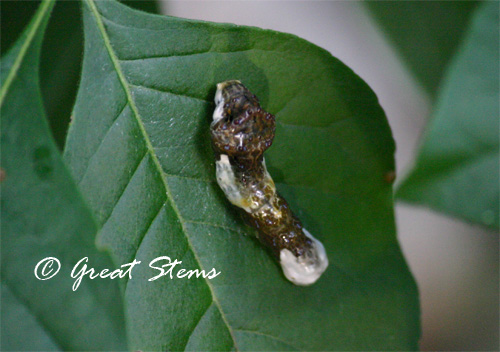
Aren’t they beautiful?!!! Yes, and gross, too. I’m completely convinced that these caterpillars have the best camouflage of any creature in the world.
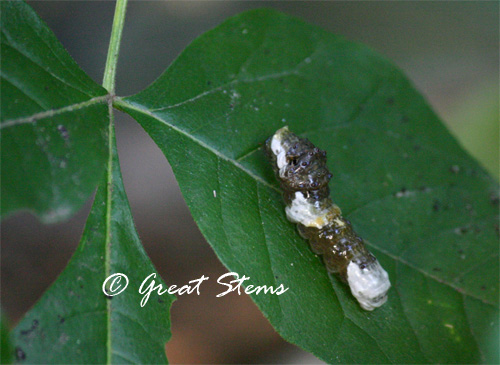
Not so much “camouflage,” though — they really are quite out in the open, saying “Here we are!” But they sure don’t look like anything I’d want to eat if I were a bird. We actually found three of them. I hope, I hope… that I’ll get to watch them through chrysalis and butterfly stage. FYI, they also like lemon trees, lime trees, and other citrus trees, so if you don’t have Wafer Ash, look for them on your citrus trees.
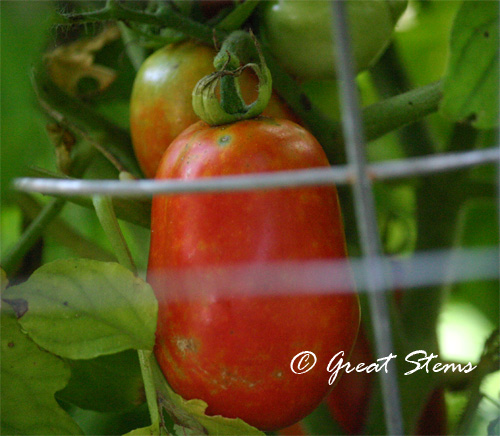
And whoa — another discovery! We have ripe Roma tomatoes! It’s official — I have bird poop AND I’m a successful tomato gardener!
 Happy, happy day.
yay for caterpillars!!! i love it!
we just started harvesting tomatoes as well…it’s been a good year so far for our plants, lots of green maters on the stalks, so even if the weather spikes i think i can call this season successful…at least compared to last where we got 2 tomatoes total..;)
Thank you so much for this post. I just saw them this morning on my orange tree and did not know what they were. I can’t wait!!!!!
Yes, they love citrus! I’ve been eagerly watching my citrus trees, too, but the Wafer Ash was the chosen plant in my yard, at least for now.
The caterpillar is amazing. You’re right: there’s nothing there that would make me smack my lips with hunger.
Meredith I’m green with envy! For the past several years a single swallowtail has graced my garden. Haven’t seen it yet this year. It is still cold outside, so maybe if we finally warm up, this is suppose to be a desert climate. Be sure to share the progress!
Joy, too funny!
Meredehuit, I hope this might be the year for you! I will do my best to report the progress. I decided to rescue the caterpillars today and house them in a shelter. Something killed one of the ones I took pictures of yesterday, and I don’t want that to happen to the other two!
LOL! Who’d have thought one could get excited about bird poop. 🙂 And it really DOES look like bird poop!
OK Ill show greater respect for bird poop in the future – didn’t know it could hide such a treasure! 🙂
I just found one on my Meyer lemon tree today. I new the moment I saw it that this was a special discovery. My oldest stepson will be excited!!!
Yay! I know you’ll enjoy watching it grow. They don’t look as much like bird boop as they get bigger, though. Pretty interesting.
I had three of these caterpillars on my citrus tree. They have left their chrysalide as butterfly and flew away about a week ago. It seems as though one has returned today! Do you know if they return to where they transformed regularly?
I just discovered these on my lemon tree. Never seen anything like them before. I thought they were dead and rotting but then watched as one was busy munching away. So glad I found this site to see what they are and am also anxious to watch the transformation process. This morning there is an itty bitty one among the large ones.
I suddenly have these and another type of caterpiller, Sphinx Moth I believe, eating my plants. So exciting.
We’re in Tucson, Arizona so guess we get them later than in other locations.
I just happened upon your sight as I was looking online as what to do with the many caterpillars on my trees. I have three lemon trees. Two trees are pretty big and are being nursed back to health. After purchasing them, I repotted them and they went through transplant shock for like a month and then started to grow. The two largest ones are about 7-8 feet tall and the smallest one is about 2 feet tall. All three have these caterpillars (which I suppose turns into big green caterpillars).
They have been munching away on all three trees. I don’t know what to do about them. Three days ago, I plucked 15 off and today I plucked off 20. This morning I saw a butterfly on one of the biggest trees. It was black and yellow. I also see black specks on the leaves.
Should I allow them to continue to munch away? Will it destroy my trees? Do I need these caterpillars for any particular reason?
By the way, I am located in the South of Yemen 😉
Thank you and kind regards
Hi, Shyla. Plants in general will always have some sort of bug that munch on their leaves, and the plants are remarkably resilient. After all, plants and the animals that depend on them have evolved side by side in time. I’ve seen caterpillars eat some perennials literally to the ground, and the plant comes right back. With trees, there are usually plenty of leaves to support both the trees and the caterpillars, so unless you are really concerned, I’d leave the caterpillars alone and give them a chance to become butterflies (and often the butterflies that munch on citrus as caterpillars are GORGEOUS). The trees will likely be ok, unless you still feel that they are in shock and need some more protection until they are stronger. Often the plant will actually respond to foliage damage by strengthening its roots and putting out denser foliage. The caterpillars might be actually good for your plant’s health.
Nature typically has its own way to keep caterpillars from being too plentiful — birds, for example, might just take care of the overpopulation, and hornets and wasps might use the caterpillars to feed their young. I’ve found that I actually have to protect certain caterpillar species in my yard and put them in a net tent with their favorite leaves just to help them get to chrysalis stage before the predators get them. This is just while my plants are more sparse — later, when the plants are bigger, the caterpillars will be less noticeable to would-be munchers. Good luck!
will somebody please post a picture of the moth/butterfly so I can quit killing these pests. They are eating my lime trees up!
David, here’s one of my posts with Giant Swallowtail pics. They are beautiful butterflies! http://www.greatstems.com/2011/05/the-littlest-giant.html
Thanks Meredith, they are beautiful. Maybe when my trees are bigger I can let them munch away, until then, what else do they eat in the Kansas City area?
David, see if you can get Wafer Ash (Hop Tree) or Prickly Ash for your area. Both are in the Citrus family, and Giant Swallowtails love them!
Precious! I have to do a paper on bird poop and boredom, because my teacher is just that strange, but I will make sure to add these beautiful creatures in my essay on how bird poop is good. 🙂
Hi, Ashley. Sounds like an odd but interesting paper! How did it turn out?
Hi! I was off on a trip and came back to find these little “bird poop” inhabitants on my young citrus. I am so glad to read that my citrus is okay, and that this little guy will become a beauty! P.S. I’m in Tucson, AZ.
Wonderful to hear, Edilia! I have several bird poop caterpillars on my Wafer Ash right now — I love watching them grow!
I noticed these bird poop droppings on my orange tree two weeks ago and tried to spray them off with the hose but they wouldn’t bugde, so I just left them alone. I really didn’t want to touch it. But just a few moments ago I was looking at the tree again trying to see if any buds or blossoms were coming (wishful thinking, on my part) and I saw the bird poops again. However, much to my surprise, there were 3 more of them in different stages, and two of them huge, and that’s when I realized they were caterpillars! Yay for this site that let me know what kind of butterfly they will turn out to be. My kids will be excited. They have been wanting to see a caterpillar in a cocoon to see process of becoming a beautiful butterfly! Thanks!!!
I hope your kids enjoy watching the caterpillars, Rosi — they continue to be my very favorite caterpillar to raise. I took some giant swallowtail caterpillars to the kids’ wildlife gardening class I taught yesterday, too — they loved it!
I found two on my orange trees! Didn’t know what they were. Thanks for all the great information.
Glad to help, Julie — enjoy your wonderful caterpillars and butterflies!
I have to disagree with the statement that caterpillars won’t cause any long term damage to a tree. We live in the southwest and have seen entire juniper/pinon forests decimated by caterpillars, all the pine needles turn brown and eventually fall off and these huge stands of dead pines are them a dangerous fire problem. If there is a large enough infestation, and a tree is already weak or young, caterpillars can and will destroy it.
There are certainly situations where something is off in the ecosystem. There might be weakness in the tree, a lack of biodiversity to naturally control insect populations, or introduced insect species that are overwhelmingly invasive — many other situations, too. But generally speaking, a healthy environment with biodiversity and plants not weakened by drought or other conditions shouldn’t experience extreme decimation by caterpillars. Caterpillars very much have their place in the ecosystem, and many, many birds and reptiles and other critters need them!
I found a lot of those bird poop caterpillars in my mini lime tree. I was surprised to find out they were caterpillars, what thought I was cleaning off my leaves was poop, actually starting to fight back…
That’s such a funny image, Charles. I hope you enjoyed the big butterflies!