Ah, Horseherb (Calyptocarpus vialis), also called Straggler Daisy. There doesn’t seem to be much of a gray area on this one. People either truly love this little groundcover or hate it with a passion. I’m of the former variety. I adore this little plant.
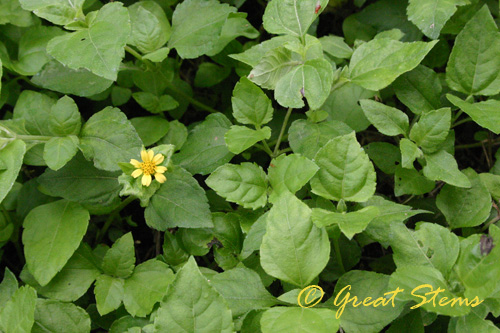 Why do I love it? If you’ve ever walked past a field of horseherb, you are presented with an incredibly lush sea of green, with the daintiest of little yellow flowers throughout to catch your eye. I’ve seen some gorgeous fields, and each time I was mesmerized by the beauty and serenity of the scene.
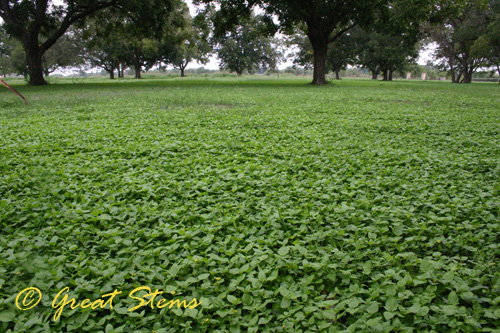
Field of horseherb at Hornsby Bend
I almost don’t want to walk on it — it’s so pretty in appearance — but for a non-lawn groundcover, it can withstand some foot traffic. It only needs water in the worst of droughts, and it loves shade and sun.
Horseherb is also native to the southern U.S. on into Central America, and it makes a great alternative to the exotic and water-hogging Bermuda and St. Augustine grasses. I’d love to see it replace Asian jasmine, as well — now THAT is a plant that will take over a garden bed and yard. Horseherb is considered semi-evergreen, blooming most of the year except in cold winter areas, and if you like you can mow it, or you can let it grow to its typical max height, which is about 8 inches. But as bonus, horseherb also attracts small butterflies, including sulfurs and skippers. And think of all the happy little lizards that will zip underneath the foliage!
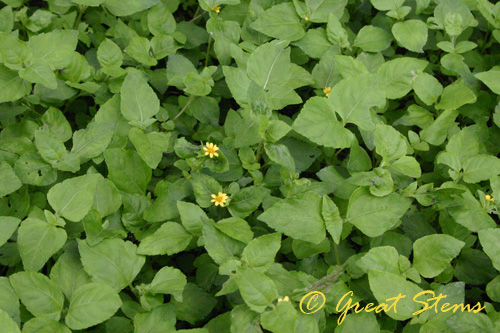
It’s an eco-friendly solution to having a lawn without having to resort to heavy chemicals or fertilizers or ridiculous amounts of water to sustain it. Lawn irrigation tops the list on where our municipal water goes, and the time for water conservation is now, especially in Texas.
Why do some people want to leave it? Well, in some yards it can be a big nuisance. For those who keep a grass lawn, horseherb is a competitor, and it can be difficult to get rid of. And it can spread into garden beds, though I’ve found that so far it doesn’t bother much with my well-mulched beds. In fact, one of the characteristics of this plant is that it supposedly doesn’t do well in areas that have heavy leaves that take a long time to decompose. It spreads by both seeds and runners, which means that if the goal is to remove all of it, you’re going to have a challenge. In a wildflower field, I have to imagine that it would be another competitor, but it’s going to depend on the goals you have for your yard or area.
But for now I prefer to embrace its desire to spread. What I loathe is the Bermuda Grass and St. Augustine in my yard. I loathe the unnamed weeds that dominate my backyard. I love my buffalograss in the back, but it too is losing to the weeds, and in the drought, the buffalograss was dead most of the time, so I didn’t end up loving it as much as I wanted to – I loved it when I could see it.
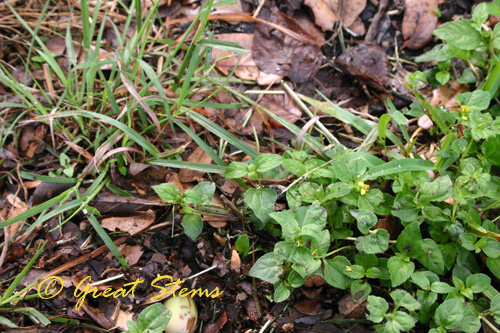
What would you choose: spotty grass or spreading horseherb?
Will I regret it? Some gardeners are going to shout out an absolute yes to that question. But I do regret having Bermuda and St. Augustine (not that I planted it; that was the previous owners), so it’s not a big deal to switch from frustration with the grasses to frustration with another groundcover, unless I’ve got all three to deal with at the same time. At least horseherb is native. But I’m going for the complete wildscape, and I have a lot of ground to fill and a lot of grass to get rid of. In those bed areas I want to keep maintained, I’ll do my best to keep horseherb in check. And love it everywhere else!
So how about you? Do you prefer to love it or leave it?
Interesting. Didn’t know of this plant before. Thanks for posting!!
Wow that field horseherb is stunning! I don’t think we have that up here in New England. Great pics! -Jackie
Send some down here!
I love it! It took us 7+ years, but we no longer have any grass lawn and do not own a lawnmower. Horseherb is our primary groundcover in our xeriscaped front yard garden and also in back surrounding the veggie raised beds. In the full-sun front yard, it got crispy and brown this summer but is coming back like crazy now. The few times it’s encroached on a flower bed, it was easy to yank out and keep away with mulch. Your post says it all.
Reading about your positive experience with horse herb is a delight! I love it, too, and hope to encourage a friend in San Antonio to stop pulling it out! Sharing your story! Thanks.
I can imagine how pretty a field of this might be, especially with the butterflies. Wouldn’t be hardy up here, I bet. Thanks for introducing me to something new.
wow its looking terrific in mass planting. never heard of this plant though. i would love to grow it.
Since I am not that familiar with it, I can’t give you a great opinion, but I would rather have that lovely ground cover than scraggly grass, which is what I have.
Rosey
I regret my kikuyu grass, long runners. NOT planted but bobs up wherever gardeners have/had lawns, even just nearby! Sulks in a cherished lawn, and flourishes here where it is disinvited.
Sounds like a good lawn substitute to me. I’d love seeing those yellow flowers
I reluctantly admit that I’m not really a fan, but I can certainly see why you would prefer it to a Bermuda/St. Augustine mix or other more-thirsty groundcovers. Hmm, maybe your picture of the horseherb field at Hornsby Bend will change my mind.
THAT is what that’s called!! we have some on our side yard and I LOVE It. I tried to dig some up and transplant it to the mud pit out back, but it died instantly. where can you buy this?
Hi Meredith, I am with you on this one hundred percent. We had St. Augustine in Houston, and I despised everything about it. If this plant can take some foot traffic, why not have it as an alternative to the water thirsty grass lawns? The wildlife aspect sounds perfect and being a native another plus. I have never heard of it or seen it, might not be growing here in TN, but getting rid of lawns and their water needs seems to make sense.
Frances
Pam, I honestly don’t know how I would feel if I had a different kind of yard plan in mind. But my first glimpse at a field of horseherb was in the Wells Branch area, walking along the trails (I’m not sure Wells Branch planted it, mind you, given that their creek area is overrun with Chinaberry trees and poison ivy; I suspect that the horseherb just made a home there). I can honestly say it was breathtaking. And the field at Hornsby Bend was that times 30 in size. So pretty. So I’m a fan.
Diane, I know they sell it at Natural Gardener, but it’s pretty easy to increase the numbers using what you have, too (from what I’ve read). I’ve never bought any — I’m just encouraging what I can to spread.
Wow, the field of the horseherb looks fabulous! I’m not sure which I would prefer. I guess it would depend on the effect I’m trying to create. I’d like to see yours in a couple of years. Keep us posted.
I’ve never seen this plant before — I think I’d love it and leave it. Those are the dearest little flowers…so dainty. I can’t imagine walking on it…maybe it’s the lizard (or snake) thing. 🙂
I agree with you that it is very pretty. I don’t think it grows here in New York though. At least I don’t remember hearing the name. That was a very interesting post. Thanks.
Love it, in your yard. If it would grow here I’d give it a chance in our more weed (wife)/wildflower (me) than grass lawn.
Lovely – but can see why it could be a problem. I don’t think we have it in Europe (???)
Came in to say thank you for the congrats. Must admit to not having followed your blog regularly – but really like it and will be back.
Sue
I like it a lot and have it growing in various spots in my yard. It has completely filled in a lightly shaded area (8 x 15 ft) between my house and an adjacent brick pathway. I never installed a lawn at my house, so it doesn’t matter to me where it grows.
I’d love to have that for a lawn of green with bonus flowers. Will have to see if it’s hardy in the NW!
Excellent photos Meredith. I agree completely on the St. Augustine issue. The less the better and if I could (without being in trouble with our Homeowner Association) I would remove it completely.
I also live in Austin, and I have this growing naturally in my yard, too. Probably about 70% of the back yard is covered in it. It looks very verdant and covers up the brown spots well… sometimes a little too well, as you can’t always see what you’re stepping on. That same foliage that gives the little ground lizards cover can also hide dog turds and rocks, so watch where you step, especially if it has grown tall. I do like the little 1/8″ yellow flowers all over the place. Nice pics!
Help…after reading all the previous postings…and viewing the pics, I wonder if what I have is horseherb…the stems have a purplish color to them and the leaves look a little more elongated…I do remember seeing the tiny yellow flowers. So my question is what could this hearty little ground cover be?…Are there different varieties of this plant?
By the way, it loves my flower bed…and I am not enjoying it. I am afraid to leave it and let it grow because I do not want it in my grass…although, after all this time I have not noticed it on the other side of my sidewalk…any suggesstions? I might add, because we live in a rural area where copperhead snakes are a problem…we cannot walk in any ground cover where you cannot see where you are stepping. Thanking you in advance for any help you could give.
Renee
Renee, if you could send me a picture, I’d do my best to help you identify it. I don’t know about other varieties, but those little yellow flowers are probably your key to identifying whether it’s actually horseherb. I understand your concern about snakes — horseherb definitely grows tall enough to give them cover, but I’ve found that snakes will be anywhere they choose to be, and its always a surprise. E-mail me at meredith @ greatstems . com
I just had to thank you again for your help! You are absolutely correct, it is purslane. Oh my goodness, I had no idea this little weed is edible, is full of omega 3, benefits the soil, the list goes on…Thank you again for your help! I am most happy!
Renee
I’ve read that purslane is edible, but I haven’t tried it yet. It will definitely spread, though, but maybe you can eat all the baby sprouts, hehe. Just make sure you haven’t been using any herbicides in the area.
Diane, I have transplanted clumps of horseherb successfully here in the Texas Hill Country. I did so at the beginning of this past summer, with record-breaking high temps and drought. The secret is to keep watering it until the roots get established, even though the transplant looks wilted immediately and appears dead soon after. IT IS NOT DEAD!
It is merely ‘playin’ possum’. 🙂 Once the roots are established it will come back bigger and better than ever. I love horseherb!
sandy
You may love it but your neighbors may not. I live next door to someone that loves horseherb. I struggle to keep it out of my flower beds – even on the opposite side of the house – even my neighbors on the other side are having problems with it as are the people down our alley. I paid to have a below ground concrete barrier installed. That has helped prevent the crawl in the yard but it still gets in my flower beds and it is really really difficult to kill.
I can understand that. Horseherb can spread to areas where some don’t want it, but so can any other number of weeds. But don’t necessarily blame your neighbor — horseherb can be found everywhere. I never planted horseherb, but between it and Bermuda Grass, I can’t help but choose it over the other, my nemesis.
Where can I get seed for Horseherb?? Thanks.
There’s a nursery in Belton, Texas, that sells horseherb seeds: Sweet Briar Nursery & Gardens. But ask around — if it grows locally, you might be able to find someone willing to give you a few from their yard.
I’ve been seeing this pretty little groundcover every since we came to Belton 9 years ago, and I’m finally going to try transplanting some into my yard, after spending too much money and time planting and watering shade-tolerant St. Augustine which still won’t grow. Unfortunately, Sweet Briar Nursery went out of business several years ago, but if you don’t mind foraging I think you could find horseherb in almost any shady vacant lot or roadside around Central Texas.
My only problem getting it to grow may be the armadillos that root around in my yard almost every night. I tried putting out a live trap in hopes of relocating the main offender, but caught a skunk instead. Not going to try that again! Any suggestions, either about the armadillos or the transplanting?
Can you purchase Horseherb anywhere? We are in desperate need of a low maintenance ground cover in Hockley, TX and this sounds perfect. I’d love to get some seed or plants for my property.
Hi, Ashlyn. Your best bet is to start with your local nurseries or to check with neighbors who might have it growing naturally on their property — it’s easy to transplant. I know that at least 2 of our Austin nurseries carry it from time to time. I haven’t seen it as seed, but you might get lucky with an Internet search. Some people who have traditional American lawns consider horseherb a weed, but it can make a gorgeous native groundcover for those who let it grow.
Thank you for the photos of the beautiful fields of horseherb. I’ve had this in a portion of my back yard for years, but thought it was a weed. This season it is in one of the flower beds and I like it. I have a beautiful grove of live oaks in my front yard and for years had wide-leaf ivoy as ground cover beneath them. Awesome sight. But two years ago the deer came and had a feast, nibbling it clear to the ground. This area is encircled with Austin limestone. I am going to attempt to transplant the horseherb into this bed. Do you know if deer will leave it alone?
Hi, Alice. I believe horseherb is considered somewhat deer resistant — I can’t vouch for what they’d do during hard times, though. But because it reseeds easily, I’m certain it would grow back just fine. That’s why people with grass lawns don’t care for horseherb — me, I’m wishing my grass would die and let the horseherb grow instead! But mine’s finally starting to spread.My neighbor’s ivy got eaten by deer, too — I think he finally gave up. My other neighbor, on the other hand, has lots of horseherb, and it looks lovely.
I had a beautiful yard of horseherb but 2 years of drought and forbidden watering almost killed it and some kind of wild grass has taken over in parts. how do I get my horseherb back?
Hi, Kathy — I think horseherb will be happy to come back once the conditions are right. If you’ve still got some in patches, it will do its thing once rain arrives again. Perhaps in the fall you can transplant a few horseherb plants to the areas where it died away. Whether it can compete with the grasses you have, I can’t tell you, though — you might need to “weed the grasses to put in the (so-called) weeds”! My horseherb is hanging in there despite the drought, but it will look much better if we ever get any rain.
Wow! This is awesome!! I’m in Denton, TX and I have several spots where nothing will grow and now the dirt is dry and beat down to something that resembles concrete! I noticed this stuff growing on campus at Texas Woman’s University. They mow it here and the stuff pops right back within a day, complete with the little yellow flowers. I have a horrible yard with nothing but grass burrs and milkweeds. Any tips for getting rid of the weeds and getting this stuff to take off? Can I just gently pull some up at TWU and transplant it in my yard? Can you plant other stuff, like bulbs, in a field of horse herb?
Gigi, assuming TWU doesn’t mind if you take some from their grounds, it’s pretty easy to transplant. It will look best if it gets water from time to time, so don’t expect it to look great during the summer if you don’t get a little rain or water a bit. So I’d start small while we’re in a drought, though you might be getting more rain up there now than we are.
If you truly have Milkweed, that’s a valuable and critical plant for Monarch and Queen butterflies — I’d hate to see you get rid of it! As for the grass, your best bet is to dig it out or try some method of sheet mulching or solarization. One area at a time will keep things manageable.
Gigi, assuming TWU doesn’t mind if you take some from their grounds, it’s pretty easy to transplant. It will look best if it gets water from time to time, so don’t expect it to look great during the summer if you don’t get a little rain or water a bit. So I’d start small while we’re in a drought, though you might be getting more rain up there now than we are.
If you truly have Milkweed, that’s a valuable and critical plant for Monarch and Queen butterflies — I’d hate to see you get rid of it! As for the grass, your best bet is to dig it out or try some method of sheet mulching or solarization. One area at a time will keep things manageable.
Do you think horse herb would do well in flowerbeds under my live oaks? I’m worried that it may be too invasive and would harm the trees, but can’t figure out anything else that’s shade tolerant…
Live in Austin and Heatwave of 2011, I let the St Augustine grass dry and die out. As the runners began to dry out, little sprouts of what I thought was a weed took its place…but I just discovered that the “weed” is actually horse herb. I decided to let it take over the lawn and it is now growing all over the place – with almost NO watering. What a nice surprise, plus I love the little yellow flowers that appeared after a brief rain shower. Also easy to control from beds with a trimmer or pull our directly. Count me in as a convert and fan of horse herb. go native!
Yay — horseherb would be my preference, too. Thanks for letting me know, Paul. As I always say, once you see a beautiful field of horseherb, you realize this is no “weed” but a worthy garden choice. Congrats!
A poem my Grandmother embroidered on a picture . .
“Once upon a golden hour,
I cast to earth a seed.
Up there came a flower . .
the people said “a weed”.
– Flavia
Humble yet strong. Hated yet, enduring. Soft on the feet of little children, yet hardy enough to withstand the misery of drought. Requiring nothing but your desire to have it in your life, to grow. All encompassing and beautiful, once embraced.
Why, horseherb represents the very nature of Goodness itself.
A perfect, poetic description of horseherb — thank you for sharing!
Just wondering how horseherb compares to wedelia. I love horseherb, but I’m a bit leery about recommending it to clients. I’d appreciate your thoughts on how the two compare. Thanks!
Hi, Marlene. I apologize for the delay in responding — I was on vacation with the kiddoes. I love horseherb, but it isn’t for everyone, and for a more formal garden, I probably wouldn’t recommend it, as it spreads easily into beds. But as a lawn alternative, I do like it, particularly if you have enough moisture to keep it consistently visible. As for Wedelia, I grow mainly Zexmenia, which is considered a small shrub. It’s a favorite of mine, but I don’t grow it as a groundcover but rather a blooming feature in my garden. I hope that helps!
Here’s a “weed” story: in Austin it’s called dollarweed and people want it gone. In Southern California it’s called Dichondra and people spend their Saturdays manicuring it.
Yea horseherb!
I think we’re talking about two different plants, but the scenario sounds similar. However, horseherb (Calyptocarpus vialis) is native here in Texas, as is some Dichondra. But I don’t know that there’s a CA native Dichondra, is there? In that case, I’d probably call it a weed, too, if it were spreading like crazy and didn’t belong there! Thanks for the tidbit of info — I hadn’t heard that before!
This plant is adorable and sounds perfect for my needs in the Bay Area (California) BUT I can’t find it for sale anywhere, at local nurseries or online. Do you have any idea where I can get it online so I can try it out? No websites talk about it growing anywhere but in the southwest but my conditions are so close (identical?), even a little less harsh in the summer heat-wise. Invasive plants are my favorite because it’s so hard for me to kill them!
Hi, Leigh. I wouldn’t grow it in California. It doesn’t look like it is native to CA, which means that it could become an out-of-control non-native weed in your area or eventually even across the state — I’m sure you wouldn’t want that kind of result!
Thanks so much for your thoughts. I just saw them while doing the same search as I was in 2012 apparently!
Pingback: What is this plant taking over my yard? - City-Data Forum
I love it!! It creates a beautiful lush green lawn and is very soft to walk on barefoot. Give it a bit of water where it gets full sun in summer and it will be fine even up next to concrete. It will grow right out over the sidewalk giving a soft natural look rather than the usual harsh straight line edge most people give their lawns. I have never fertilized it and yet its a wonderful green color. It pulls up easily if it comes up where not wanted and will grow in between stepping stones.
It’s definitely under-appreciated, Deanna. That’s not to say it’s perfect for every landscape, but it’s much preferred over Bermuda grass, in my opinion!
So glad to find out what this is! I have it all over in my backyard. My various grasses are dying from the drought, but this is thriving. I was hoping it wasn’t a noxious weed. 🙂
Horseherb often does thrive, which is one reason some people actually don’t like it, can you believe it? I’m excited to see it spreading nicely in the areas of my backyard that I wanted it to. At some point, I might have to strong-arm it if it gets too pushy with certain plants I’m also trying to grow, but we’ll see what gets established first in those areas.
I want to plant Horseherb in my back yard since nothing grows there except the oak trees but I have a concern. This concern is that my neighbors may not appreciate it spreading to their lawns. Is there a good solution for this?
I’m not sure what to tell you, Patty — I think it depends on the neighborhood you live in. We are in older neighborhood with no HOA, and I’m sure the entire neighborhood with the exception of one house has horseherb. I think communication is the best thing — maybe your neighbors will be interested in it for their yard, too. It isn’t for everybody, though, and that’s just how it is. It can be hard to break away from the mindset of “pristine lawn.” Perhaps if you had a controlled patch and kept everything else looking nice, it might appeal to others.
I noticed today (hence my goolge search which led me here) that a customer of mines yard has bermuda grass doin its agressive thing. But you wont see it growing in the horse herb that she has, and they border each other. And now that i had thought about it, i dont recall ever seeing bermuda grass in thick horse herb. Maybe some horse herb in bermudagrass but….n e ways…so i think there is hope for my clents that suffer from bermuda grass in ther beds. Anybody know anything about that? Different microbes support different things. Is it partially a microbial thing?
I’ve noticed the same thing, Jubal. Where horseherb exists in my yard, the Bermuda grass no longer dominates — in fact it’s not visible at all. Of course, I know there are still plenty of Bermuda seeds biding their time in the soil. I think this would be a fascinating scientific study!
Thank you for this nice breakdown – you’ve almost convinced me (in Austin as well) to replace my St. Augustine with horseherb. It’s a little offputting since I’ve typically sworn at it (in particular, its stolons, its buried nodules, and its three-inch roots), but if you can’t beat ’em… 😉
Do you know how deep the stolons will run? If I switch over, I’d like to place a barrier around my property to protect my neighbors,and if I can do it with cheap and low-profile plastic pound-in sections, rather than concrete, that’d be a great selling point. Not to mention that I have a decomposed-granite walkway that I’d also like to protect – though I’m sure seeds will still be an issue.
Alas, I don’t know how deep they go. I’m pretty relaxed about it right now — I’m just happy to be almost rid of the St. Augustine. But I do keep my eye on it — I don’t want it to overrun the garden plants.
Do you think this will grow in full sun in East Texas? We have a fairly steep slope that is difficult (impossible) to mow or weed eat. This sounds like a great solution.
Hi, Nancy. In my experience, Horseherb/Straggler’s Daisy tends to like a little shade, but if you get enough rain in East Texas it will probably do okay. We don’t water here, so ours thrives best with a little more protection from the crazy Texas sun.
What can I say .
I have grown to love this plant. we got this big yard that my wife was wanting to spend lots of $ on planting grass. Well tomake a long story short …this plant has invaded my yard and it looks absolutely beautiful!
We don’t water it what do ever ! What a gift from God.
It does spread easily, but it’s telling us something, too — that we don’t need turf grass when horseherb is free, willing to grow, and doesn’t take much attention from us. Plus, it is a pollen source for little native bees and a caterpillar host plant for Bordered Patch butterflies. Many reasons to give it a chance.
what’s that about caterpillars? I’m terrified of them. My barren new backyard has grown some horse herb with recent rain. I’d like to encourage it as I do not want grass & will be filling the barrenness with tree & shrubs. Like this in between all. But caterpillars????
I rarely see caterpillars on them, honestly. I think the Bordered Patch butterflies prefer to lay eggs on sunflowers, with horseherb — at least in my garden, that’s how it is. Don’t be terrified of caterpillars — they become butterflies and moths, flying wonders that are important pollinators and food sources for other animals! Actually, the caterpillars themselves are important food sources, especially for birds.
I have only horse herb in my backyard it has been here for many years and is nearly 2 feet thick in some areas it seeds are everywhere. I am in the process of taking it out because as it matures it can become an extreme irritant to short hair dogs. Two of my dogs have to be medicated due to the horse herb. It has taken over my property due to irrigation. I live in arizona please be aware horse herb can be an irritant to some dogs
Very interesting, Jason — I’ve never heard of it being an occasional irritant. But because we don’t water, our horseherb never reaches that height, and we’d probably give it a haircut before it grew that tall, if it tried. Our dogs haven’t had any reaction, and I walk barefoot through mine a lot. But it’s good to know of the possibility –thanks for sharing.
Mine is only an inch or two. Like to keep it that way!. Less water keeps it low? ( I sold my lawn mower when. I moved to tx & don’t want any thing to now). So the only way to get it to spread is to dig/pull all the other weeds out by hand?
It’s pretty hardy, Karen. Give it time and it will spread on its own, but you’ll need to let it get big enough to reseed or to get new roots going from runners.
I love your article and I too am in the process of converting my horrific 20 year old balding lawn into a Horse Herb delight. So far I have had no complaints from the HOA or the neighbors, but who knows. I mow mine just to give it a more manicured look. I can’t wait for it too finish taking over. Yes, it is invasive, but no more so then anything else and at least it is pretty. Great article… thanks for posting.
Isn’t it nice that it tolerates mowing, Dee? So easy.
The other nice thing about horse herb is that it doesn’t compete with the trees for water the way non-native grasses do so you don’t have to mulch around your trees and everybody stays happy. We chose to let this lovely native take control of our yard so that we don’t have to worry about watering or mowing. We do mow it in spring or if we’re having a vigorous growing summer (not often in Austin) and otherwise we let it go and it keeps our topsoil from eroding. That is an extra bonus as we are on a sloped property with retaining walls and have watched our neighbors yard sink 1 1/2″ below ours and lose all topsoil. Ours stays in place with the horse herb and looks beautiful and lush.
Jen, you are so right. It places nicely with the trees, unlike many grasses.
Wow! Who knew this sweet plant had a fan club!! I have been encouraging it for the past 5 years. It is really working out well: spreading and looking lush despite the drought. It makes a wonderful desk top or screen saver!
It really is a “love it or leave it” relationship for many folks, Ros. I’m now letting it spread in the shadier areas of our backyard, but I’m starting to remove it from the front yard as we get closer to shaping our front garden the way we want it. For a while, it was key to us controlling the St. Augustine in the front, but now we’re planning our pathways and I’ve got a wonderful Cedar sedge spread going, along with the perennial and annual beds. In the back, it is soooo much better than Bermuda. I’m hoping that in the spring I’ll finally be able to get the rest of the Bermuda out. Woohoo!
Where do you get it?
Some of our local nurseries carry it from time to time, but often there are people willing to just give it away — it’s still considered a weed by many folks.
How far north–hardiness zone?–will horseherb survive? I’m in southern Kansas. Thanks.
Hello Meredith…I just planted 6 plants…3 in the front and 3 in the back. I was doing it on a trial basis. I think it will be the perfect fit for me. I was thinking about doing the decomposed granite with stepping stones and rocks. I still may do some of that but the horse herb sounds like a more economical approach. How did yours do during this harsh winter we had this pas winter? Thanks!
Horseherb has always been willing to come back for me. It wants to grow, believe me. 🙂
Does anyone know anywhere to buy this at any retailer in the North Texas area? Does anyone sell it anywhere?
If you don’t find a retailer, try looking around in friends’ yards. They might be willing to share, especially since so many people consider it a weed.
My front yard in completely dead because I have a huge oak trees that covers the yard in almost complete shade. I would love to have a pretty green ground cover that did not require huge amounts of water, but I fear that if I planted this, it would spread to my neighbors yards. I live on a small maybe 1/4 acre lot, so my neighbors are right next door. Anyway to keep that from happening?
I do think it would try to spread. Perhaps a barrier of low perennials or a rock wall of sorts?
I’m in Austin, too. Our yard has been taken over by this naturally. At first, I was concerned, but then noticed that it was quite attractive. We mow it down because it’s mixed in with various wild grasses. The mowed horseherb and grass makes for a pretty nice turf. I don’t think I’ve watered it in over a year. It also grows between our stepping stones to give a very nice texture around our garden beds. I’m a horseherb convert.
I certainly never water mine, either, Kevin. Bit by bit I’m actually removing mine from the front yard because I finally settled on the look I wanted — I’m using Cedar Sedge to create a rolling turf. There’s still plenty of horseherb in the backyard, though!
What do you think it will do to my Bluebonnets? They cover is so thick I think it will prevent them from sprouting. Have an opinion? thanks
I think the horseherb could prevent them from germinating, Tina, if it covers them that densely. I’d pull the horseherb back first.
It’s all over my yard, and I’m wondering if people can eat it? Horses and rabbits love it. As long as it grow, I’ll never have to buy hay again!
I’m glad to hear that mammals like it! My chickens eat only a little — they are too busy catching bugs and finding other greenery (like my veggie garden) to nibble on!
Hi,
I’m looking for a ground cover my my yrd in FL. I have two large oak trees that provide lots of shade and keep anything from growing and 2 active boys who run around providing plenty of foot traffic!! Would horseherb work in FL? If not do you have a similar alternative?
I believe it does grow in Florida, Camila — according to the Wildflower Center’s database.
I’m in love with my horseherb. I planted some two years ago and it just keeps coming back. I live in the Dallas area. I plan on transplanting this year to have more.
I think I got mine at North Haven Gardens.
Good to know, Diane! Thanks!
I’m a new homeowner and we’ve been upset our back yard is mostly weeds. But now I think I’ll embrace it! It was until recently, very green and I like the cute yellow flowers. Our soil is very dry and clay-like and we’d have to do so much work conditioning the soil to put in turf grass. Plus I don’t feel like watering it or paying the water bills for grass. So thanks for your post, we’re going to be a pro Horseherb home!
How’s it looking now, Carol? I love that the flowers support pollinators.
I let it invade an increasingly shady area under a rapidly growing oak. It looks great. I don’t cut it, only the remaining St. Augustine that surrounds it, and I’ll be happy to let it take over my front yard. Your picture poses the question perfectly, and for me the answer was obvious.
Martin, glad to hear you enjoy horseherb, too. It makes me happy that it also supports pollinators.
Do you know if Horseherb is toxic to dogs? Mine would graze on it all day if I let her. She’s managed to get a few mouthfuls and hasn’t exhibited any ill effects, but I’m worried that she may get more before I notice.
Martha, I can’t confirm either way, but I think if it were a concern, it would show up on a toxicity database, since it is such a prevalent plant in many areas. My dogs ignore it completely — if they graze, they pick out grasses. Hopefully your dog is just fine and hasn’t chewed up your house and yard completely! I’ve had munching dogs and digging dogs and dogs that open gates. They keep us busy, don’t they?
I live in the Houston area. If it gets into St. Augustine it will definitely kill it as it gradually takes over. I hate it with a passion.
Thanks for your comment, William! I imagine St. Augustine grows well in Houston — here in Austin, it requires regular and costly watering in order to grow well, and that makes horseherb a reasonable alternative for many. But I imagine that horseherb would be an annoying competitor in your situation. Just another way that it a plant with a love-or-hate history!