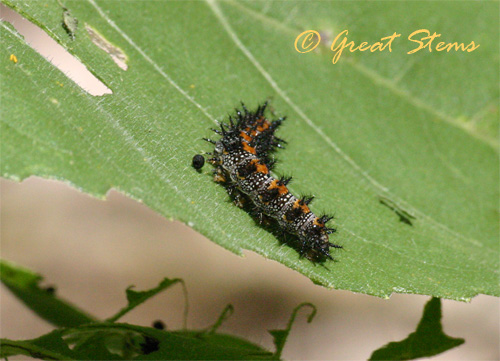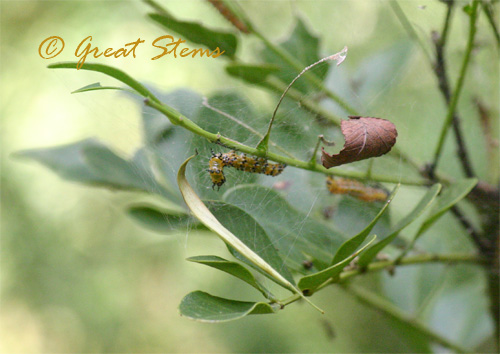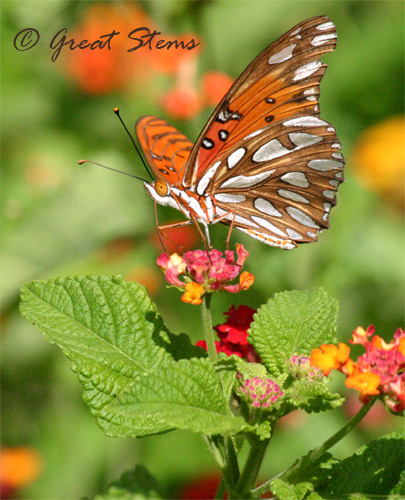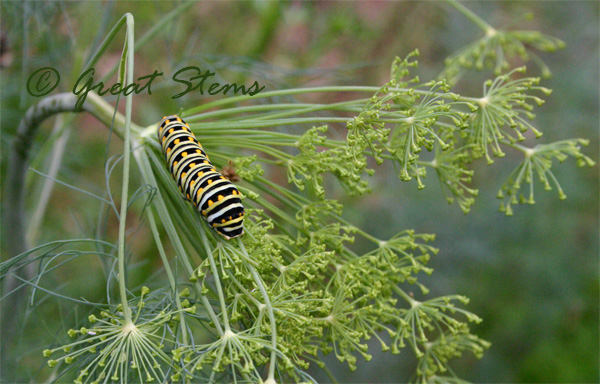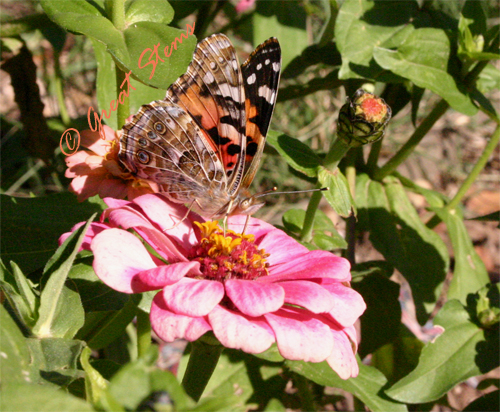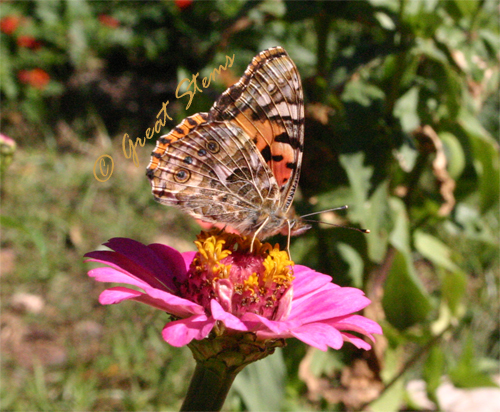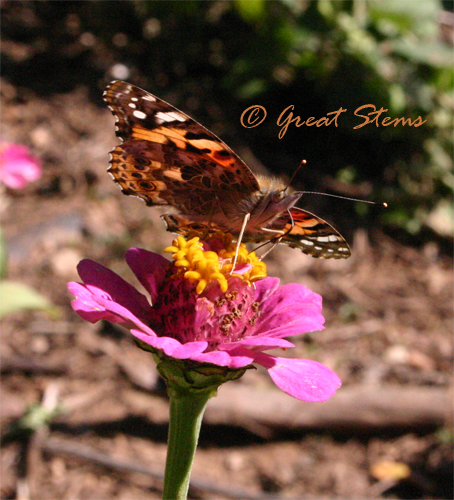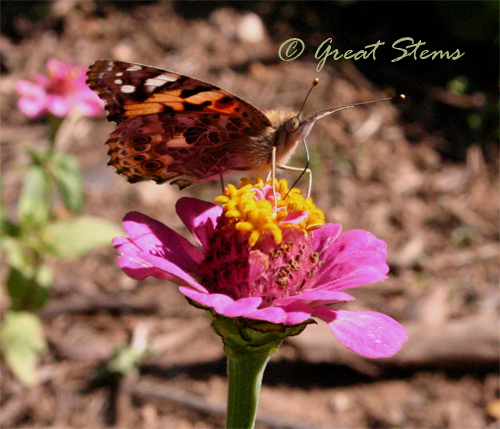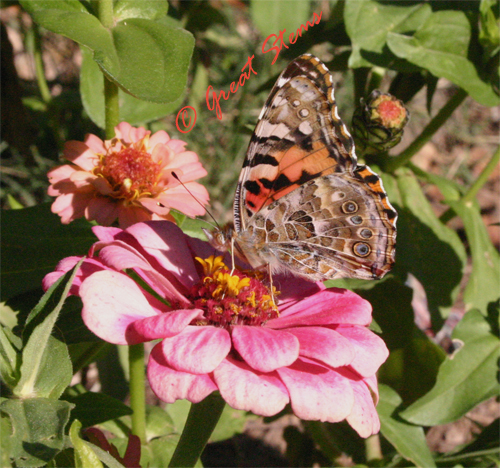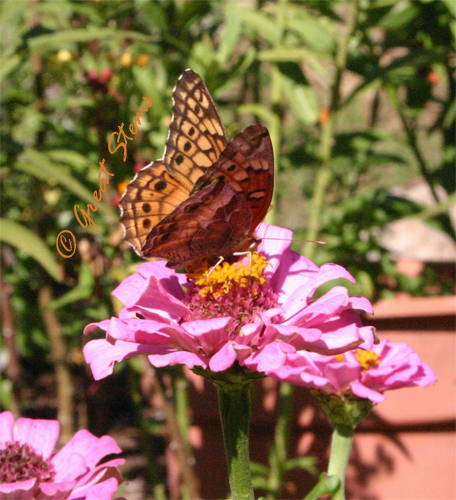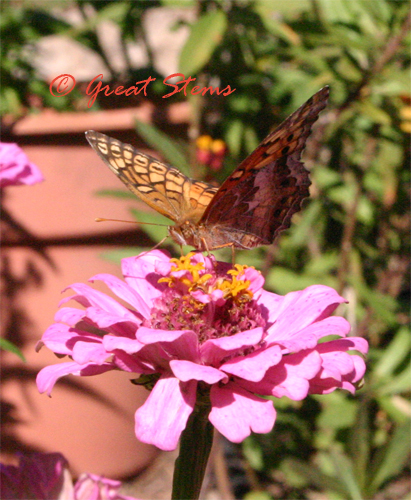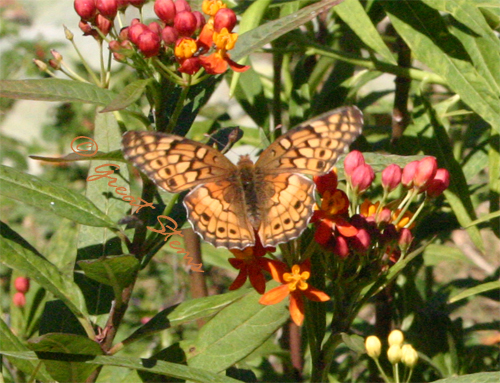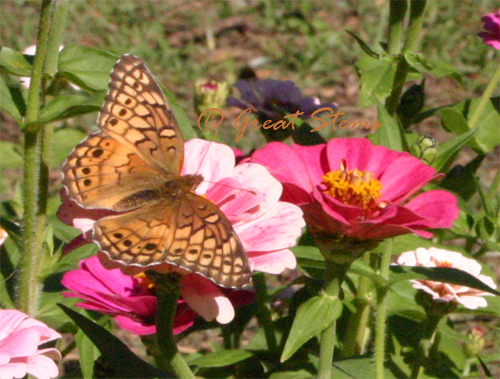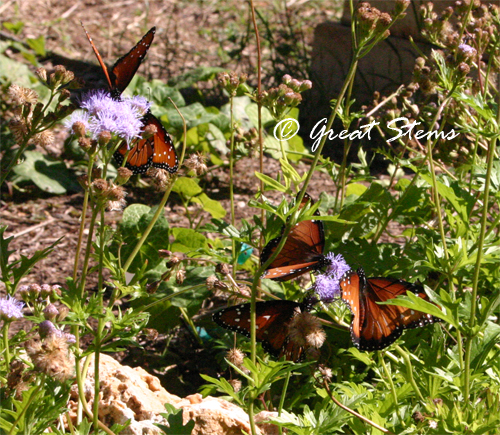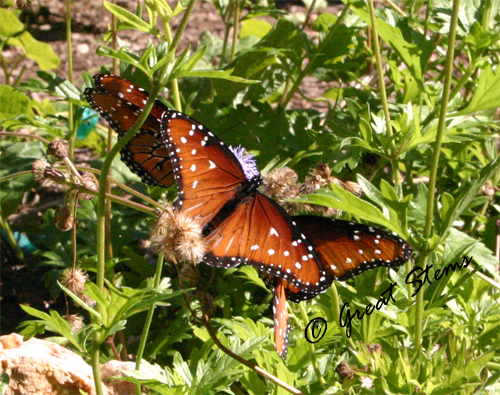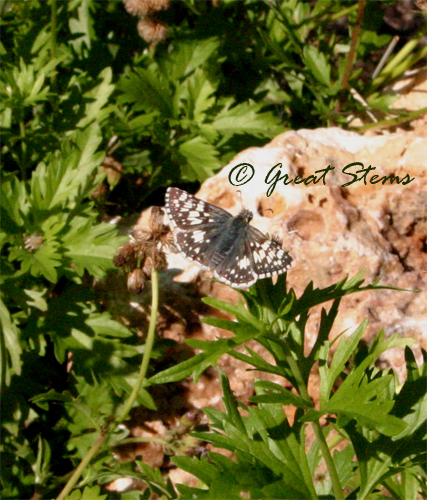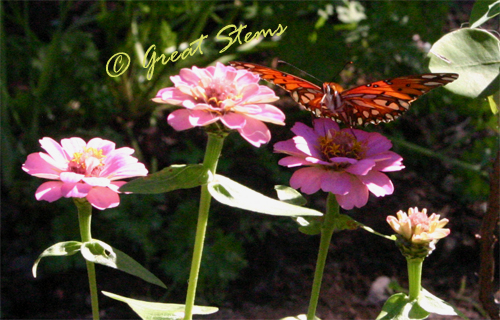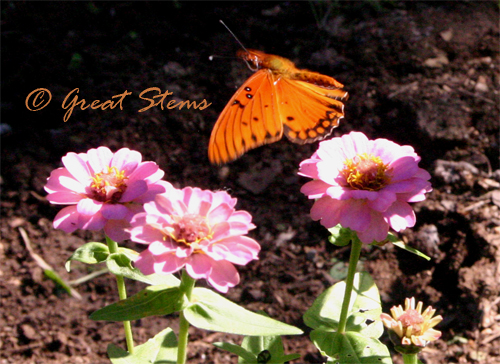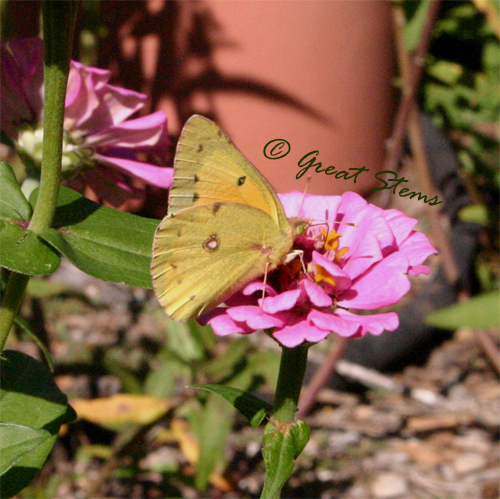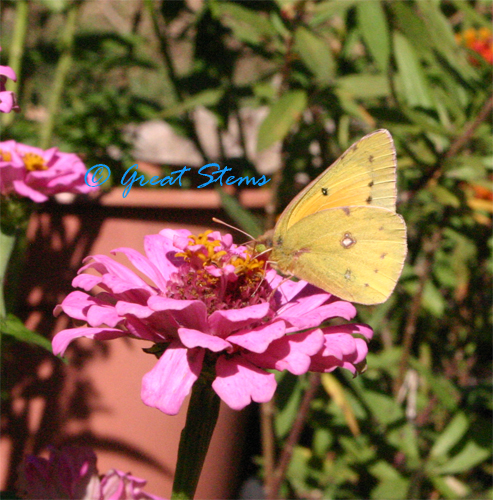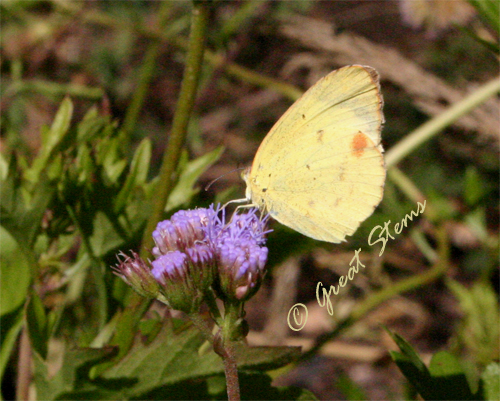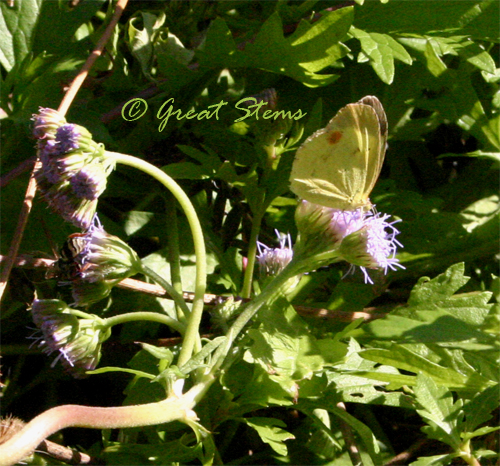
My initial shock and dismay over the vast destruction laid to my Cinnamon Sun sunflowers and Zexmenia by millions and gazillions of caterpillars all at one time were fortunately temporary emotions, and I've adjusted to this new level of habitat. I'm back to feeling happy, content, and utterly pleased. The butterflies fluttering about the garden today are more numerous than I'd ever dreamed of (I'm still astounded by this, I admit), and they swept me up in waves of joy and peace. Soon, all those hundreds of ravenous Bordered Patch caterpillars that caused me momentary freak-out will create an even more amazing butterfly scene -- who can argue with that?
So I won't dwell on the skeleton leaves and plant carcasses they are leaving behind and I will instead rejoice in the fact that most of the plants so far are surviving and putting on a beautiful bloom display -- 30 blooms almost entirely on one Cinnamon Sun plant alone. I get to report on new butterflies in the garden, as well, and also bees and spiders, and this habitat mama is happy as a clam.
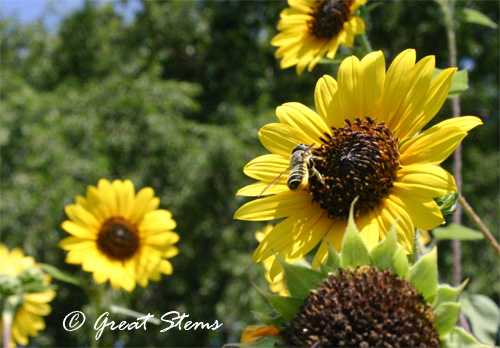
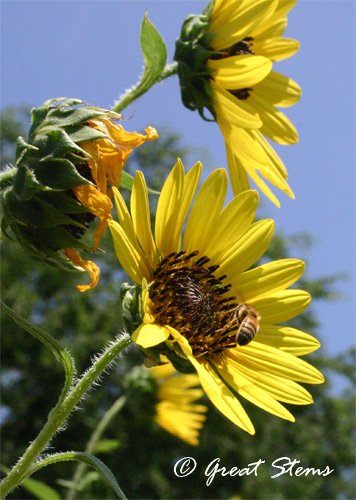
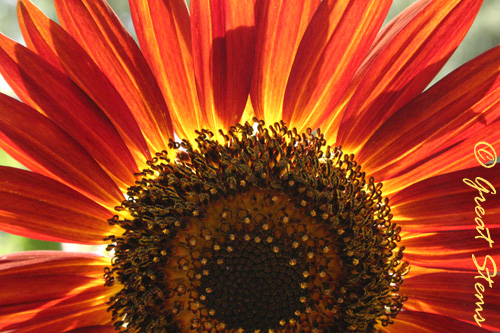
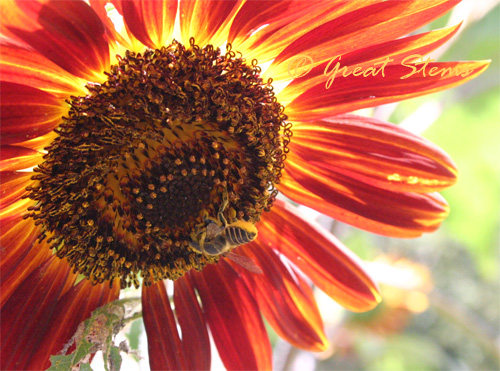
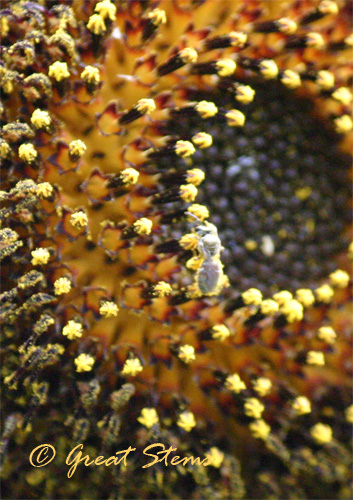
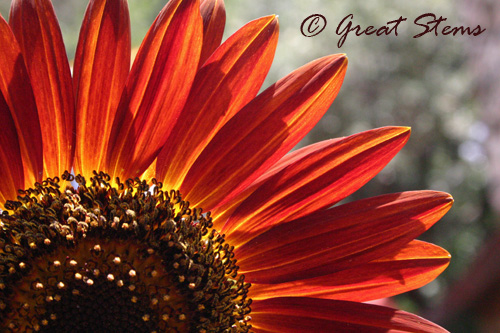
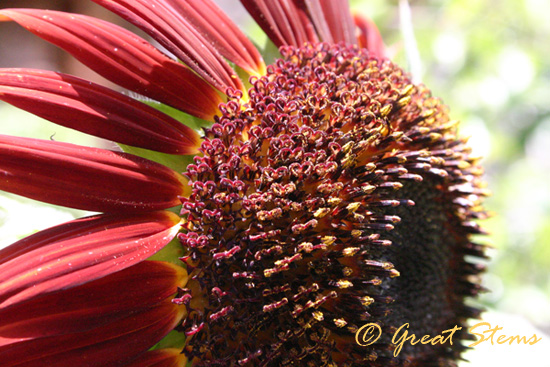
If ever there was a question about sunflowers being so aptly named, I present this photo as a clear argument for the appropriateness. It shows the fiery side of the sun in flower form. In fact, I almost named this post Sunrise or Sunset after this shot, because that's what it makes me think of, but I actually took this in the middle of the day, so it would be cheating.

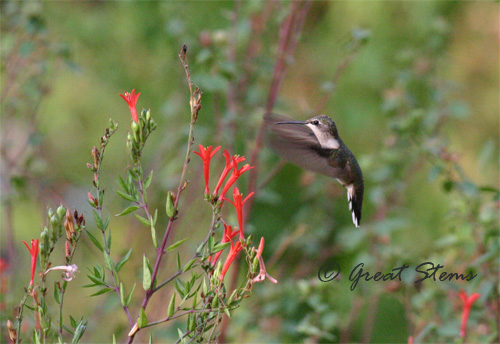
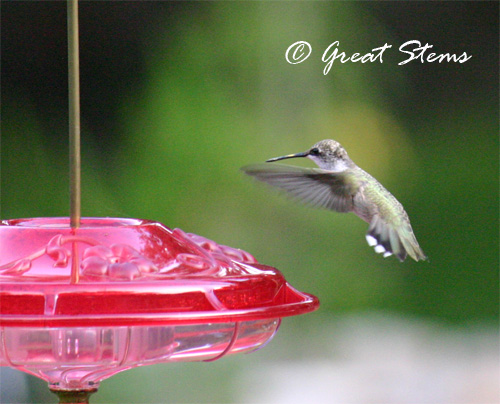
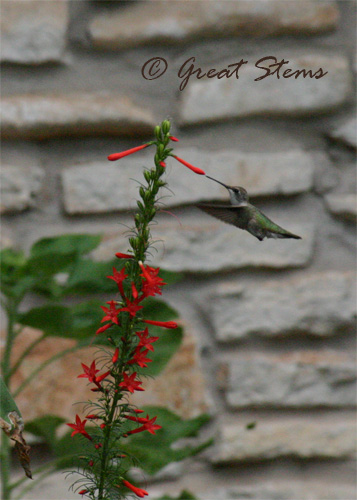
As I hovered around my sunflowers, alternating between pictures of blooms and caterpillar damage, I was joined by hummingbirds just a few feet away at the Standing Cypress, flying closer to me than ever and completely ignoring me. I missed the snapshot, though, because the two hummingbirds suddenly had one of their feisty spats and flew off. I'm not sure they even realized how close to me they were.
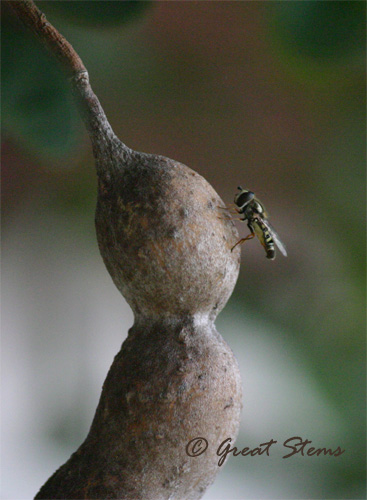
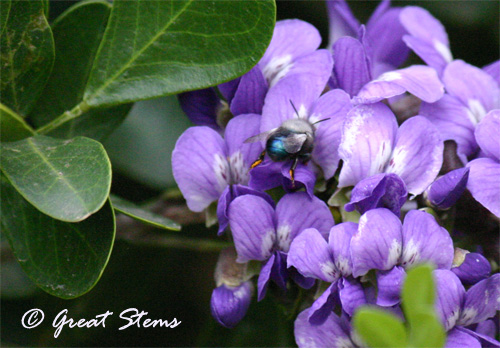
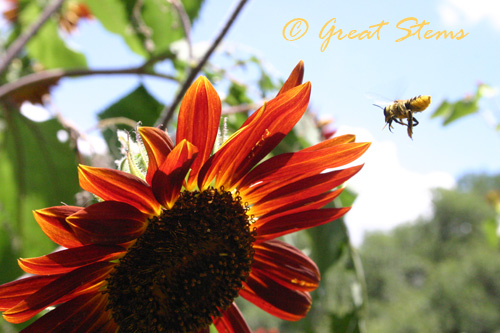
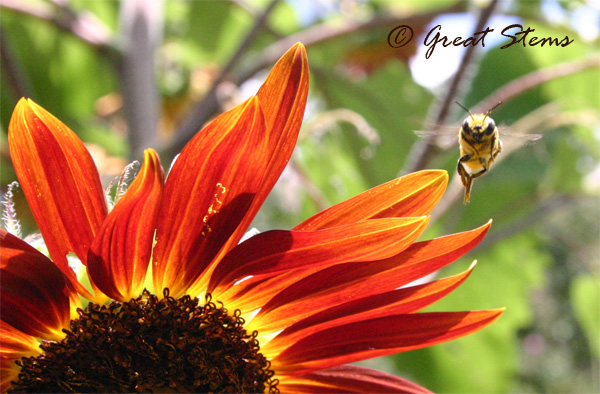
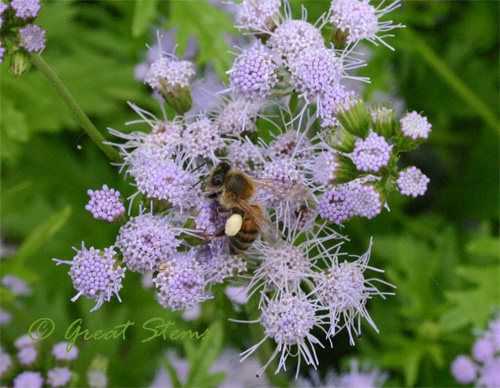
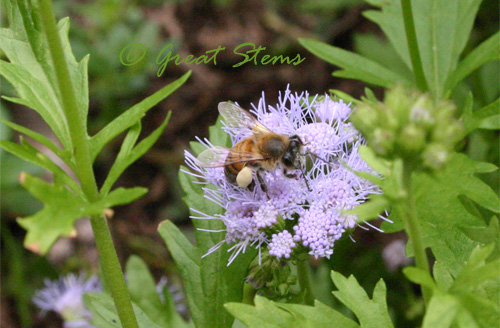
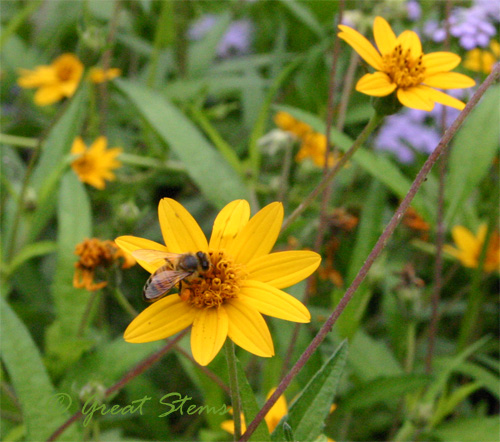
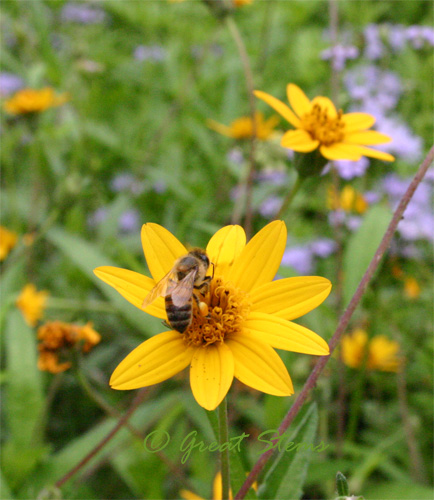
And then I saw the bees at the sunflowers, and my attention turned back to the fiery blazes before me. These weren't honeybees -- they were "Yellow Butt Bees" as I called them when I first saw them (Please don't think that's their real name! I was just distinguishing them from the similarly-sized honeybees we all know. Besides, perhaps "Yellow Belly" would be more appropriate; I can hear Yosemite Sam now calling them Yellow-bellied Varmints... except they are no varmints!). The best I could do was try to get some pictures in the poor light so that I could ID them later. I believe they are the species Megachile perihirta. Western Leafcutter Bees. Texas natives, woot.
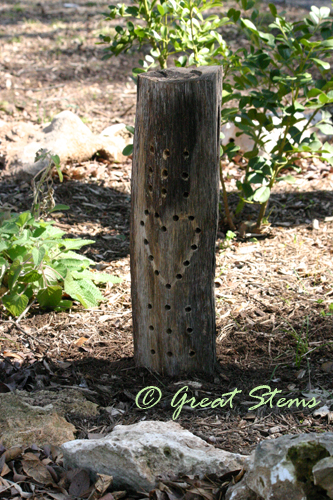
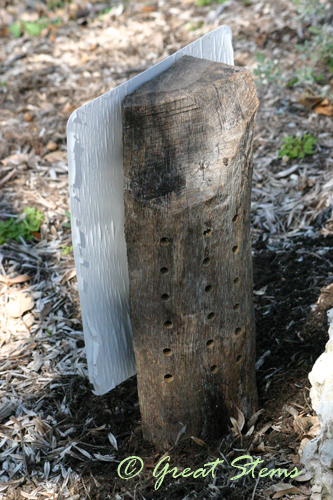
Why are they called Leafcutter Bees? Well, they cut small little circles out of leaves and use the pieces to fashion little nest cells, adding to them some nectar and pollen for the eggs they'll lay. These solitary bees are some of the bees that benefit from Bee Boxes.
At one point, one of the bees looked straight at me. The little bee looks so cute that it seems unreal -- my son actually thought I stuck the bee image onto the photo. I like to think that it was posing for the camera and not considering me a momentary threat. In any case, it was cute enough to become a header shot for the blog page (scroll up and click refresh if you'd like to see it).

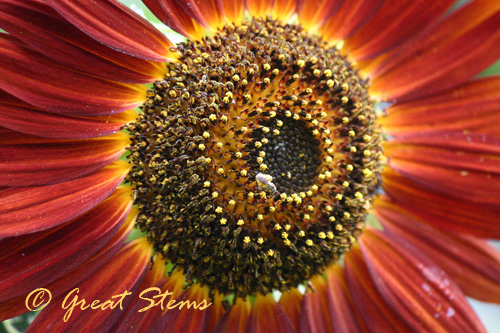
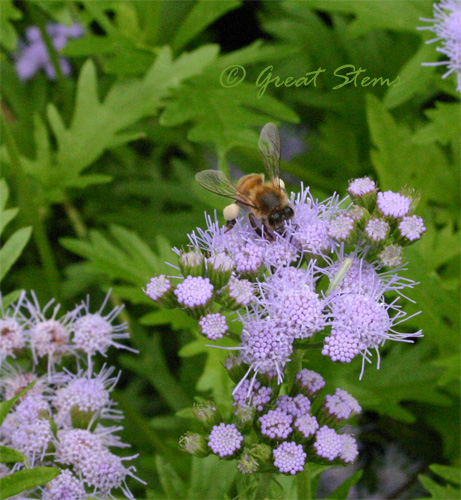
At the same time as their larger cousins, tinier native bees were also busy at work. They are harder to see, crawling in and out of the little flower parts.
These native bees are the best pollinators a garden could ask for. Hugs to them all.
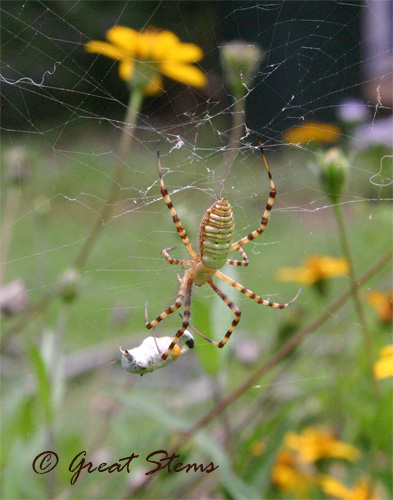
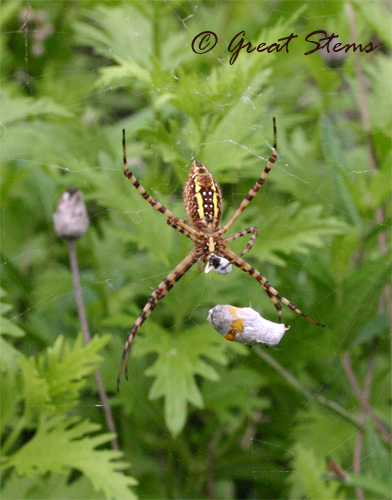
Back at the Gregg's Mistflower in the Spider's Favorite Locale, a spider reigns queen predator. I believe she is a Banded Garden Spider, Argiope trifasciata. And I think she might be the very same spider I found in the same spot a couple of weeks ago, perhaps then a juvenile and now mature (I've edited that post). She's a beauty, and highly successful in her predator talents. She had four wrapped-up carcasses that she was very focused on, and within hours she had consumed them, removed them, and repaired the web, ready for more.
She's as beautiful on her upper exterior...
as she is underneath. In fact, I shot the picture below first before I even realized she was facing away from me.
I spy what might be pollen seeping through the silk encasing -- might that be another bee? Gah. The nature of nature, once again.
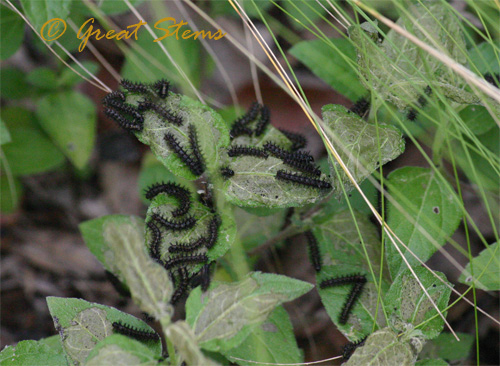
To follow up on the Bordered Patch butterflies, I'm happy to report that they do eat Straggler Daisy, or Horseherb. In fact, there are already other groups of them out there munching away. The ones in the picture below are a little too small for me to identify for sure as Bordered Patch, but they are surely related, at the very least.
I took a few of the more severely devasted sunflower leaves still covered with tons of caterpillars and relocated the little crawlies to the Horseherb for a dietary change, and so far so good. There are still many dozens on the sunflowers, but I feel better about all the plants' chances at this point. And as I mentioned last time, I've got plenty of Horseherb to go around. I also discovered even more groups of young caterpillars on the Zexmenia, but those plants are fairly well established and are thus on their own. I read that one Bordered Patch female can lay 500 eggs -- now I understand why I have such an invasion of munching munchers.
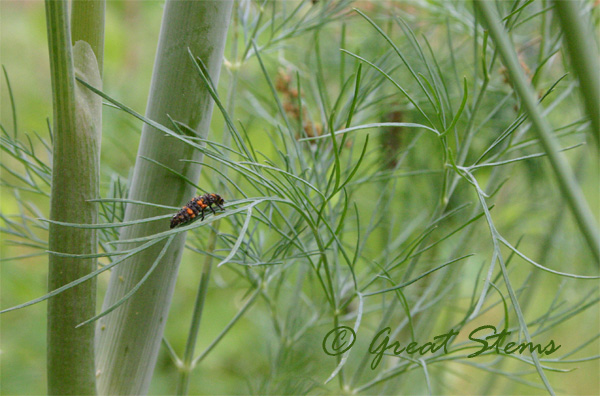
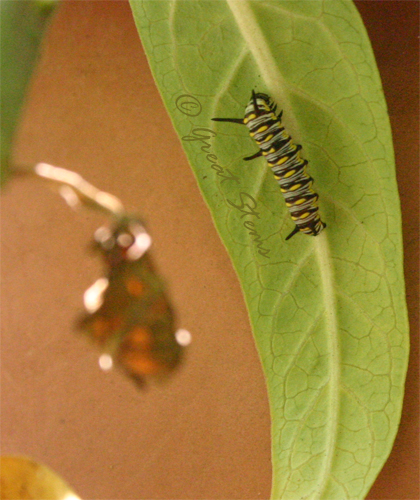
The older caterpillars are looking quite interesting, now that they are getting large.
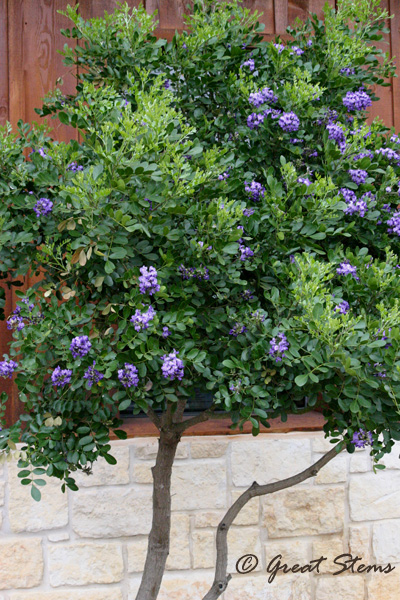
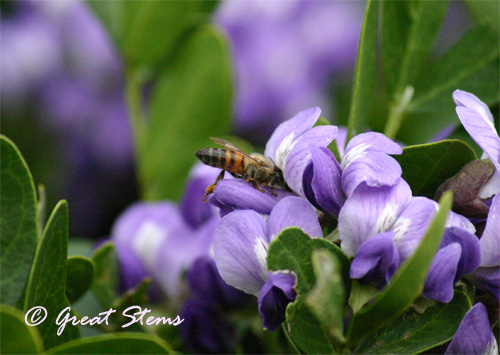
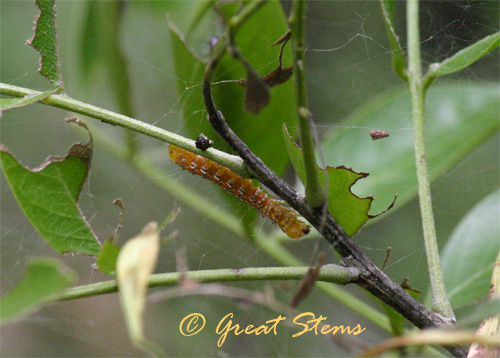
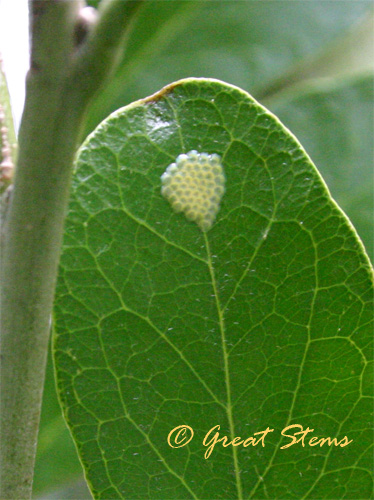
Hmmm. Another caterpillar discovery. I have Genista moth caterpillars munching on one of my Texas Mountain Laurels, and eggs on another. But from what I read, the laurels should be okay. There are so many mountain laurels here in Austin, Texas, and they all do okay, right? The damage is ugly, though, but not devastating. I think. Hmmm, I feel the inkling of worry again...
I'm not sure whether these are Genista eggs, but I suspect they could be.
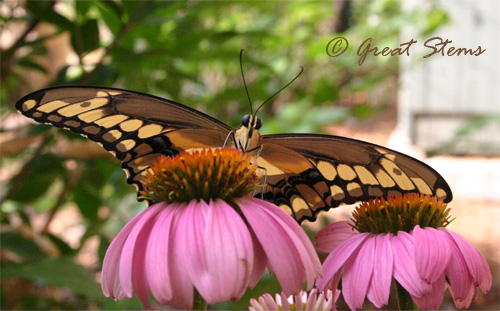
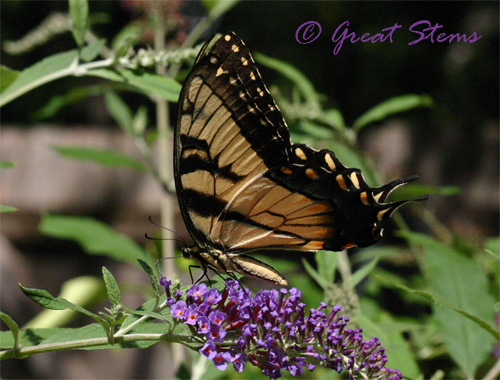
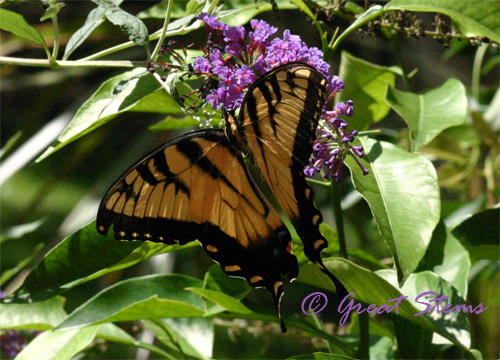
While I was walking around outside, something large moving by caught my eye. At first I thought it was a bird, but then I realized it was a butterfly. From a distance I couldn't tell whether it was a Giant Swallowtail or an Eastern Tiger, but it was definitely huge. And then it came down right by me for a nectar feast on the butterfly bush. An Eastern Tiger Swallowtail. Yay!

It's the first time one has stayed still long enough for me to get a non-blurry picture. The sun was too harsh, but I'll take what I can get. I continue to have a wary eye on the butterfly bush (Buddleia davidii, a non-native with a questionable reputation), but it earned big points when that Eastern Tiger landed upon it.
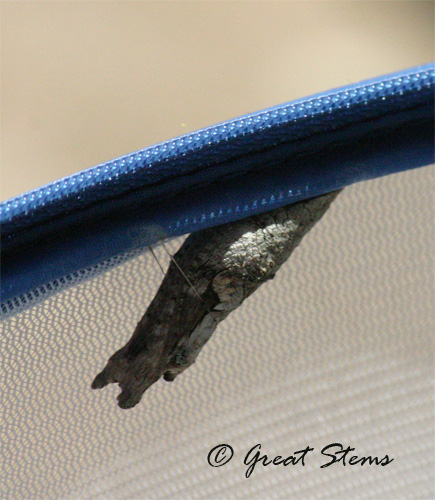
I'm still waiting on my Giants to emerge from their chrysalises. I'm getting nervous, as I always do.
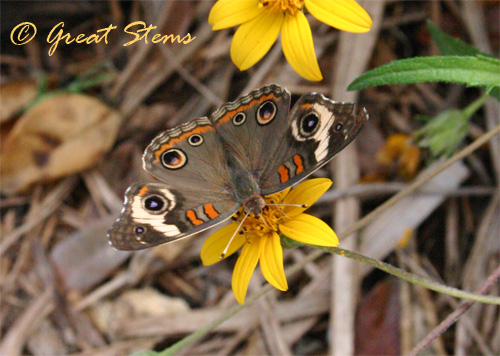
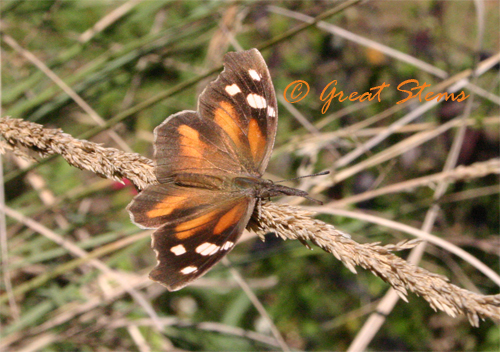
Buckeyes are here now! New visitors to the garden. So beautiful.
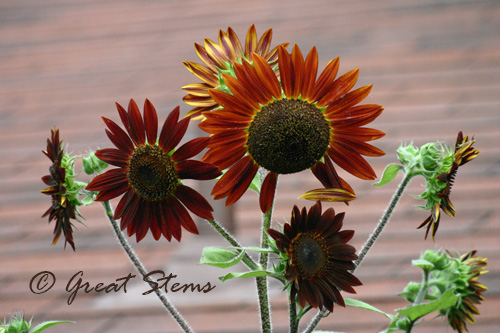
And I still can't resist the charm of the Cinnamon Sun sunflowers. More pictures must be posted.

See what I mean?

That's a Black-Eyed Susan vine climbing the trellis. I didn't realize how nicely matched it is with the pretty feeder. I mean, I did that on purpose. Yeah.


Hummingbirds!


One morning, and a fine one at that.


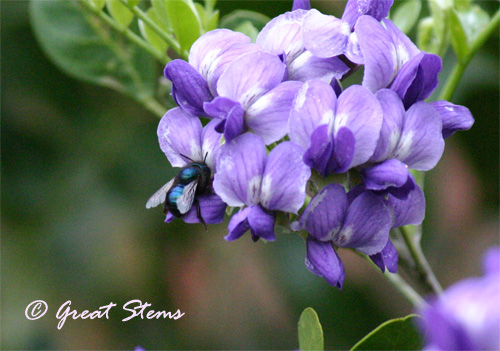
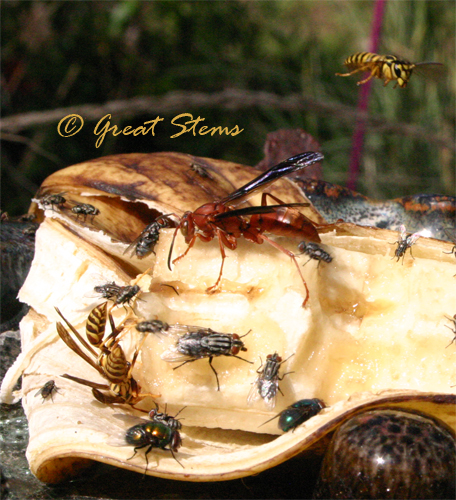
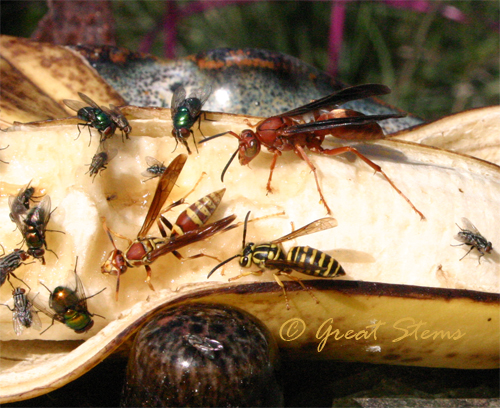
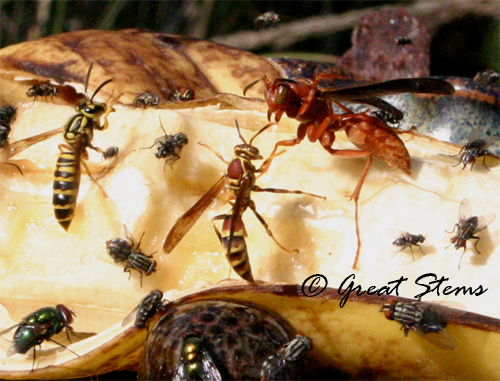
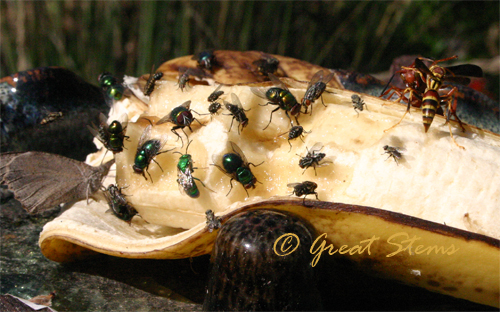
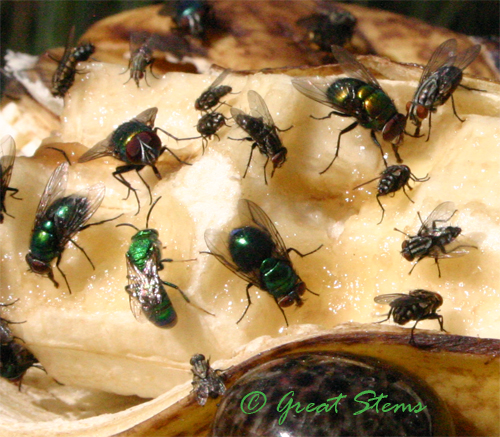
Do you see the beautiful metallic turquoise insect in the lower left corner? That's a Cuckoo Wasp -- the only one I can identify other than "fly" or "wasp."
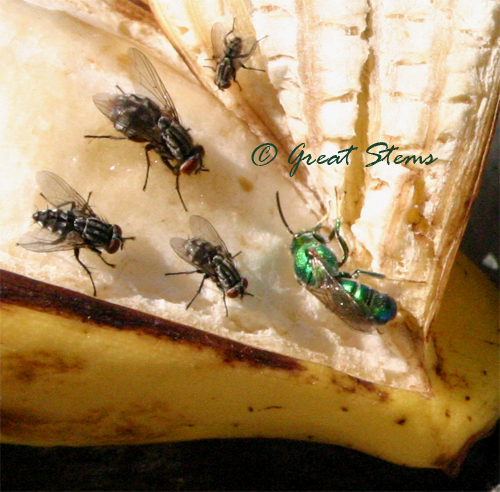
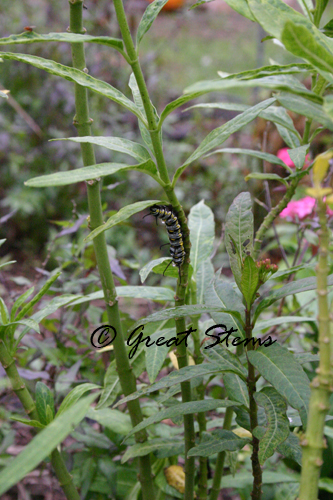
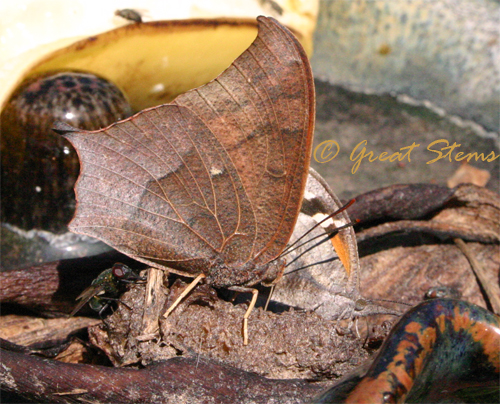
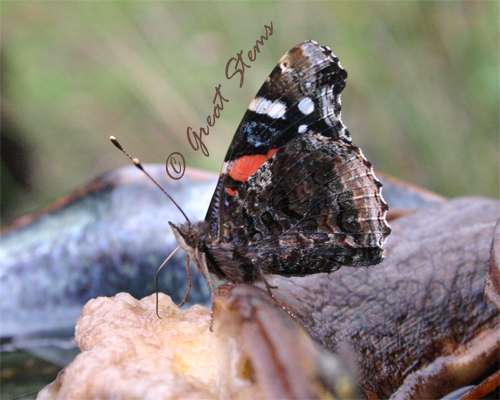
And the flies and wasps weren't the only visitors to the bananas. Snouts began to venture over to the fresher banana, and today I found my first Red Admiral. What a beauty!
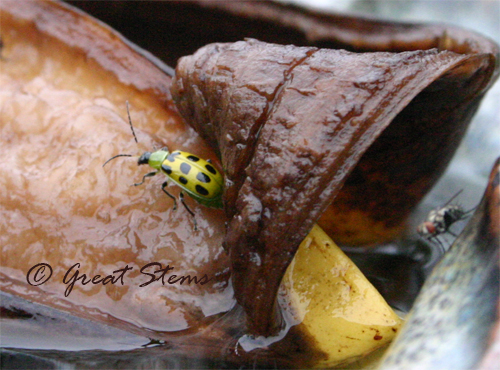
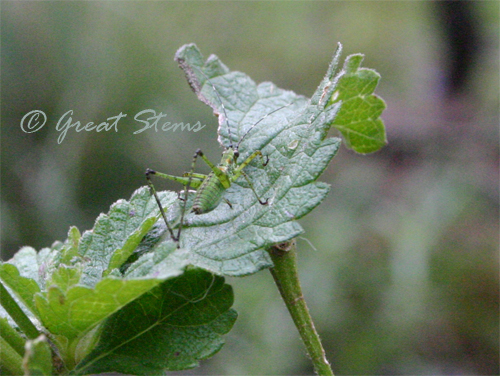
And off in the former pumpkin patch, where a few pumpkins and vines await me doing something about them, I found an icky green guy having a feast.
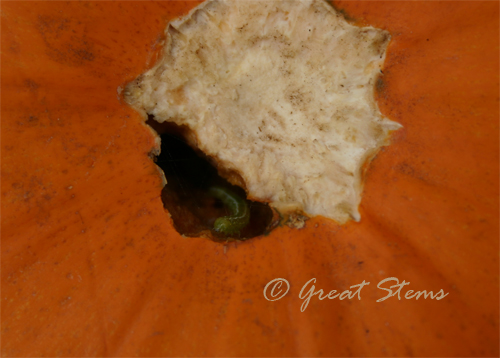
Enjoy it while you can, buddy. 
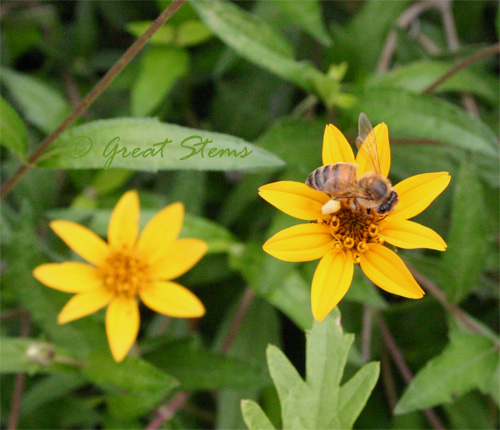
In the same patch of flowers, the honeybees on the Zexmenia had bright orange pollen baskets on their little legs.

These are the eggs of green lacewings. As larvae, they are voracious aphid eaters. Yay, another ally in the garden! I need them because the aphids are worse than ever. I seem to have least three species now --- I'll call them green, yellow, and beige. The green I'm sure are corn leaf aphids. I have got to get out and tackle them TODAY. My veggies, my milkweed, and now my firebush plant are all having an aphid problem. The little pests took advantage of my time away from the garden during the rainy week and bred like rabbits. I'm starting to think that it's the other way around, and rabbits breed like aphids. Today I'm seeing wings on some. Gah, more colonization!
So I've got new lacewings arriving soon, and of course I've got ladybugs. More spiders are arriving, as are earthworms. The bees are getting plentiful, and I don't even have to do the veggie porn thing to pollinate my plants anymore. I truly love the way nature just naturally (ha) balances its ecosystems. Got organic wastes? Happy earthworms move in. Got flowers? Let's pollinate. Overpopulation of something? Here come the predators. And here come the predators to eat the other predators. Oh look, birdie treats. And then snakes. And hawks. Whee, life is grand.


With the rain this week, the yard is a big mudfest for the dogs, and they took advantage of it -- digging where they shouldn't, trampling through the butterfly garden, and taking turns leaping over the pumpkin vines. I'm out there yelling, "This is not your playground!" And then I realized my neighbor must think I'm nuts, because of course it IS their playground. If I can manage it, I'll try to get a picture of the husky leaping in full gallop over the massive pumpkin plants (in between my yelling at him, of course). It really is a sight to behold. 

Rockport isn't just about hummingbirds -- hundreds of species of birds are year-round residents or migratory passers-through, and birdwatchers excitedly converge with binoculars in hand to enjoy the sheer numbers and to hopefully catch a glimpse of a rare species. At any given home on the hummingbird tours, there might be as many as 100 or more hummingbirds zooming about the feeders.


But there were a variety of landscapes on the tour, and there was even a school garden, planted and maintained by students and teachers.
It was thoroughly entertaining watching the antics of the territorial hummingbirds. Their behavior is different at migration time -- because the birds need to build up their energy stores, there is more willingness for many, but not all, of the birds to share a feeder from time to time. Despite the many feeders about a yard, the hummingbirds might swarm a particular feeder, as if they think that because others are that feeder, it must be good food. But territoriality is hard to resist sometimes, especially for the males. The vibrant color of the throats of the male birds was impressive, though Sheri said that these feathers are post-mating season, and thus less vibrant than at other times. Pretty cool. 
The majority of the hummingbirds that pass through Rockport are ruby-throated hummingbirds, but several species have been sighted, and in all more than 500 species of birds have been documented.
There was another creature that threatened to bring downfall to the festival this year, the heat-seeking, blood-sucking, mass-attacking mosquito. It was unbelievable the numbers of mosquitoes everywhere, and they swarmed every person by the hundreds. The mosquitoes were so bad at the very first house we stopped at that, that our hummingbird viewing would have come to an end before it started if we hadn't decided to just go ahead and use some loaned icky chemical spray that I would never touch at home. But we were having to do a ridiculous and constant "Mosquito-Slapping Dance" until we finally used the spray, and if a green person is going to that extreme, you know it's bad. 

Outside of Moon Dog, where we had lunch, a lone pelican rested peacefully. It was quite the contrast to the zooming hummingbirds at the inland homes. 


So I began the process of cutting up the fruit for the compost bin. By the way, ever wonder what the inside of a young cantaloupe looks like? Pretty cool.